If global surface temperature keeps rising at the current rate
Sou | 12:45 AM
]I'm not going to go full-on with some wide-ranging projections, this article is mainly about temperature. It was prompted by something silly written in an article at WUWT, by a random blogger who goes by the name of Larry Kummer.
Larry was musing about how fast it's warming. He nicely put up some facts, based on the NOAA temperature report but then showed the extent of his ignorance about climate change.
First, he stated, correctly, the temperature trend of the past 30 years:
"0.19°C/decade (0.34°F) – 1989-2019 – The past 30 years, the period for climate metrics defined by the World Meteorological Organization."In fact, this is the temperature trend since the mid 1970s, the past 45 years or so, the last time there was a change in the trend.
The ignorance of Larry Krummer
It's what Larry wrote after that that gave me pause. He doesn't have a clue about what's happening or what is to come. He wrongly said the rate of warming is very slow. It's not. It's on track to warm ten times faster than any time in the past 65 million years.
Larry also said it's "small" compared to natural variations over centuries and thousands of years. He's wrong there, too. It might not be as big as variations over millions of years, but over the past 100s to thousands of years, it's not a small rise by any measure.
Let me illustrate.
If you extend the current warming rate ahead for 100 years, this is what you'll get - a rise of about 3C above pre-industrial:
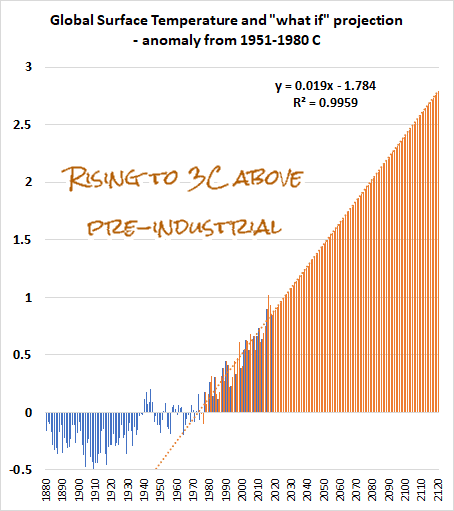
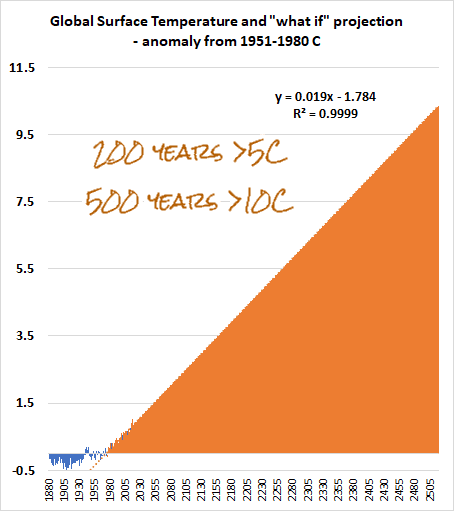
If you extend it out 200 years, you'll get more than 5C above pre-industrial; in 500 years it would be more than 10C above pre-industrial, meaning that large and larger areas of the land surface would be uninhabitable.
What are the chances?
Now that will only happen if the temperature keeps rising at the current rate. If it rises faster, and keeps going, we'll wipe out large areas of land much sooner. If, as is hopefully more likely, we get to a point where we cut emissions quickly enough, we might limit the warming to between 2C and maybe 5C above pre-industrial, which will save quite a bit of land. There will still be a lot of land that almost nothing can survive and, of course, a lot submerged under the sea, not to mention the sixth major extinction. But it's better than what would happen with 10C of warming.
Okay, I'll speculate. As the temperature gets closer to 2C above pre-industrial, there'll be more and more civil unrest, climate migration and so on. Above 3C there would be even bigger changes to the world both economically and socially. I'd say these changes would be to such an extent that economic activity would reverse, which would likely put a real dampener on much more warming. The ice will continue to melt and the seas will continue to rise; however, in my view, the temperature would reach a peak then slowly start to fall over the next few centuries to millennia. That's with assumptions, such as the natural sinks not shrinking too much and continuing to suck up half our emissions. If they don't, we could be in for faster shocks.
Larry and his 100s to 1000s of years...
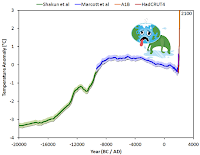
As for Larry saying this is nothing compared to the past centuries and thousands of years, I'll show (again) the chart prepared by Jos Hagelaars on Bart Verheggen's blog.

This shows a rise of a bit over 3C up to pre-industrial temperatures, with a bit more to the early Holocene, but most of that increase was spread over more than 10,000 years, not a mere 100 years.
Since civilisation began, the temperature dropped less than 1 C before starting its phenomenal rise as we burnt more and more fossil fuel and chopped down more forests. That decline was spread out over more than 10,000 years too. The rapid rise of more than 1 C has taken less than 200 years, with most of it in the last 50 years or so.
We humans have never had global temperatures as high as we're experiencing now - and certainly never as high as those we're facing, let alone as fast a change.
blog.hotwhopper.com |




