
William Pruitt started working at Virginia Tech in 2009, not long after a gunman killed 32 students and professors in the deadliest campus shooting in American history.
As a coordinator of the university’s international-exchange programs, he spent much of his time reassuring partner universities around the world that they could still send their students to rural Blacksburg, Va. Some administrators were so unnerved that they insisted on visiting the campus, and Pruitt would walk them through the safety protocols Virginia Tech had put in place. He and other officials delivered the message that what happened was an awful aberration and that it remained safe to study at Virginia Tech — and in the United States of America.
“Back then, there was a saying on campus that we got struck by lightning,” says Pruitt, who is now the associate director of community engagement and service learning at the University of South Carolina. “You could say it then. You can’t say it now.”
In the decade since Virginia Tech, lightning has struck again and again, as mass shootings have occurred in communities and on campuses across the country: El Paso and Dayton, Las Vegas and Pittsburgh, Marjory Stoneman Douglas High School and the University of North Carolina at Charlotte. As of mid-November, the Gun Violence Archive had tallied 366 mass shootings in the United States in 2019.
International news networks like CNN broadcast images of these attacks around the world. Local outlets overseas amplify the coverage, particularly when someone from that country has been caught in the crossfire: an Indian graduate student killed in a holdup in Kansas City, a Saudi student wounded in Charlotte, a teenager from Pakistan among seven students and two teachers fatally shot in a Texas high school.
Among those watching are prospective international students and their parents — and the images may be coloring their perceptions of studying in America. On the road, admissions officers are peppered with questions about campus safety. A survey of about 2,000 current international students and recent graduates of American colleges by World Education Services, a nonprofit international-education research company, found that nearly two in five are worried about gun violence. This spring, the Chinese government even warned students and other travelers about the risks of going to the United States.
Though various officials The Chronicle contacted for this article privately acknowledged the fraught nature of the subject, many were reluctant to talk on the record.
“It’s the elephant in the room,” says Paul Schulmann, the associate director of research at WES.
Over the last few years, American educators have been anxious about the “Trump effect,” the idea that the administration’s travel ban, tougher visa policies, and anti-foreigner rhetoric have led to a drop in new international students enrolled at American colleges. But maybe something else is scaring students away from the United States. Maybe it’s guns.
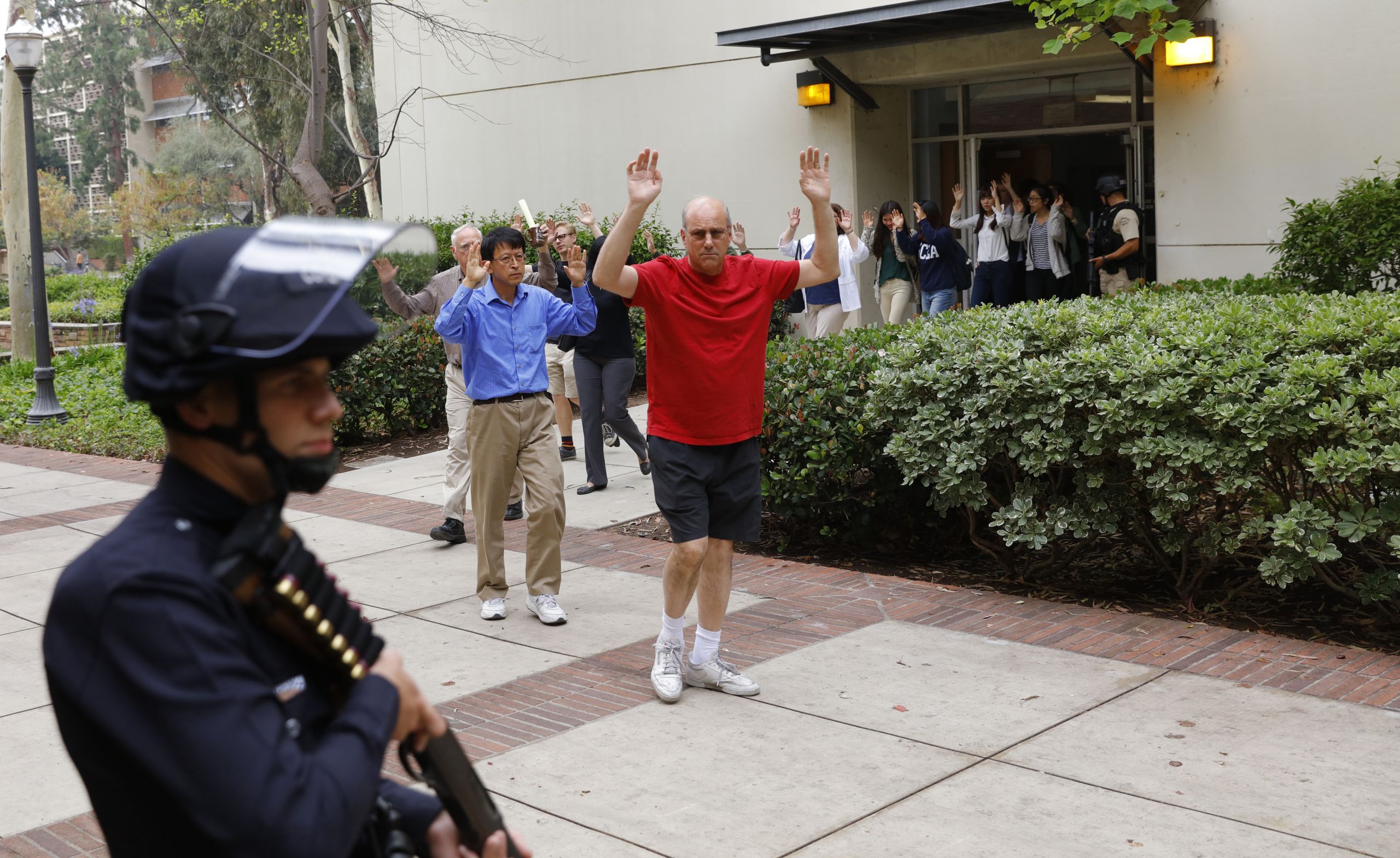
Images of campus shootings, like this one at the University of California at Los Angeles, get beamed around the world and help shape the impressions of international students and their families of the U.S. as a dangerous place. (Jay L. Clendenin, Los Angeles Times, Getty Images)
Mass shootings — incidents in which four or more victims are injured or killed, not including the shooter — make headlines at home and abroad. But gun-related violence is more commonplace here than in many other developed countries. Homicide rates in the United States are more than double the average of the other industrialized nations that are part of the Organization for Economic Cooperation and Development. Three-quarters of murders in this country are committed using a firearm.
Americans have a profoundly different relationship to guns than does much of the world. In the countries that send the most students to American colleges — China, India, and South Korea — it’s rare for the average citizen to own a firearm. In the United States, by contrast, there are more guns than people, an estimated 120.5 civilian-owned weapons per 100 residents. Americans possess 40 percent of the world’s civilian firearms, according to the Small Arms Survey, a project of the Graduate Institute of International and Development Studies, in Geneva.
It’s little surprise, then, that America’s gun culture can come as something of a shock to students from overseas.
The prevalence of guns also sets the United States apart from other countries, like Australia and Britain, that attract large numbers of foreign students. When IDP Connect, a global student-recruitment firm, polled current and prospective international students and their parents about their perceptions of major destination countries, both groups of respondents rated the United States dead last on safety.
World Education Services routinely surveys students about safety and security as part of a broader look at international students’ experience at American colleges. But safety is a squishy word that can mean different things to different people. Some students may fear hostility because of their race or religion. Others may feel uneasy because of the political climate. Female students may worry about sexual assault. So this year the researchers decided to query students specifically about gun violence, Schulmann says. What they found jumped out.
While nine out of 10 students reported generally feeling safe on campus, a quarter said they were concerned about gun violence at their institution. Thirty-seven percent worried about it in their local community.
“Those are big numbers,” Schulmann says.
All international students are not equally anxious about potential shootings. Students from Latin America and the Caribbean report less concern about gun violence, on campus or off. But fears run especially high among students from Asia, where homicide and gun-ownership rates are low and where news about incidents involving students abroad travels quickly.
Ask Blaire Tian about her impression of the United States growing up in Nanjing, a city of eight million in eastern China, and she sums it up in one word: “Dangerous,” she says. “Lots of guns. That’s the stereotype.”
Violent crime in America is a staple of the news programs her father watches and is buzzed about on WeChat, the popular social-media platform her mother follows. Someone is always getting killed in imported American movies, in comic-book blockbusters and high-minded Oscar fare alike. One of the most popular television shows in China today is about a group of Chinese students studying at a college in the United States. The plot line of an early episode centers on one of the students and his father getting caught in, and eventually thwarting, a shooting on campus. Images of America as the wild, wild West are pervasive.
“In China, the food may slowly kill you,” Tian says, mentioning the country’s food-safety problems. “But people don’t shoot people here.”
Still, when it was time for college, Tian’s parents agreed she should go to the United States. The universities were better, and the teaching style more appealing.
“They like to hear my voice. They keep repeating to me, mind your safety, mind your safety.”
But where could they send their only daughter so that she would be safe? When Tian, who is 18, saw a college she liked, the family would go online and pull up crime statistics for the surrounding area. Johns Hopkins was a good university, but Baltimore seemed dangerous, so she didn’t even apply. Ditto for the University of Chicago. In Texas, there are so many guns — she crossed colleges there off her list.
In the end, she decided on Northwestern University, in suburban Evanston, Ill., a top-ranked college in a community with a lower crime rate.
Tian’s approach isn’t unusual. High-school counselors and student-recruitment agents in China and India told The Chronicle that it is common for families to weigh crime statistics when choosing between colleges. And location can affect perceptions of safety — students at colleges in the suburbs were less likely than those in cities or rural areas to fear gun violence, the World Education Services survey found.
Even so, Tian, who is now a freshman at Northwestern, exercises caution. At night, she mostly travels with a companion; if she goes out on her own, she uses an app on her phone that will alert an emergency contact if she doesn’t reach her destination within an allotted amount of time. Every morning — evening back in China — she leaves her parents a voice message. “They like to hear my voice,” she says. “They keep repeating to me, mind your safety, mind your safety.”
chronicle.com |



