Harvard Scientist, Longtime Solar Skeptic, Now Sees the Light
by Joe Ryan
May 3, 2016 — 9:01 PM PDT
Researcher had long doubted that solar would be afforable
Solar has the potential to cheapest power on Earth, Keith says
David Keith, a Harvard University scientist, has long doubted solar energy’s potential to compete on cost with conventional power sources. Now he sees the light.
“I was wrong,” largely because the fundamentals of solar power have changed, Keith, a professor of applied physics and public policy, wrote in a recent essay. “One can now build systems in the world’s sunny locations and get very cheap power.”
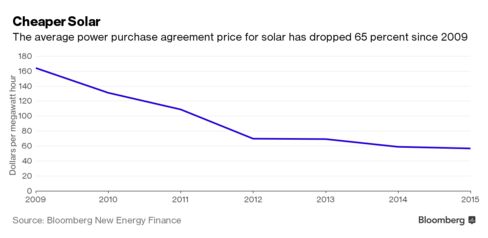
His reversal reflects the steep declines in producing electricity from sunlight. Even without government subsidies, power from large solar farms in some regions is now significantly below $40 a megawatt-hour and is on pace to drop below $20 by 2020, Keith wrote. That would be the cheapest power on the planet.
It’s a significant shift from his earlier stance, that high costs would relegate solar power to being “green bling for the wealthy.”
Lower prices, however, don’t solve the issue that solar panels stop generating power when the sun goes down. And the technology may not make sense in regions like New England, northern Europe and coastal China. Yet in places where sunshine is plentiful, solar has the potential to reshape power markets, Keith said.
“Obviously the market was created by subsidies,” Keith said in an interview Tuesday. “But the subsidy-created market really did drive this supply chain innovation.”
(click on link below for videos)
bloomberg.com |



