Re <<“ agnostic “>>
I do not know what the % breakdown be amongst vaxxed / to-be vaxx-ed / never-vaxx / agnostic
I suspect that whatever the numbers, the folks who got and shall get infected are and shall be higher in the never-vcxx / to-be vaxx / vaxxed than in the agnostic group. a wild guess.
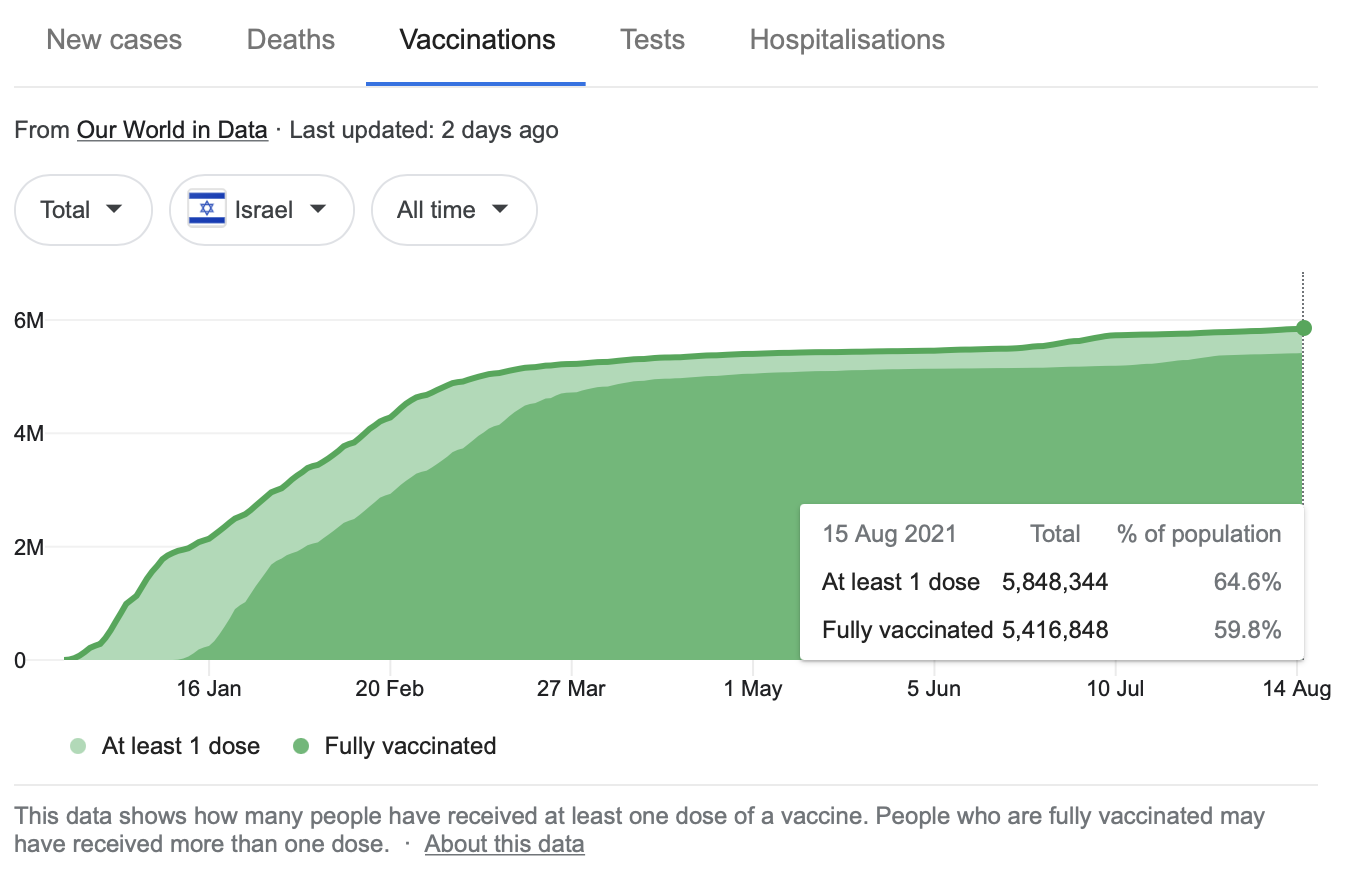
in the meantime, taking Israel as a watch & brief triangulation point, where most of the folks are vaxxed w/ BioNTech flavoured mRNA vaxx
A local media seems to go thumbs-up on vaxx
Another local press seems to warn (well, the PM warned) that events shall worsen
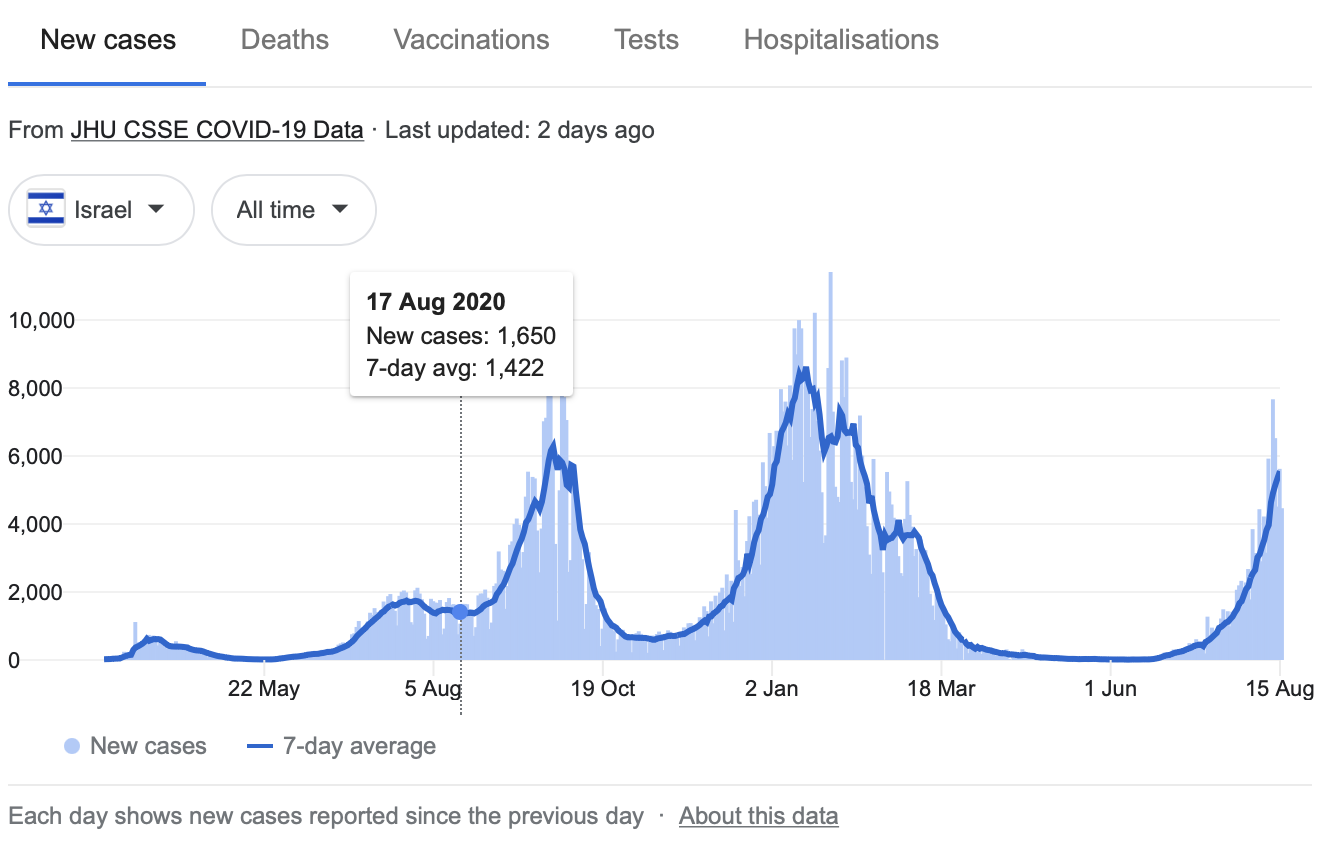
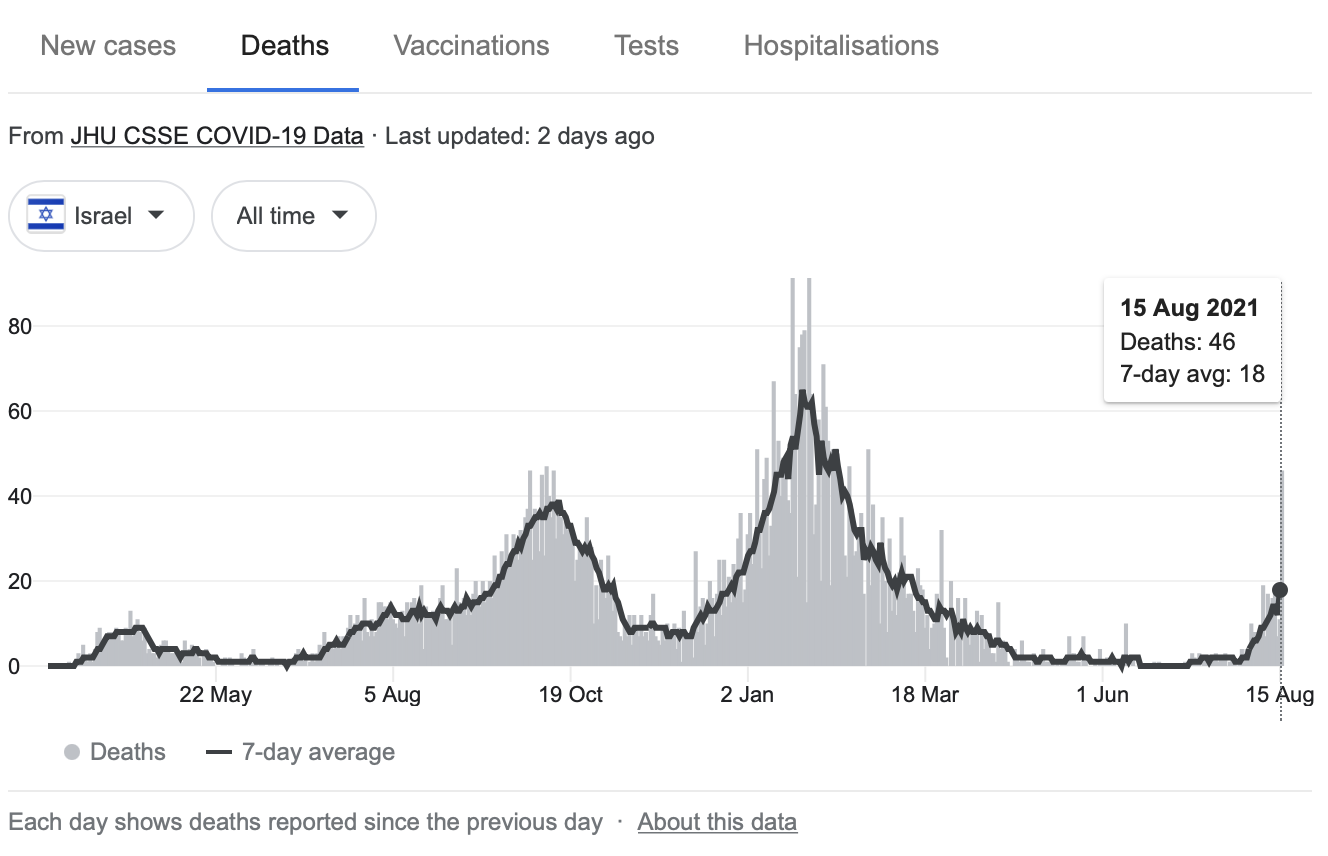
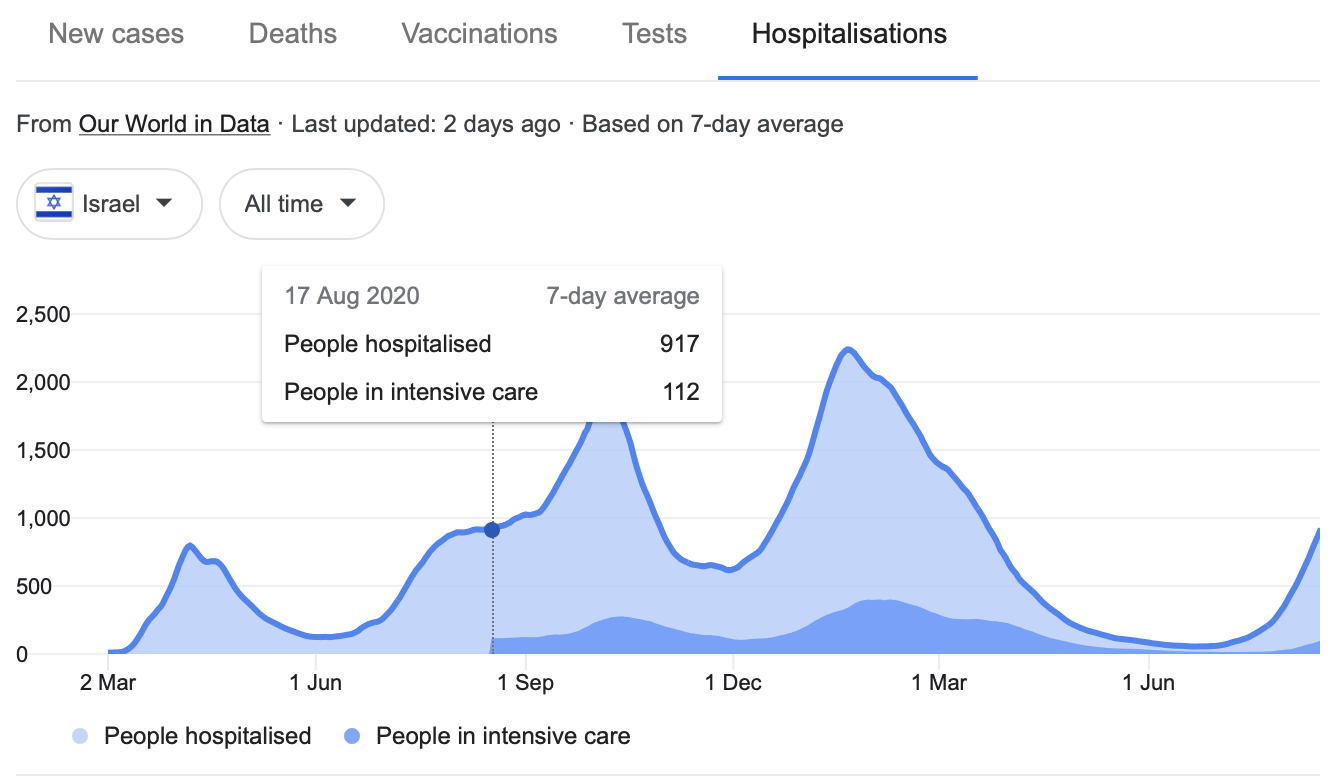
My read of the aggregate chart, without slicing and dicing the minutia, seems to say
- BioNTech mRNA may be ameliorating infection and death and hospitalisation (iow, serious cases), but to say life is normal as enabled by vaxx would not be true given all numbers are higher today than 365 days ago
- I do not know what casualty count is tolerable in Israel, relative to flu, so am not in position to comment on how serious Covid is in Israel
- I suspect that to tag Covid as 'just another' flu might not be correct
- I am not (yet) saying it be the case that someone honest should pipe up, but I doubt the Israeli government and ruling party and its coalition of like-minded are in any politically invulnerable position to come out and intone, 'We screwed up on bum-rushing all towards an experimental / investigation fluid, and we messed up on semi-shut down of the economy. We were setup and betrayed. We are sorry. Give us another chance to make right'
- Time shall tell, because the flu season is soon.
haaretz.com
These Israeli COVID-19 graphs prove Pfizer vaccine works - Israel News - Haaretz.com
Sam SokolAug. 16, 2021 11:48 AM
Despite a recent increase in the number of serious cases in Israel, including among the fully vaccinated, those who received both doses of the vaccine against COVID-19 are significantly less likely to experience severe illness, according to data released by the Israeli Health Ministry.
As of August 16, the ministry recorded 159 severe COVID-19 cases per 100,000 people among the unvaccinated over the age of 60, compared to 20 per 100,000 people among the fully vaccinated. This makes the unvaccinated elderly more than eight times as likely to experience a severe case than their immunized counterparts.
For those under the age of 60, the rate of severe illness among the unvaccinated stood at 2.4 cases per 100,000 people – 2.7 times more than the 0.9 per 100,000 among those who are fully vaccinated.
According to the data, while the risk of experiencing severe symptoms increases with age for both the vaccinated and unvaccinated, it rises much more dramatically among the unvaccinated.

Israeli Healthy Ministry COVID numbersCredit: Israeli Health Ministry
For those aged between 60 and 69, there are 71.8 cases per 100,000 among the unvaccinated, as opposed to only 8.7 for the fully vaccinated. This rises to 208 and 20 cases, respectively, for those aged 70-79 and to 266 and 47 for those aged 80-89.
Speaking with Haaretz during a live Q&A last week, Prof. Ran Balicer, chairman of Israel’s expert panel on COVID-19, said “there’s no question” that people who are unvaccinated are at a higher risk of developing severe illness from COVID-19.
“You can see this in the most simple graphs published by the Health Ministry. When you look at Israelis above the age of 60 and you examine severe illness rates – not numbers, rates, which means the number of illnesses per a specific number of the population – then what you see is that among those who are unvaccinated, there’s a considerably higher rate of severe illness than among the vaccinated,” he explained.
Finally, a politician admits what Israel's COVID policy really means Guess who's fueling Israel's disastrous COVID anti-vaxxer movement? On COVID-era travel, Israel and the United states adopt new, healthier approachWhile the effectiveness of the COVID-19 vaccine may have waned somewhat over the past several months, those who are vaccinated are protected five to 10 times as much as those who are unable or unwilling to receive the shot, said Prof. Nadav Davidovitch, director of the School of Public Health at Ben-Gurion University of the Desert, Be’er Sheva, and head of the Israeli Association of Public Health Physicians.
Both the length of time that has passed since vaccination and a patient’s age can affect the likelihood of their contracting a severe case of COVID-19. “Those who were vaccinated in January are somewhat less protected compared to those vaccinated in, for example, March,” Davidovitch said, adding that it is possible that the more infectious delta variant could also have an impact on the incidence of serious cases.
Israel saw a drop in new coronavirus cases Saturday, with Sunday’s Health Ministry data revealing 2,886 new cases. Serious cases rose to 348 on Saturday, 19 more than the previous day.
Some 5.8 million Israelis have received at least one shot of the coronavirus vaccine. And of them, 422,326 have received three doses as part of the new campaign to give booster shots to the elderly and other vulnerable people.
The Health Ministry said late last month that the effectiveness of the Pfizer-BioNTech coronavirus vaccine in preventing infection and mild symptoms has dropped to 40 percent, although the data might be skewed because of issues with the small sampling size. It maintained that the effectiveness of the vaccine in preventing hospitalizations and severe symptoms stood at 88 percent and 91 percent, respectively.
In a statement on Monday, the Government Press Office said that Prime Minister Naftali Bennett and Health Minister Nitzan Horowitz had held a discussion with the CEOs of Israel’s four national health maintenance organizations “in order to increase the pace of vaccinations around the country.”
During a televised speech last month, Bennett accused vaccine refusers of “endangering their health, their surroundings and all Israeli citizens.”
The purpose of the vaccine had less to do with preventing transmission than providing “protection against mortality and severe illness,” although such protection is a “welcome outcome,” explained Prof. Hagai Levine, an epidemiologist at Hebrew University and Davidovitch’s predecessor at the Association of Public Health Physicians.
While it now appears that there is “four or five times lower incidence” of severe cases among the vaccinated, a fuller examination of the data, correcting for age and preexisting conditions, may reveal that the vaccine “is even more effective than seen from this graph,” he said.
https://www.timesofisrael.com/bennett-says-tough-days-ahead-warns-about-economic-cost-of-lockdown/
Bennett says ‘tough days’ ahead as Tel Aviv hospitals send patients to JerusalemPM pushes back on calls for ‘destructive’ lockdown to stem surging morbidity as serious COVID cases near 500
By 14 August 2021, 11:43 pm
Prime Minister Naftali Bennett on Saturday warned that Israel faces “tough days” ahead as it deals with a resurgence in coronavirus cases, while pushing back on calls for another national lockdown to stem the rising morbidity.
“Everything possible is being done to avoid lockdowns, which are destructive tools for our livelihood, for the economy, and for the education of our children,” Bennett wrote in a lengthy Facebook post. “Lockdowns are a last resort.”
Bennett asserted that the three lockdowns over the past year — imposed by previous governments led by former premier Benjamin Netanyahu — cost Israel over NIS 200 billion ($62 billion).
“Our goal is simple: to preserve the health of the citizens of Israel, and also to preserve the economic future of the State of Israel,” he wrote.
Bennett warned of “tough days” to come, but said “I am sure that if we act in accordance with the plan, and if the citizens of Israel wear masks, get vaccinated as soon as it is possible for them, and in general — if we act in solidarity and mutual assistance — we will overcome the Delta variant.”
Get The Times of Israel's Daily Edition by email and never miss our top stories
By signing up, you agree to the terms
His warning came as the Health Ministry said that 5,868 new cases were recorded on Friday, continuing the trend of around 6,000 daily cases over the past five days — numbers not seen since February, during the country’s most serious outbreak. Another 3,389 cases were recorded since midnight.
Prime Minister Naftali Bennett attends an inauguration ceremony marking the opening of a new police station in the northern Israeli city of Kiryat Ata, on August 11, 2021. (Roni Ofer/Flash90)
According to Channel 12 news, Health Ministry officials warned during a meeting on Friday that the country could see some 10,000 daily virus cases next week.
The ministry also said that nearly 130,000 tests were conducted on Friday, with 4.93 percent coming back positive.
Advertisement
Of the 48,401 cases, 494 people were in serious condition, out of 827 hospitalized at coronavirus wards.
The death toll since the start of the pandemic stood at 6,622.
Amid the rising number of hospitalizations, Shamir Medical Center in Be’er Ya’akov stopped receiving additional patients as its coronavirus wards filled up, Channel 13 news reported on Saturday.
The network said that new COVID patients requiring hospitalization were diverted away from hospitals in central Israel — including Assaf Harofeh in Be’er Ya’akov and Kaplan in Rehovot — to hospitals in Jerusalem that were less packed.
Health officials reportedly showed Bennett figures on Wednesday that forecasted that, within a month, Israel could see hospitals overrun with 4,800 coronavirus patients, half of whom would be suffering from serious bouts of COVID-19.
Health workers in the coronavirus ward at Ziv hospital in Safed on August 11, 2021. (David Cohen/Flash90)
Overnight on Saturday, a mass vaccine drive was hosted at Tel Aviv’s Dizengoff Square, targeting partygoers and youths in the coastal city who have yet to be vaccinated. On Saturday, Bennett instructed 10 other cities to do the same from Sunday through Tuesday, the Kan public broadcaster reported.
Advertisement
Out of Israel’s population of some 9.3 million, over 5.8 million have received at least one vaccine dose, and nearly 5.4 million have gotten two.
Last month, Israel became the first country in the world to begin administering booster shots to those over 60, and became a pioneer once again on Friday, as it began giving third doses to people older than 50. As of Saturday evening, 813,216 people in Israel have received the booster.
Israel hopes the booster shot will begin to show results soon and slow the growth in the number of serious cases amid the rapid spread of the super-contagious Delta variant of the coronavirus.
Raoul Wootliff contributed to this report. |



