Solar industry leads 14% rise in renewables jobs, global data shows
China emerges as top employer, followed by US and Brazil, but employment in the UK is stagnating
theguardian.com, Monday 12 May 2014 08.25 EDT
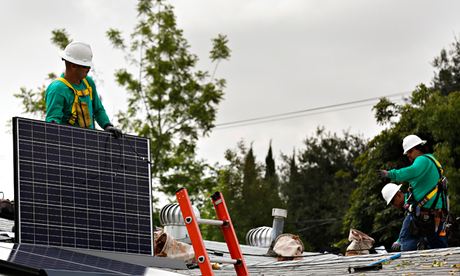
SolarCity Corporation employees install solar panels on the roof of a home in a Los Angeles neighbourhood in California, US. Photograph: Patrick T Fallon/Getty Images
The number of people working in the global renewable energy industry grew by 14% to 6.5 million in 2013, according to a new report from the International Renewable Energy Agency (Irena). However, employment in renewable energy in the UK is stagnating, according to the most recent government data.
The biggest renewable sector employer worldwide is the solar panel industry, which employed 2.27 million people, according to Irena, a body comprising 168 member nations. Biofuels, with 1.45 million, and wind power, with 0.83 million, were the next biggest employers. The largest employer by country is China, with 2.6 million jobs. Two-thirds of these jobs are in solar, in which employment has trebled in two years. Brazil, with 0.89 million jobs, and the US, with 0.63 million, are the next biggest renewable employment nations, with both countries having large biofuel sectors.
"With 6.5 million people directly or indirectly employed in renewable energy, the sector is proving that it is no longer a niche – it has become a significant employer worldwide," said Irena director-general, Adnan Z Amin. A major recent report from the Intergovernmental Panel on Climate Change concluded that low-carbon energy output needs to treble by 2050 to avoid catastrophic climate change.
The price of solar photovoltaic panels has fallen rapidly in recent years and the report identifies increasing installations as the main driver behind the jobs rise. "Surging demand for solar PV in China and Japan has increased employment in the installation sector," said Rabia Ferroukhi, lead author of the Irena report. "Consequently some Chinese manufacturers are now adding capacity."
However the outlook for solar in the UK is uncertain with the fourth review of subsidies in less than three years expected imminently. Leonie Greene, at the UK's Solar Trade Association said: "The government is in danger of pushing the whole non-domestic solar PV sector of a cliff."
She told the Guardian: "We are happy to discuss cost reductions with the government but let's do it on the basis of evidence. This latest review seems to be purely political and reactionary." While solar power is overwhelmingly the most popular technology in the UK, some large solar farms have generated local opposition and Conservative energy minister Greg Barker has called them "monsters".
"Solar jobs in the UK were growing nicely and we had lots of member companies taking on new staff," said Greene. "Whether that continues depends on what happens on Tuesday."
The most recent UK government statistics on the wider £128bn green economy show it employed almost a million people in 2011-12 – more than teaching – and grew at 4.8%, far outstripping the whole economy. The data includes the clean energy, waste, water and pollution sectors but showed that the number employed in the renewable energy sector was static compared to the previous year at about 275,000.
Solar has also suffered from government subsidy cuts in Australia, according to the Irena report. It said the 23,000 solar jobs on 2012 is expected to fall to 12,300 in 2014. The Irena report found employment in the wind sector had also suffered from uncertainty over state policies, particularly in the US, Europe and India. But this was offset by positive moves in China and Canada, the report said.
theguardian.com |



