RE- FED Rate Cut- I've never been a fan of 0 US interest rates. A rate cut aside to restructure debt of all kinds. IMO Economically it's meant to stimulate the US economy. Could this be the straw that break the camels back in our elected representatives in getting a infrastructure bill passed?
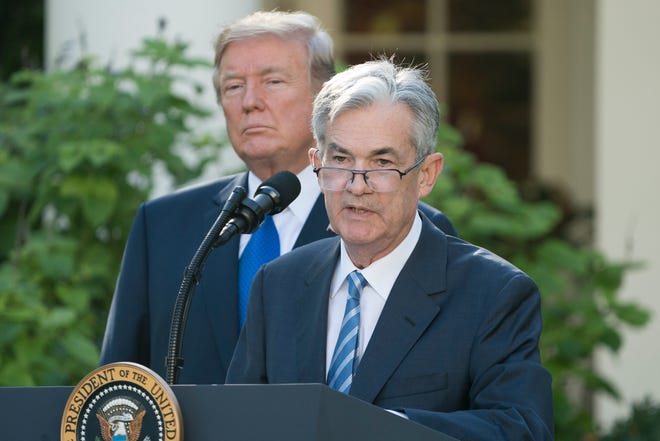
P.S. The chairman looked nervous in saying his calming effects speech.
If it happens. Who wants to make o interest for leaving money in a bank? Maybe it's possible now? Sure seems we have an advantage over Europe's Negative rates. Now with the generic saying. Even with the market Crash of 1929. The US Stock Market has proven, over time, to be among one of the best long term investments.

Sept.012 2019.
Trump wants Fed to cut interest rates to zero or below. Here's what it could mean for you.
Paul Davidson
USA TODAY
It seems like only yesterday that the Federal Reserve was steadily raising interest rates as the U.S. economy picked up steam after years of near-zero rates following the Great Recession of 2007-09.
But the Fed cut its key rate in July for the first time in a decade, another such move is likely next week and there’s growing talk of pushing rates down to, or even below, zero.
JPMorgan Chase CEO Jamie Dimon this week said bank executives have discussed imposing certain fees on consumers if rates fall to zero. And President Donald Trump on Wednesday tweeted that the Fed “should get our interest rates down to ZERO, or less,” allowing the federal government to refinance its massive debt at a lower cost.
Here's why the Fed may eventually lower rates to zero or below – and what that would mean for consumers.
Pouring it on: President Trump rips Fed as 'boneheads,' calls for zero or negative interest rates
When might the Fed reduce its benchmark rate to around zero?
The central bank almost certainly would not take such a step in the short term. Fed Chairman Jerome Powell has said the U.S. economy is performing well, and the Fed’s key rate is well above zero at a range of 2% to 2.25%. But Powell and other Fed officials are worried about risks that could derail the record 10-year-old economic expansion, such as Trump’s trade war with China and a slowdown in global growth.
As a result, the Fed is likely to continue to gradually trim the rate to spur more borrowing and economic activity, with markets expecting five more quarter-point cuts by early 2021, according to Bank of America Merrill Lynch. That would leave just three more decreases to get to zero, suggesting it could happen in 2021.
 Why would the Fed lower the rate to zero? Why would the Fed lower the rate to zero?
It likely would take a recession, says economist Paul Ashworth of Capital Economics. But it wouldn’t necessarily need to be a deep recession, such as the 2007-09 downturn, he says. That’s because rates are already historically low as a result of a slow-speed U.S. and global economic recovery rooted in an aging population and weak productivity growth. Many economists are forecasting a recession by the end of next year.
What are the benefits of a zero, or near-zero, Fed rate?
A Fed rate at zero doesn’t mean consumers wouldn’t have any borrowing costs – banks still need to make a profit – but it likely would mean very low monthly interest costs for home and car buyers, as well as businesses and other borrowers. The problem: Far fewer households and businesses will be eager to take out loans if the economy is in recession, says Greg McBride, chief financial analyst for Bankrate.com.
What's the downside?
Seniors and other Americans who depend heavily on income from bank savings would be frustrated by a return to microscopic savings rates below 1%.
Low rates also squeeze the profit margins of banks, who make money by paying interest to depositors and lending it out at higher rates to borrowers. The prospect of slimmer margins is what prompted JPMorgan’s Dimon to say bank officials are considering introducing new fees to bolster earnings if rates dropped to zero.
That could mean raising overdraft charges and ATM fees and adding or increasing monthly maintenance fees for checking accounts, McBride says. Some banks might even hit customers with charges to transfer money or complete other transactions in person rather than online, he says.
What would it mean for the Fed to lower rates below zero?
A negative interest rate means banks would pay a small amount of money each month to park some of their money at the Fed – a reversal of how a bank typically works. Banks, in turn, could pass those interest costs to customers by charging for deposits. Currently, banks earn a small amount in interest by leaving cash at the Fed.
Does that mean you would have to pay interest on savings and money market accounts?
Banks likely would charge big companies and other large depositors who need a place to store their many millions of dollars but could protect consumers from negative rates on deposits.
Do negative rates mean you could get paid to take out a mortgage or other loan?
That’s theoretically possible, but it’s more likely a bank would charge very low interest rates on loans. If a loan did carry negative interest, the bank would increase other fees to ensure it makes a profit.
Why would the Fed push rates into negative territory?
If the Fed nudges rates to zero, it has few options left. The goal of below-zero rates would be to spur banks to lend more, jolting a sluggish economy, and encourage consumers and businesses to spend rather than save their money. Presumably, a bank would rather lend, even at a low interest rate, than pay to keep its money at a central bank.
So if interest rates go to zero, are negative rates next?
The Fed likely would first try other strategies, such as resuming its financial crisis-era purchases of Treasury and mortgage bonds to drive down long-term interest rates, Ashworth says. But Bank of America notes the 10-year Treasury rate is already so low that it recently dipped below the 2-year note – a development that signals a dim outlook and hurts consumer and business confidence. So the Fed may be hesitant to worsen that situation.
Would it be viable for the Fed to lower rates below zero?
Some experts say the law would need to be changed to allow it or the move could face legal challenges, Ashworth says. There are also practical concerns. Money market mutual funds would likely charge consumers for deposits. That, he says, could lead to a run on the funds, which are used to finance short-term commercial loans, potentially slowing the gears of the financial system.
usatoday.com
Visualizing the 700-Year Fall of Interest Rates

Published
4 weeks ago on
February 4, 2020

Visualizing the 700-Year Decline of Interest Rates How far can interest rates fall?
Currently, many sovereign rates sit in negative territory, and there is an unprecedented $10 trillion in negative-yielding debt. This new interest rate climate has many observers wondering where the bottom truly lies.
Today’s graphic from Paul Schmelzing, visiting scholar at the Bank of England (BOE), shows how global real interest rates have experienced an average annual decline of -0.0196% (-1.96 basis points) throughout the past eight centuries.
The Evidence on Falling Rates Collecting data from across 78% of total advanced economy GDP over the time frame, Schmelzing shows that real rates* have witnessed a negative historical slope spanning back to the 1300s.
Displayed across the graph is a series of personal nominal loans made to sovereign establishments, along with their nominal loan rates. Some from the 14th century, for example, had nominal rates of 35%. By contrast, key nominal loan rates had fallen to 6% by the mid 1800s.
Centennial Averages of Real Long-Term “Safe-Asset”† Rates From 1311-2018
%1300s1400s1500s1600s1700s1800s1900s2000s |
| Nominal rate | 7.3 | 11.2 | 7.8 | 5.4 | 4.1 | 3.5 | 5.0 | 3.5 | | Inflation | 2.2 | 2.1 | 1.7 | 0.8 | 0.6 | 0.0 | 3.1 | 2.2 | | Real rate | 5.1 | 9.1 | 6.1 | 4.6 | 3.5 | 3.4 | 2.0 | 1.3 | *Real rates take inflation into account, and are calculated as follows: nominal rate – inflation = real rate.
†Safe assets are issued from global financial powers
Starting in 1311, data from the report shows how average real rates moved from 5.1% in the 1300s down to an average of 2% in the 1900s.
The average real rate between 2000-2018 stands at 1.3%.
Current Theories Why have interest rates been trending downward for so long?
Here are the three prevailing theories as to why they’re dropping:
1. Productivity Growth Since 1970, productivity growth has slowed. A nation’s productive capacity is determined by a number of factors, including labor force participation and economic output.
If total economic output shrinks, real rates will decline too, theory suggests. Lower productivity growth leads to lower wage growth expectations.
In addition, lower productivity growth means less business investment, therefore a lower demand for capital. This in turn causes the lower interest rates.
2. Demographics Demographics impact interest rates on a number of levels. The aging population—paired with declining fertility levels—result in higher savings rates, longer life expectancies, and lower labor force participation rates.
In the U.S., baby boomers are retiring at a pace of 10,000 people per day, and other advanced economies are also seeing comparable growth in retirees. Theory suggests that this creates downward pressure on real interest rates, as the number of people in the workforce declines.
3. Economic Growth Dampened economic growth can also have a negative impact on future earnings, pushing down the real interest rate in the process. Since 1961, GDP growth among OECD countries has dropped from 4.3% to 3% in 2018.
Larry Summers referred to this sloping trend since the 1970s as “ secular stagnation” during an International Monetary Fund conference in 2013.
Secular stagnation occurs when the economy is faced with persistently lagging economic health. One possible way to address a declining interest rate conundrum, Summers has suggested, is through expansionary government spending.
Bond Yields Declining According to the report, another trend has coincided with falling interest rates: declining bond yields.
Since the 1300s, global nominal bonds yields have dropped from over 14% to around 2%.

The graph illustrates how real interest rates and bond yields appear to slope across a similar trend line. While it may seem remarkable that interest rates keep falling, this phenomenon shows that a broader trend may be occurring—across centuries, asset classes, and fiscal regimes.
In fact, the historical record would imply that we will see ever new record lows in real rates in future business cycles in the 2020s/30s
-Paul Schmelzing
Although this may be fortunate for debt-seekers, it can create challenges for fixed income investors—who may seek alternatives strategies with higher yield potential instead.
visualcapitalist.com
Message 32577254 |



