Samsung’s monstrous 15TB SSD is now shipping
Samsung isn't saying how much it costs, though. Probably "a lot."
by Peter Bright - Mar 3, 2016
arstechnica.com
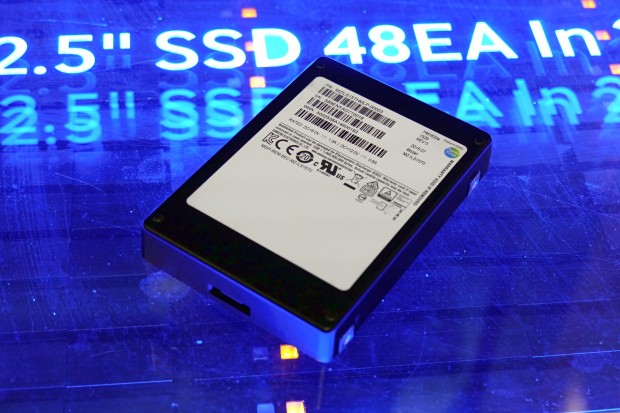
Samsung has announced that it is now shipping its PM1633a SSD. That's a boringly mundane name for a drive that's anything but: the PM1633a isn't just the biggest SSD around, it's straight-up the biggest drive around. At 15.36TB, it dwarfs other SSDs and surpasses the capacity even of the very latest magnetic spinning disks. Remarkably, it packs all this storage into a conventional 2.5-inch package.
The company explained how this was done in August last year. While traditional integrated circuits (whether processors or flash memory or RAM or anything else) have a flat, essentially 2D structure, this drive uses Samsung's 3D V-NAND technology, which vertically stacks 48 layers of NAND cells to greatly increase the storage density. The highest performance flash memory stores a single bit in each flash cell; Samsung's trades a bit of performance for density, storing three bits per cell. Each die using this technology stores 256Gb (32GB) of data.
The company then adds a second level of layering: 16 of the 256Gb dies themselves are stacked up, creating a package with a 512GB capacity. Of these packages, 32 are used in the PM1633a to give it its total 15.36TB capacity. Samsung plans future versions with 7.68TB, 3.84TB, 1.92TB, 960GB, and 480GB capacities. The 15.36TB unit also has 16GB of RAM embedded.
The PM1633a is aimed at enterprise markets, and accordingly it will use an enterprise interface: 12Gb/s Serial Attached SCSI (SAS). The raw performance of this drive won't match the very fastest PCIe-attached drives, with Samsung saying it offers read and write speeds of 1,200MB/s, with 200,000 read and 32,000 write operations per second. However, these numbers handily beat spinning disks, and previously, that was the only way of offering this kind of capacity. As for endurance, Samsung says that the drive supports 15.36TB of writes per day over its five-year life cycle.
The South Korean firm is leaving one important detail out, at least for now: the price. As is typical for enterprise products, if you have to ask, you can't afford it. The previous generation PM1633 products cost around $1,000 (£700) per TB. We'd assume that the new drive will cut that per terabyte price, but we still wouldn't expect to see much change from $8,000 (£5,600). Still, if it means having the biggest drive ever made, that's a small price to pay, isn't it?
* * * |



