Intel launches Stratix 10: Altera FPGA combined with ARM CPU, 14nm manufacturing
October 10, 2016
extremetech.com
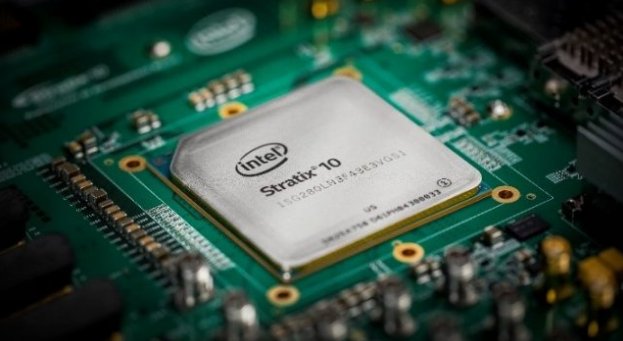
When Intel bought Altera last year, there was speculation on how we’d see future FPGA products fit within Intel’s existing product lines. Intel has previously stated it intends to offer a Xeon processor with an integrated FPGA, but we’ve yet to hear any concrete talk about what that product will look like. The new Stratix 10 family does contain a microprocessor — but it’s an ARM-based design, not an Intel chip.
That doesn’t mean Intel DNA isn’t baked into the new FPGA, however. According to Intel’s PR, Stratix 10 offers double the core performance, up to 70% lower power, up to 1TBps of memory bandwidth provided courtesy of HBM2 (that’s 128GB/s) and up to 10TFLOPS of single-precision floating point performance. ARM capabilities are provided by a quad-core Cortex-A53.
According to Intel, Stratix 10 has been fundamentally re-architected to deliver performance that’s dramatically better than any competitive solution on the market. The new chip uses “hyper-registers” to reduce routing congestion and to allow for performance tuning without requiring additional adaptive logic modules (ALMs). The chip allows for localized programmable clock trees to reduce skew and timing uncertainty. This improvement was apparently “a key feature that allows the HyperFlex architecture to reach 2X performance.”
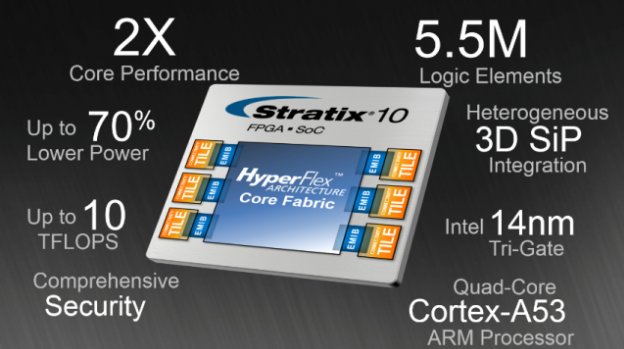
Intel also points to new design tools and options that it claims allow the Stratix 10 to scale more effectively to deal with a variety of problems than other FPGAs. The chip is built on Intel’s 14nm Tri-Gate process. Altera isn’t Intel’s only foundry customer; Achronix has also built FPGAs with the Santa Clara company, but Achronix used Intel’s older 22nm process.
FPGAs are a branch of computing we don’t typically discuss at ET. But they’ve been used extensively in data centers, software-defined networking, and device prototyping. The slide below broadly captures the difference between the three types of integrated circuits, and while it focuses on power efficiency, we can also take this as a broad stand-in for overall performance as well.
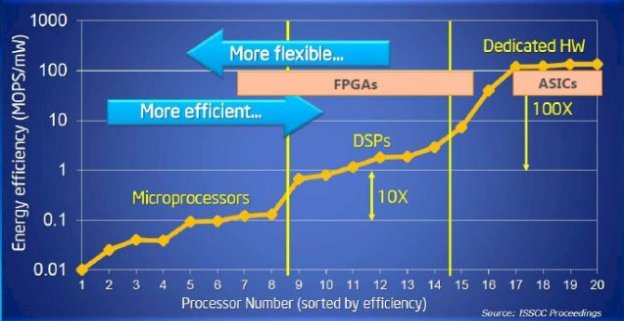
At the far left-hand side of the graph, you have microprocessors like the general-purpose CPUs from AMD, Intel, and ARM. These chips all offer a great deal of flexibility — there’s a robust compiler ecosystem and a wide variety of tools for programming CPUs, and CPUs can any workload (albeit not necessarily very well). FPGAs are more energy efficient than CPUs, but not as flexible — they can be programmed to duplicate the functions and timings of other processors, which is why many of the replica consoles you can buy rely on FPGAs instead of relying on aging, original NES hardware.
At the far end of the scale you have ASICs, which are built to do one particular task quite well and offer maximum performance, but limited reprogrammability. Modern GPUs are sometimes considered ASICs, though they have enough general-purpose compute functionality to argue the point (ASICs eventually took over cryptocurrency mining precisely because they could outperform GPUs).
Intel’s new FPGA efforts will be watched closely. The company invested significant resources in buying Altera, and its ability to fab hardware for designs that didn’t originate in-house will be a key factor in whether its foundry business can get off the ground. A full whitepaper describing the chip’s new capabilities is available here.
* * * |



