"These machines are real and capable."
These machine are a joke. Do the math. Figure out how many we need. Figure out how much energy it takes to run them. Then figure out how many people there are like you, who will say, "I ain't paying for that."
Why global emissions must peak by 2020
Filed under: Climate Science Greenhouse gases Solutions — stefan @ 2 June 2017
(by Stefan Rahmstorf and Anders Levermann)
In the landmark Paris Climate Agreement, the world’s nations have committed to “holding the increase in the global average temperature to well below 2 °C above pre-industrial levels and to pursue efforts to limit the temperature increase to 1.5 °C above pre-industrial levels”. This goal is deemed necessary to avoid incalculable risks to humanity, and it is feasible – but realistically only if global emissions peak by the year 2020 at the latest.
Let us first address the importance of remaining well below 2°C of global warming, and as close to 1.5°C as possible. The World Meteorological Organization climate report for the past year has highlighted that global temperature and sea levels keep rising, reaching record highs once again in 2016. Global sea ice cover reached a record low, and mountain glaciers and the huge ice sheets in Greenland and Antarctica are on a trajectory of accelerating mass loss. More and more people are suffering from increasing and often unprecedented extreme weather events [ii], both in terms of casualties and financial losses. This is the situation after about 1°C global warming since the late 19th Century.
Not only will these impacts get progressively worse as warming continues, but our planet also runs a growing risk of crossing critical tipping points where major and largely irreversible changes to the Earthsystem are triggered (see Fig. 1).
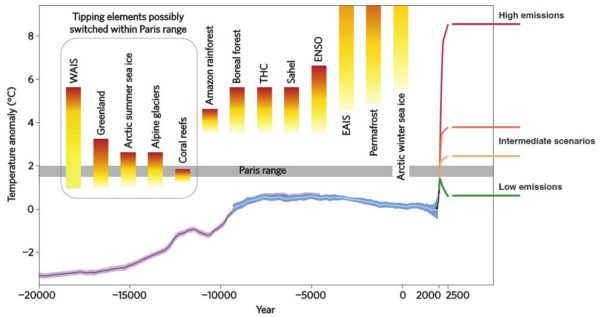
Fig. 1 Tipping elements in the Earth system, in relation to past global temperature evolution since the last Ice Age 20,000 years ago as well as future warming scenarios [iii]. The Paris range of 1.5 – 2 °C warming is shown in grey; the bars show increasing risk of crossing tipping points from yellow to red.
The West Antarctic Ice Sheet (WAIS in Fig. 1) has likely already been destabilised, committing the world to at least three meters of global sea-level rise in coming centuries [iv] – an outcome that scientists have warned about since the 1970s [v]. The Greenland Ice Sheet – holding enough ice to eventually raise global sea levels by seven meters – may likewise be destabilised below 2°C [vi]. Coral reefs have suffered pan-tropical mass bleaching in 2016 and are doing so again in 2017 as a result of warming oceans, and only if global temperature stays well below 2°C some remnants of the world’s coral reefs can be saved [vii]. The Gulf Stream system (THC in Fig. 1) appears to be already slowing [viii] and recent research indicates it is far more unstable than previously thought.
Because overall global temperature rise depends on cumulative global CO2 emissions, the Paris temperature range can be translated, with some uncertainty, into a budget of CO2emissions that are still permissible. This is the overall budget for the century and it lies within the range of 150 to 1050 Gt of CO2, based on updated numbers from IPCC [ix]. At the current global emission level of 39 GtCO2 per year, the lower limit of this range would be crossed in less than four years and is thus already unachievable without massive application of largely unproven and speculative carbon dioxide removal technologies. Even the CO2 budget corresponding to the mid-point of this uncertainty range, 600 GtCO2, is equivalent to only 15 years of current emissions. Fig. 2 illustrates three scenarios with this budget and different peaking years for global emissions. It makes clear that even if we peak in 2020 reducing emissions to zero within twenty years will be required. By assuming a more optimistic budget of 800 Gt this can be stretched to thirty years, but at a significant risk of exceeding 2°C warming.
It is still possible therefore to meet the Paris temperature goals if emissions peak by 2020 at the latest, and there are signs to show we are moving in that direction as global CO2 emissions have not increased for the past three years. We will need an enormous amount of action and scaled up ambition to harness the current momentum in order to travel down the decarbonisation curve at the necessary pace; the window to do that is still open [x].
In summary, declining carbon emissions after 2020 is a necessity for meeting the Paris temperature limit of “well below 2 degrees”.
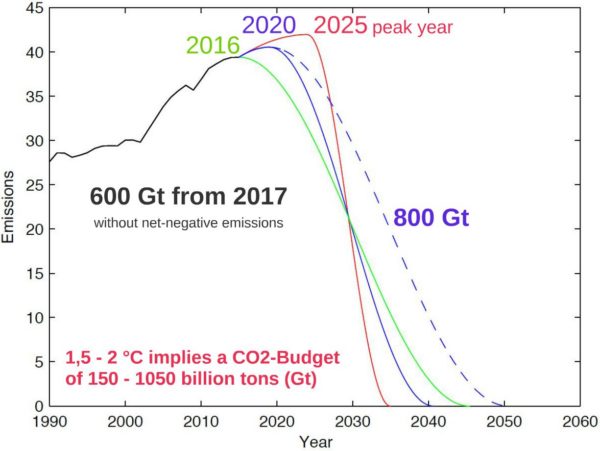
Fig. 2 Three illustrative scenarios for spending the same budget of 600 Gt CO2, with emissions peaking in 2016 (green), 2020 (blue) and 2025 (red), and an alternative with 800 Gt (dashed).
Note: This article first appeared in the report 2020 The Climate Turning Point
realclimate.org |



