CANADA Person of 'national security concern' was accidentally granted permanent residency
2 departments make changes after 'completely unacceptable' mistake
Catharine Tunney · CBC News
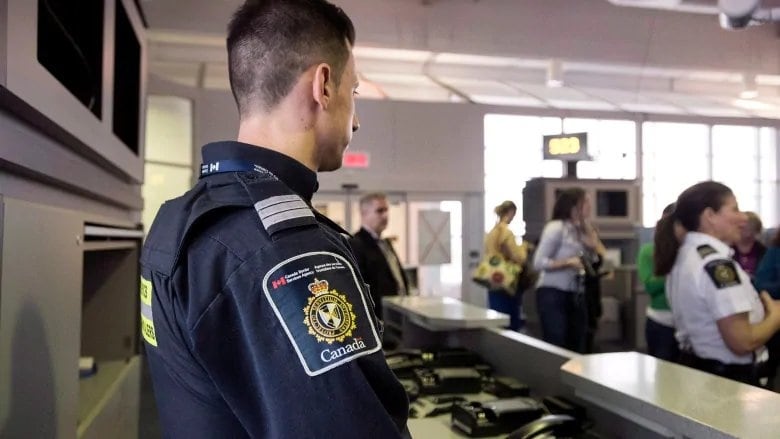
The Canada Border Services Agency said its internal review policies and procedures have been 'refined' in light of the granting of permanent residency to a person of 'national security concern.' (CBC)
A person of "national security concern" was granted permanent residency "due to a series of failures" by the Canadian border agency and immigration department.
In light of the incident, both departments have had to introduce changes in what the public safety minister's office is calling a "completely unacceptable" mistake.
The changes were outlined in a briefing note sent by Canada Border Services Agency president John Ossowski to Public Safety Minister Ralph Goodale in early 2018 regarding the 2017 error.
A heavily redacted copy of the document was recently obtained by CBC News through access to information laws.
The briefing note, titled "Subject of national security concern granted permanent residency" says the subject — their name, age and gender are redacted for privacy reasons — was granted permanent resident status "due to a series of failures on the part of both Immigration, Refugees, Citizenship Canada and the CBSA."
Most of the details about why this person is considered a security concern and how they were granted permanent residency were redacted because, among other reasons, officials believe releasing information could hurt "the conduct of international affairs, the defence of Canada or any state allied or associated with Canada."
Disconnect between agenciesHowever, the document does mention that the Canadian Security Intelligence Service had "derogatory information," meaning information that could be relevant to a finding that the person was inadmissible to Canada. CSIS and the RCMP were also tapped to monitor a national security investigation linked to this case.
"Those mistakes were completely unacceptable. Changes have been made to prevent them from happening again," said Scott Bardsley in an email to CBC News.
"While we do not comment on operational matters related to security, we can say that the government of Canada monitors all potential threats and has robust measures in place to address them."
Later, in an interview with CBC News Network's Power & Politics, Goodale said that he was not aware that any government employees had lost their jobs over the decision, although he offered assurances measures were taken.
"The right disciplinary action is always taken by CBSA and other agencies where that is necessary and appropriate," Goodale told guest host Katie Simpson. "That's a matter of internal judgment within within the public service. My concern is to make sure that the problem is is solved and that we're not vulnerable to it happening again."
Most new permanent residency cards are valid for five years, but Goodale's office pointed out that permanent residents can become inadmissible on security grounds or for a misrepresentation, under the Immigration and Refugee Protection Act.
"The government of Canada is unwavering in its commitment to protect the safety and security of Canadians," said Bardsley.
"We continue to take appropriate action to counter threats to Canada, its citizens and its interests around the world."
Changes raise red flagsOssowski told Goodale that the border agency identified a number of "vulnerabilities" and is taking steps to "respond to this incident and to prevent similar incidents from occurring in the future."
Those steps include introducing new fail-safes to the global case management system, updating the national targeting program, which helps the CBSA identify suspected high-risk people and goods, and changing the passenger information system.
In a statement to CBC News the border agency said its internal review policies and procedures have been "refined" in light of the incident.
But Sundberg, who spent 15 years working for the CBSA's predecessor, said the changes involve updating significant computer systems and working with international partners, raising some red flags.
"I don't think one case, one mistake would trigger all of these major changes," he said.
"I don't believe this is the only case. I think that this is probably more common than we believe, and it comes down to process, it comes down to organizational structure and it comes down to investment in officers. So, it's concerning."
Asked about the incident, Immigration, Refugees and Citizenship Canada said it's offering its officers more training.
Call for oversight
"The department is delivering ongoing training to IRCC officers to identify potential security concerns in order to mitigate human error," said spokesperson Nancy Caron.
Conservative Leader Andrew Scheer took to Twitter to air his displeaure.
"How does this happen? Justin Trudeau keeps telling Canadians he's got the border under control — but stories like these keep popping up. We need to get serious about screening at all points of entry. The safety of Canadians is at stake," he said.
Sundberg said cases like this highlight the need for independent oversight of the CBSA.
"I don't buy it. I don't believe that this is a one-off, that this is the 'something went wrong.' I think that this is yet another case that went public, that the government is like 'Uh oh, we better do something,'" he said.
"This is why we need to have arm's-length oversight of the CBSA so that when things go aside, when things go wrong that there is an independent civilian body that's overseeing this for the interests of Canadians and to ensure best practices."
The NDP's public safety critic Matthew Dubé said he's raised the issue of outside oversight for the CBSA in the past, arguing it would help protect Canadians' privacy and make sure frontline officers are doing their jobs.
"The only person lacking political will is the minister," he said. "No reason why we can't move forward."
When asked about a review board for the agency, Goodale pointed to a pending bill that attempts to overhaul Canada's national security regime,
"An issue relating to national security within CBSA or within any department of agency of the government of Canada will be subject to the independent oversight and review of the national security and intelligence review agency that is created by Bill C-59," he said.
The bill is at second reading in the Senate.
Last month the Opposition Conservatives called for a review and audit of the immigration screening system after a CBC News investigation revealed a Somali gang member with an extensive criminal record was twice released in Canada.
The case of Abdullahi Hashi Farah also highlighted a lack of communication, this time between the CBSA and the Immigration and Refugee Board.
Officers gained access to his phone, which had evidence of illegal activity, but didn't immediately pass that information on to the IRB. |



