SI
SI
discoversearch

We've detected that you're using an ad content blocking browser plug-in or feature. Ads provide a critical source of revenue to the continued operation of Silicon Investor.  We ask that you disable ad blocking while on Silicon Investor in the best interests of our community.  If you are not using an ad blocker but are still receiving this message, make sure your browser's tracking protection is set to the 'standard' level.
Politics : Formerly About Advanced Micro Devices

 Public ReplyPrvt ReplyMark as Last ReadFilePrevious 10Next 10PreviousNext  
To: Broken_Clock who wrote (1261281)9/11/2020 3:13:13 PM
From: Wharf Rat   of 1575718


Dr Thomas Smith ????

Jul 21st 2020, 10 tweets, 8 min read

Bookmark Save as PDF My Authors

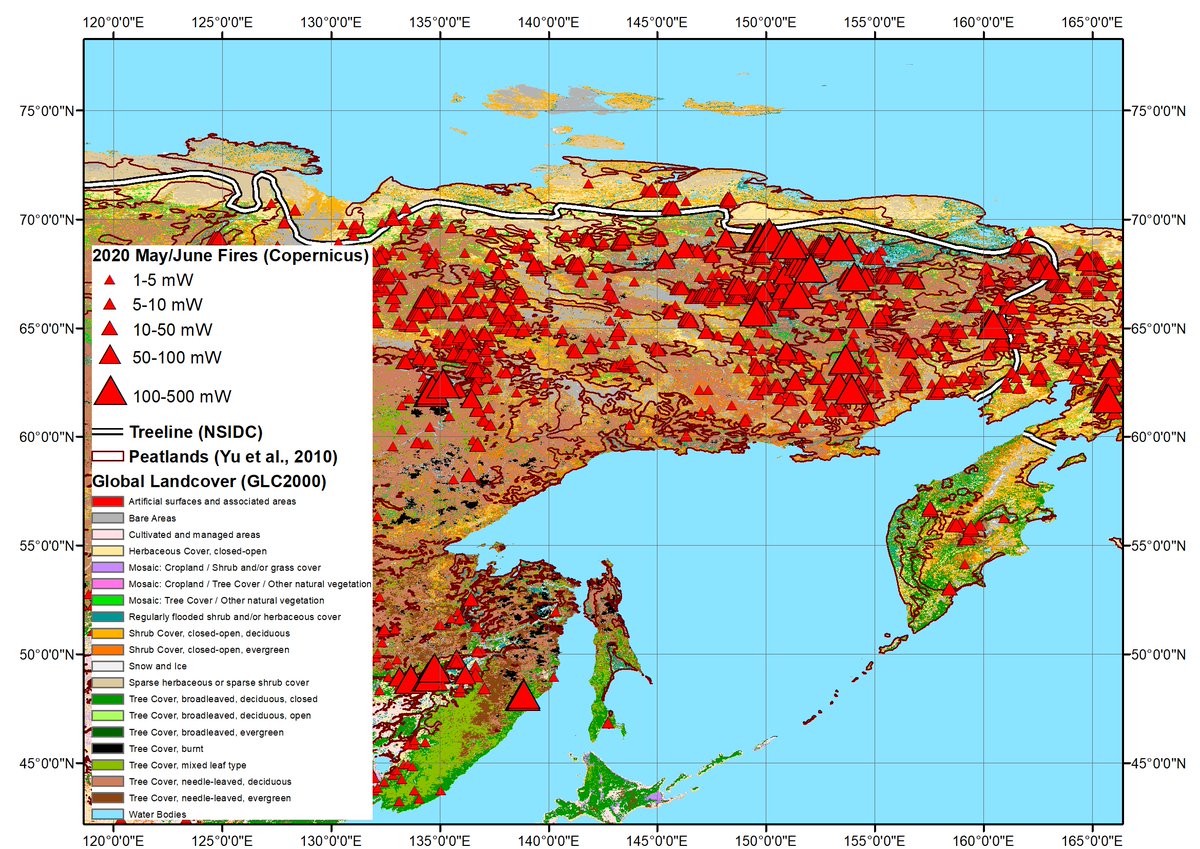
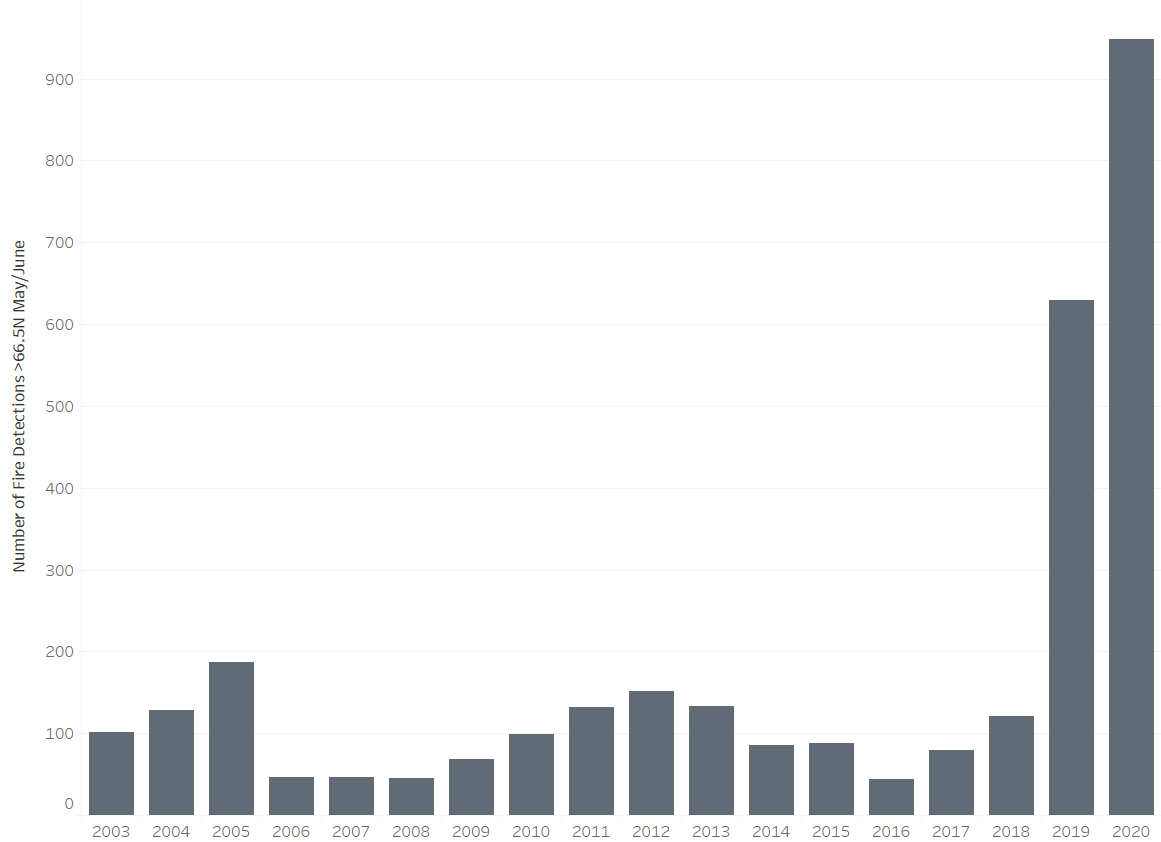
New spatial analysis of wildfires across the Arctic in May/June 2020, and how they compare to the satellite record (2003-2020). What is burning? Are there peat fires? What about permafrost? ?????thread in collab with @m_parrington @CopernicusECMWF #ArcticFires [1/9]

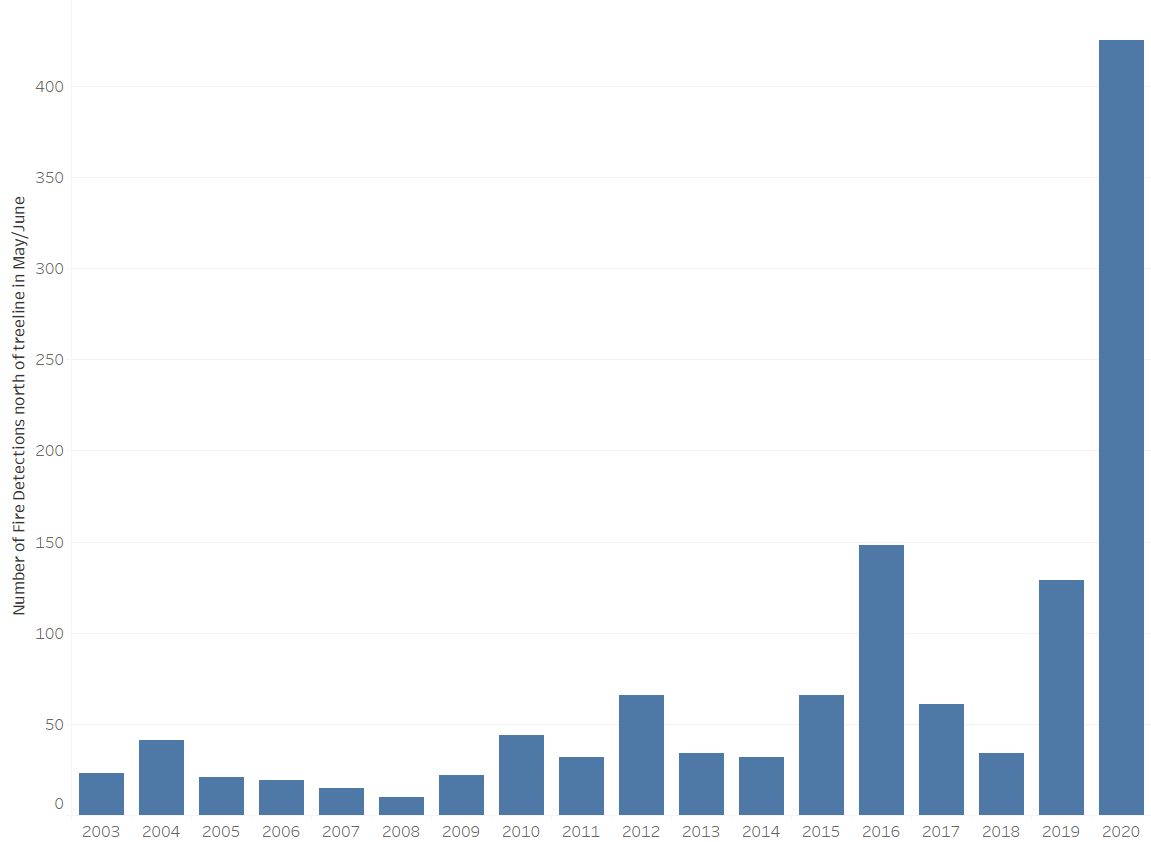
The Arctic Circle is an ecologically arbitrary line, so I also investigated fires burning north of the treeline, using @NSIDC's tundra & boreal forest boundary, a better representation of the Arctic Zone. May/June 2020 saw 10x more fires than 2003-18 average for this zone. [2/9]

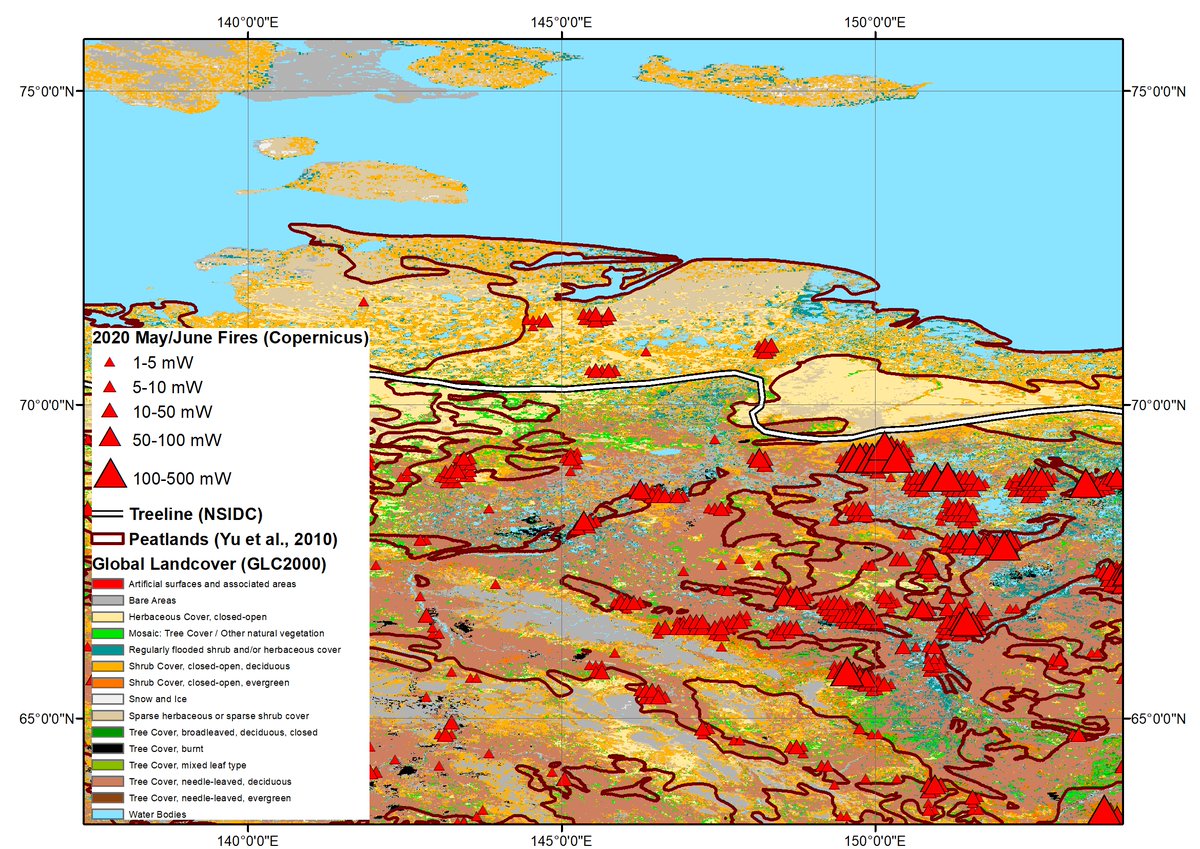
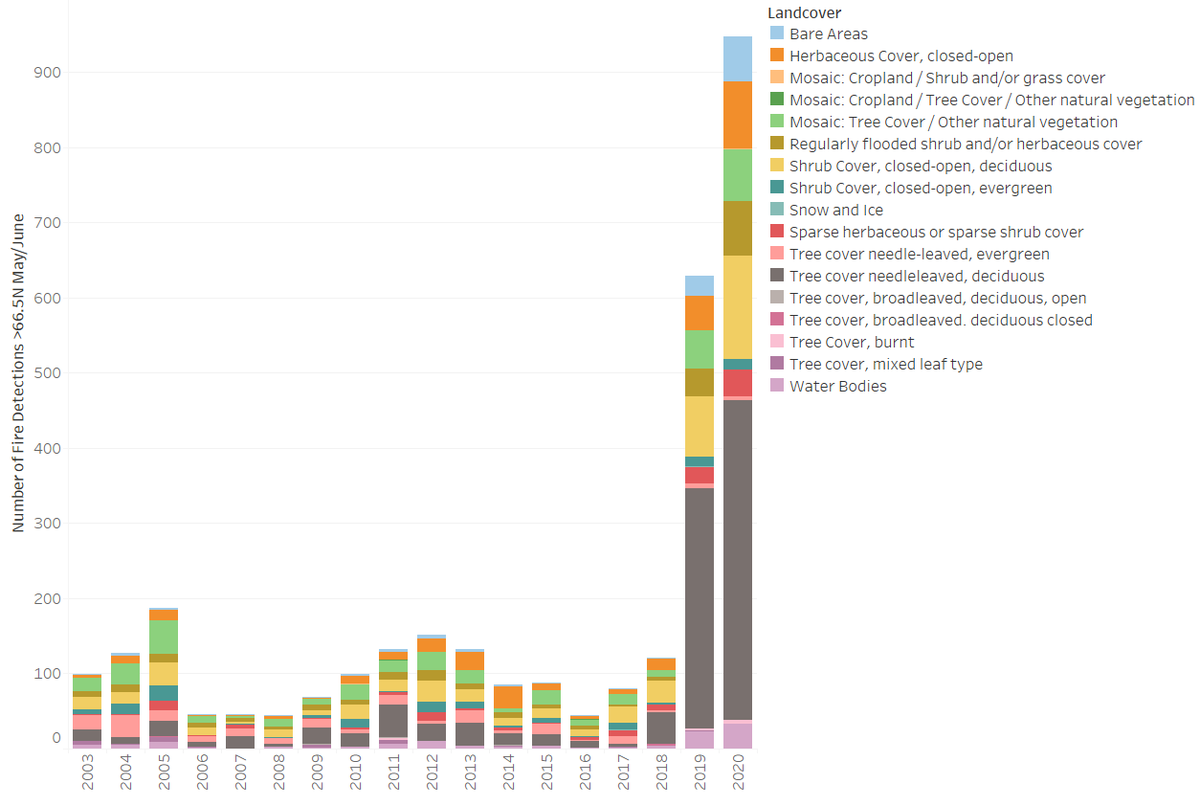
Using a Global Landcover dataset, we see corroborating evidence that the spike in fire activity in 2019/20 occurred in both the boreal forest (tree cover) and tundra (herbaceous & shrub cover) ecosystems of the Arctic Circle [3/9]

Peat soils are widespread in Arctic & Boreal biomes. We can use a global peatland map to determine proportion of the fires burning on mapped areas known to contain peat. Around half of the fires are on peat soils, with a big increase in total fires on peat in 2019 & 2020 [4/9]

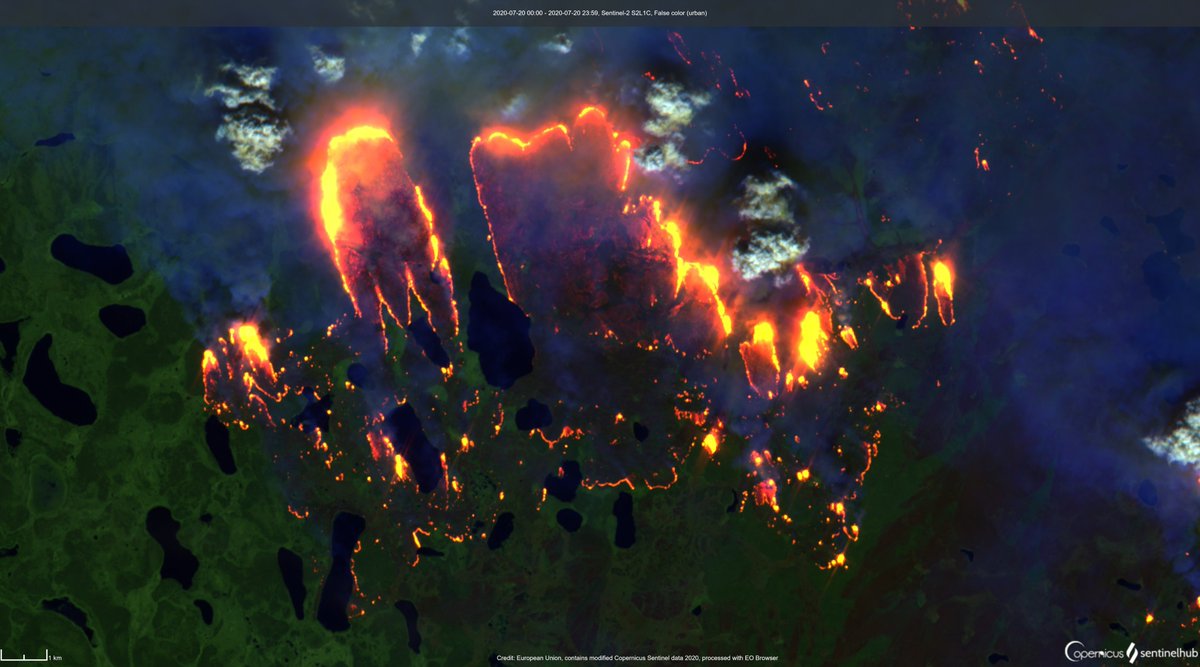
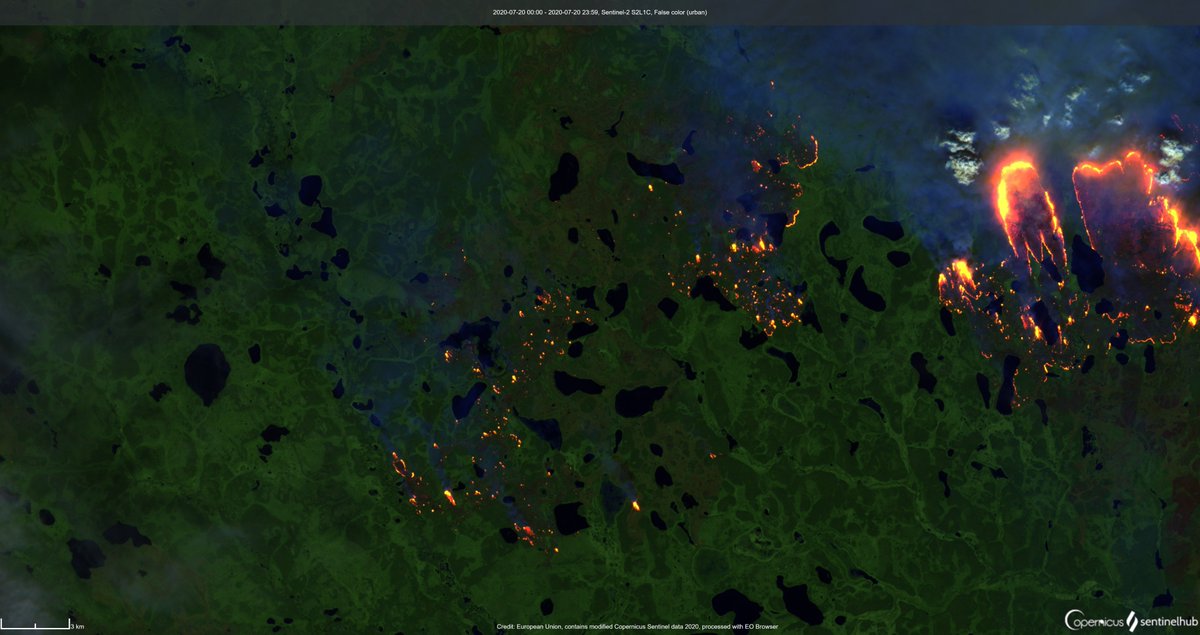
Some of these fires will have ignited underlying peat soils, although the area affected is difficult to determine from satellites. High-res imagery from @Sentinel_hub shows substantial areas of residual smouldering & fire spots burning long after the main fire has passed [5/9]

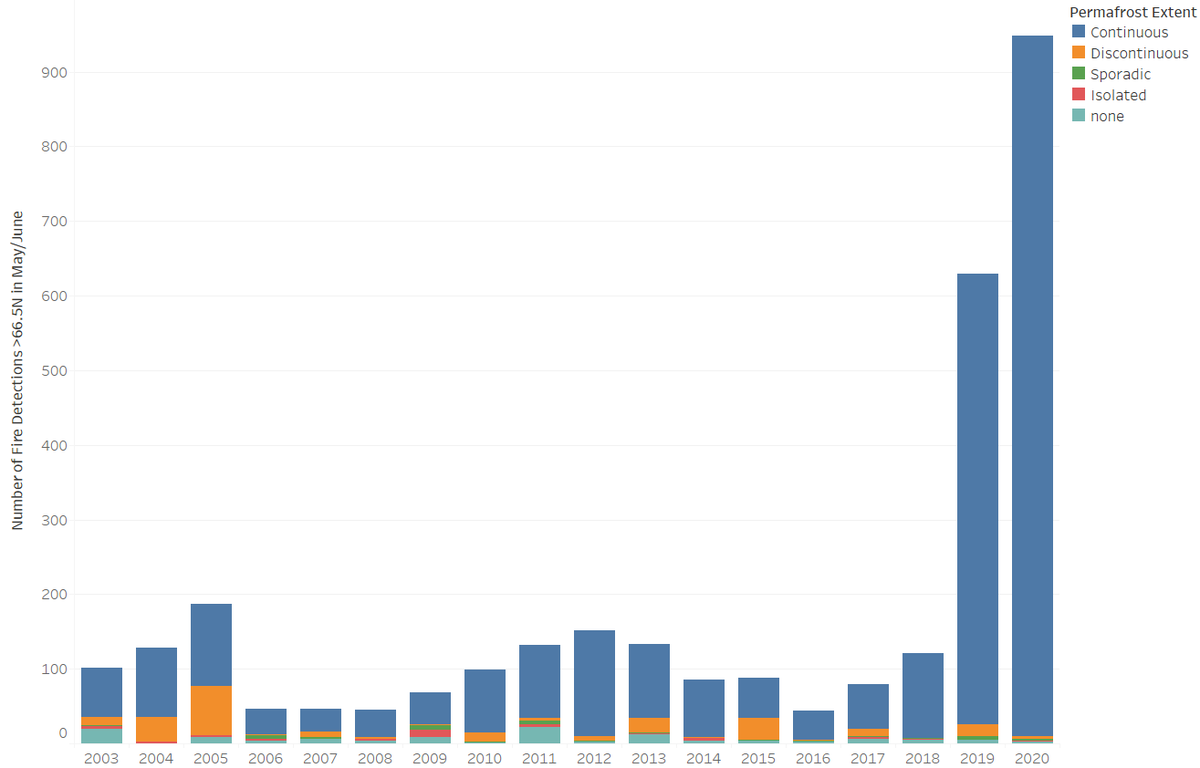
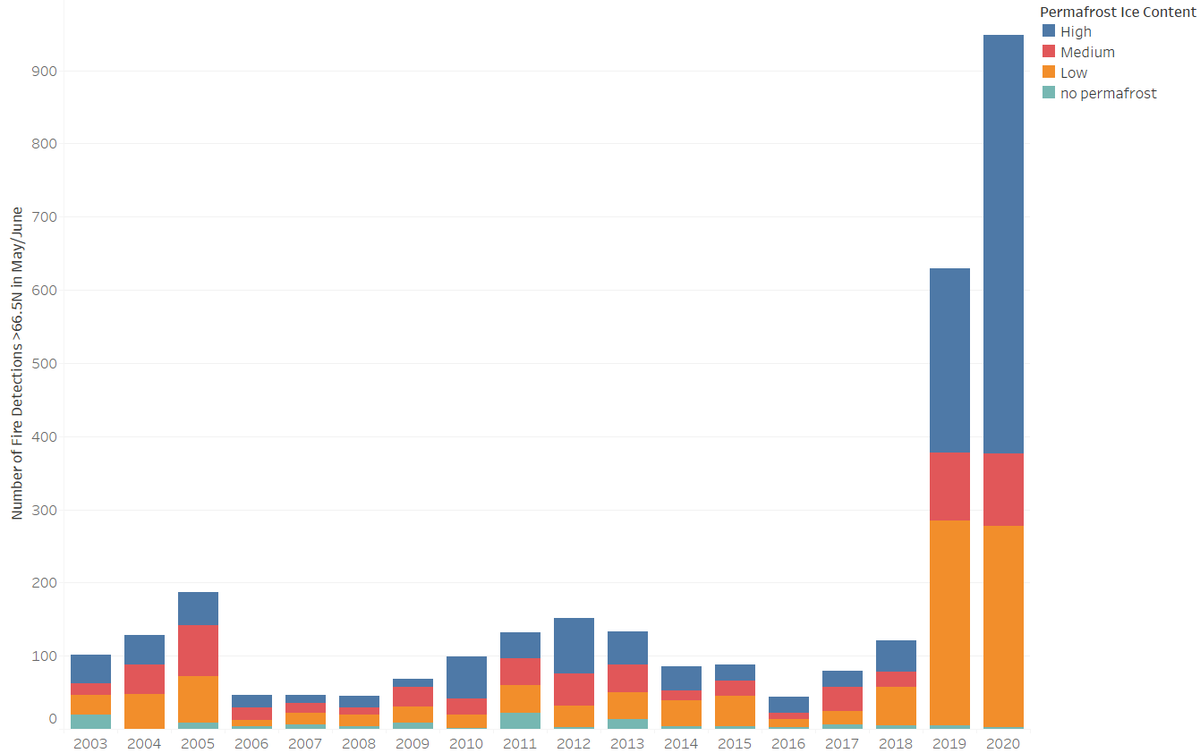
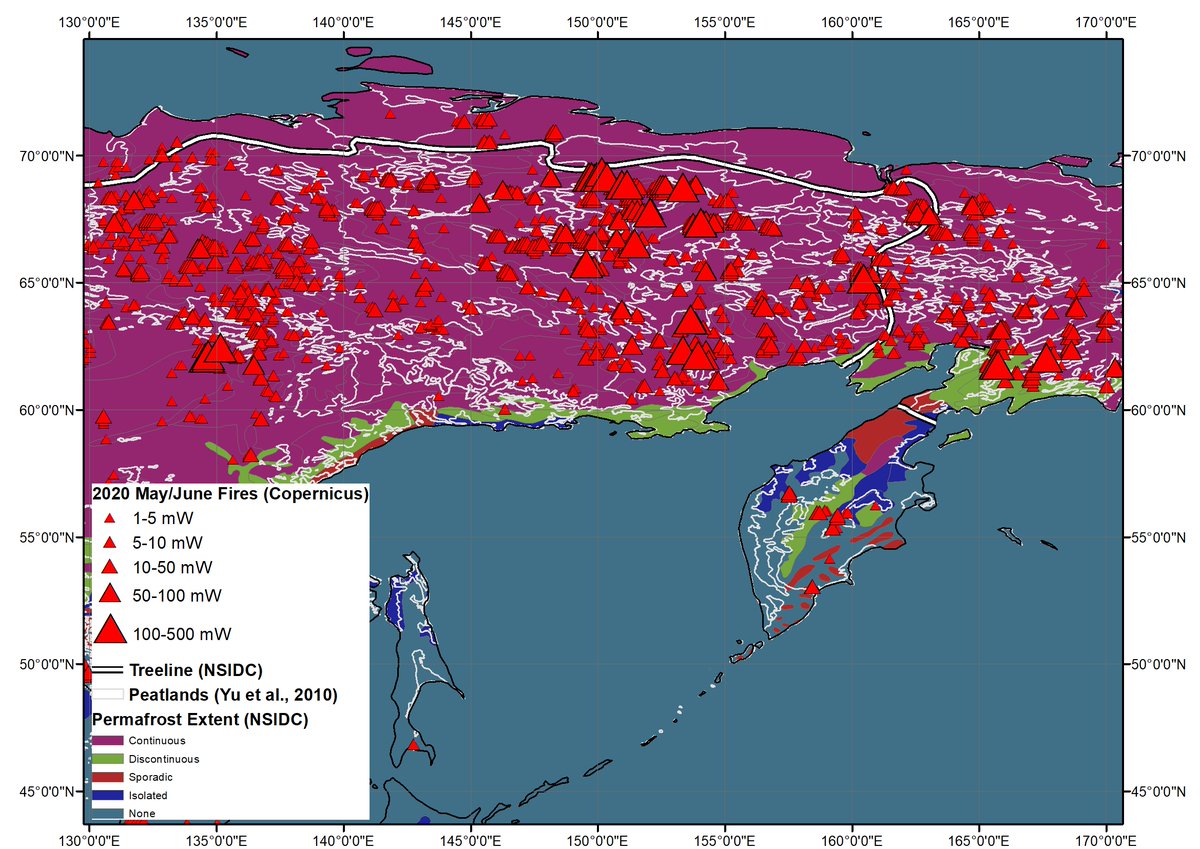
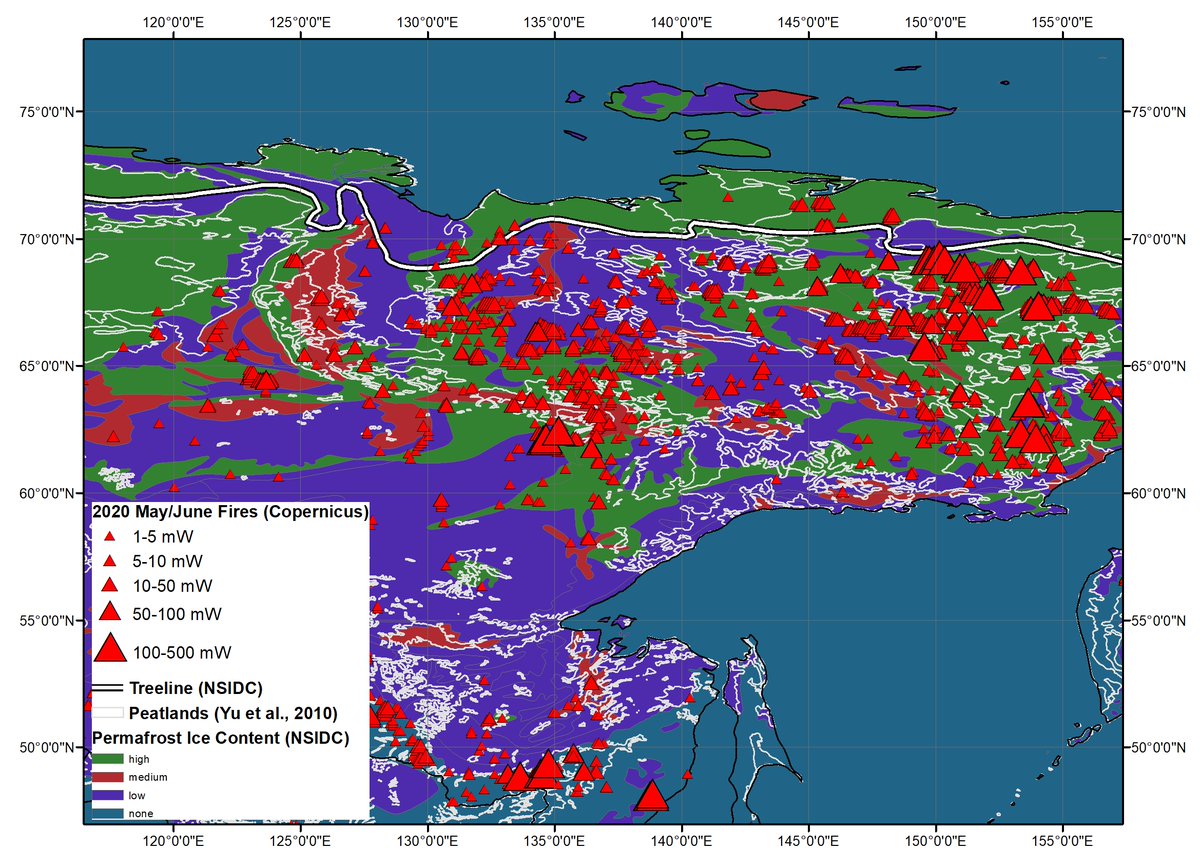
A map of permafrost from @NSIDC can be used to delineate whether fires are burning on continuous vs discontinuous permafrost, & the ice loading of those areas. Almost all of the fires in 2019 & 2020 were on continuous permafrost with high ice loading [6/9]

Finally, if we look at the latitudinal distribution of all May/June fires north of 60-degrees. We can see a very unusual distribution in 2019 & 2020, a noticeable shift to the north. Watch the animation in the next tweet... [7/9]

Here's an animation of high latitude May/June fires accumulating from 2003 to 2020, watch the Arctic fires emerging in 2019 and 2020 at the end of the animation. [8/9]

Data sources:
?? @NASAEarth Fire hotspots processed by @M_parrington @CopernicusECMWF
???Global Landcover @EU_ScienceHub: forobs.jrc.ec.europa.eu/products/glc20…
??Treeline and Permafrost @NSIDC: nsidc.org/data/ggd318
??Global peat map (Yu et al., 2010: researchgate.net/publication/23…)
[9/9]

High resolution version of this animation can be found here:

May/June high latitude wildfires latitudinal distribution animationHere's an animation of high latitude May/June fires accumulating from 2003 to 2020, watch the Arctic fires emerging in 2019 and 2020 at the end of the animation. Click to see full-size version: …http://drtels.co.uk/drtels/blog/may-june-high-latitude-wildfires-latitudinal-distribution-animation/

Missing some Tweet in this thread? You can try to force a refresh.

Tweet Share Email Embed

threadreaderapp.com
Report TOU ViolationShare This Post
 Public ReplyPrvt ReplyMark as Last ReadFilePrevious 10Next 10PreviousNext