China Isn't the AI Juggernaut the West Fears The nation excels in computer vision and facial recognition, but practical applications are limited to surveillance. The U.S. has much broader expertise.
By Tim Culpan
October 11, 2021
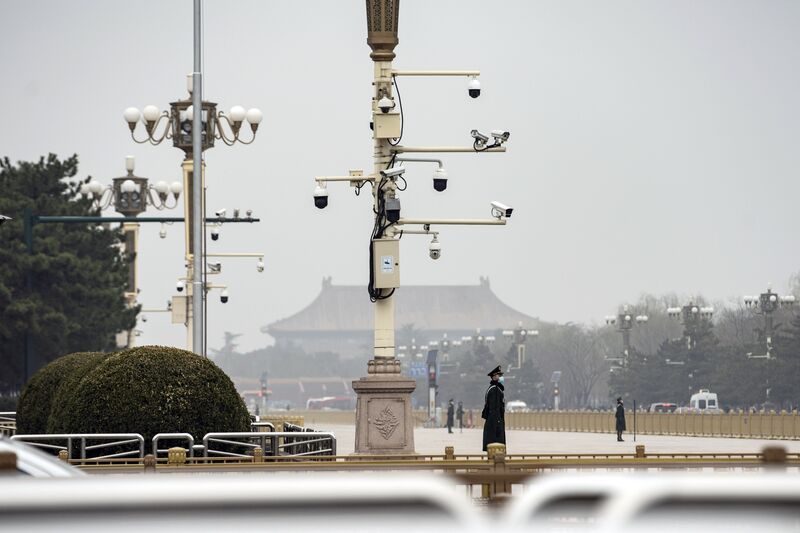
The eye in the sky. Photographer: Qilai Shen/Bloomberg
The opening scene of a brief online documentary by Chinese state-run media channel CGTN shows jaywalkers in Shenzhen getting captured on video, identified and then shamed publicly in real time. The report is supposed to highlight the country’s prowess in artificial intelligence, yet it reveals a lesser-known truth: China’s AI isn’t so much a tool of world domination as a narrowly deployed means of domestic control.
On paper, the U.S. and China appear neck and neck in artificial intelligence. China leads in the share of journal citations — helped by the fact that it also publishes more — while the U.S. is far ahead in the more qualitative metric of cited conference papers, according to a recent report compiled by Stanford University. So while the world’s most populous country is an AI superpower, investors and China watchers shouldn’t put too much stock in the notion that its position is unassailable or that the U.S. is weaker. By miscalculating the others’ abilities, both superpowers risk overestimating their adversary’s strengths and overcompensating in a way that could lead to a Cold War-style AI arms race.
Beijing is heading for world dominance because of its advances in AI, machine learning and cyber, said Nicolas Chaillan, who recently resigned as chief software officer of the U.S. Air Force after less than three years in the job, the Financial Times reported.
In fact, China’s expertise is somewhat limited in scope. Artificial intelligence encompasses many sub-fields, including machine learning, robotics, natural language processing and computer vision. The U.S. has a broad toolkit that’s deployed across each of these disciplines and used around the world. China, by contrast, excels mostly in computer vision, an area that helps Beijing build out its surveillance state.
In technical assessments conducted by the U.S.’s National Institute of Standards and Technology, Chinese algorithms consistently rate near the top across a series of tests that are akin to surveillance conditions — mugshots, visa photos and border-control images. Beijing-based SenseTime Group Ltd. is a standout. CloudWalk Technology Co., founded in 2010 by the Chinese Academy of Sciences, and a team from Beihang University also ranked high in recent examinations of more than 600 entries from around the world. 1
More than half the papers last year published by Chinese teams were in the disciplines most used in surveillance — computer vision and pattern recognition, according to data on research papers compiled by Microsoft Academic Graph and analyzed by Chinese media outlet Sixth Tone. Compared with the U.S., U.K, Germany and India, a smaller proportion of its papers are on machine learning, natural language processing and robotics.
Revenue for AI computer-vision companies in China, meanwhile, is largely linked to governments and their desire to monitor people. SenseTime, which is planning a Hong Kong public offering, got almost half its revenue in the first six months of the year from its “Smart City” business. Rival Megvii Technology Ltd., which swapped its earlier listing plans in the city for an upcoming Shanghai debut, relies even more heavily on local government contracts, with 64% of its business coming from a similar product suite it calls “City IoT Solutions.” These projects are largely based on setting up cameras and sensors around a city to track people and vehicles, then using AI software to keep tabs on their movement.
AI technology in the U.S. has many more applications. The country leads in machine learning, a branch of AI that leverages data and algorithms to learn and improve accuracy. Most of the world’s leading and widely adopted frameworks were developed in America by companies such as Alphabet Inc.’s Google, Microsoft Corp. and Facebook Inc., as well as the University of California, Berkeley. The best natural language processing engines, used to understand, process and analyze written text, also hail from U.S. tech giants — Microsoft, Google, Amazon.com Inc. and International Business Machines Corp.
bloomberg.com |



