Cold weather can cut electric vehicle range and make charging tough
Jan. 17, 2024 at 1:46 pm
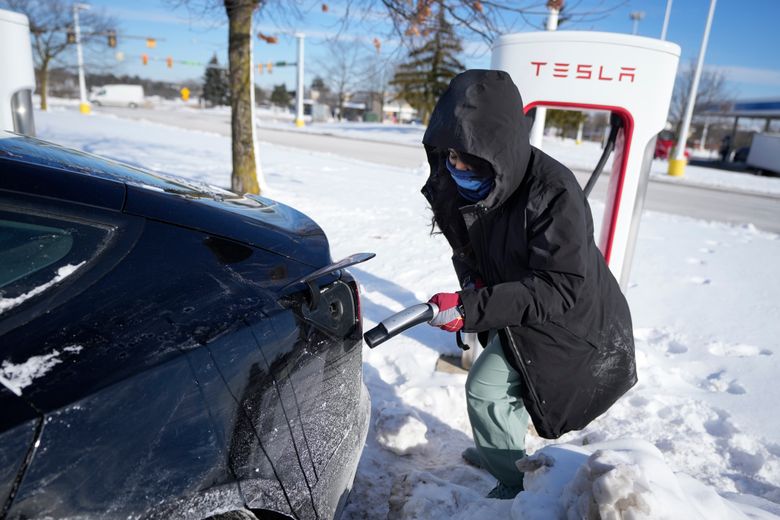
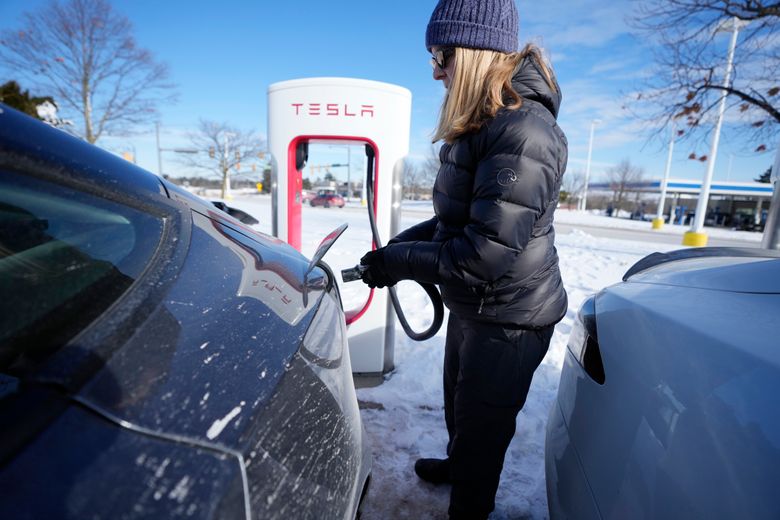
1 of 3 | Ankita Bansal prepares to charge her Tesla, Wednesday, in Ann Arbor, Mich. A subzero cold snap across the nation has exposed a big vulnerability for electric vehicle owners; it’s difficult to charge the batteries in... (Carlos Osorio / The Associated Press)
By
TOM KRISHER
The Associated Press
PITTSFIELD TOWNSHIP, Mich. — For nearly a week, frigid temperatures from Chicago to northern Texas have made life painful for electric vehicle owners, with reduced driving range and hours of waiting at charging stations.
In Oak Brook, Illinois, near Chicago, on Monday, television reporters found Teslas that were running out of juice while in long lines for plugs at a Supercharger station. The temperature hit a low of minus 9.
Outside of Ann Arbor, Michigan, Teslas were plugged in at six of eight charging stations Wednesday as the wind howled with a temperature of 7 degrees. At least one driver was nearly out of juice.
It’s well known that EVs lose some of their travel range in the cold, especially in subzero temperatures like those that hit the middle of the country this week. Studies found that range loss varies from 10 to 36%.
EVs also don’t charge as quickly in extreme cold. Some Tesla owners near Chicago told reporters their cars wouldn’t charge at all.
Experts acknowledge that cold weather can be hard for EVs, but they say with some planning and a little adjustment, owners should be able to travel pretty much as normal.
What’s the problem?
Inside EV batteries, lithium ions flow through a liquid electrolyte, producing electricity. But they travel more slowly through the electrolyte when it gets cold and don’t release as much energy. That cuts into the range and can deplete a battery faster.
The same happens in reverse. Since electrons move more slowly, the battery can’t accept as much electricity from a charging plug. That slows down charging.
The problem is that when temperatures plunge, batteries have to be warm enough for the electrons to move. And they have to be even warmer at fast-charging stations like Tesla’s.
“Pretty much anything that’s a chemical substance slows down when you get to a low temperature,” said Neil Dasgupta, associate professor of mechanical and materials science engineering at the University of Michigan. “That’s just something that nature has given us, and we have to deal with that.”
At a Supercharger station in Pittsfield Township, Michigan, just south of Ann Arbor, the battery in Ankita Bansal’s Tesla had only 7% of its charge left. She plugged in, but the car wouldn’t take electricity. Instead, the display said the battery was heating up. After it hits the proper temperature, it would take an hour and 50 minutes to get to a full charge, the display said.
“I have a long way to go,” said Bansal, a University of Michigan graduate student who wanted to get to a full charge because she doesn’t have a charging station at home.
How to make it work
Bruce Westlake, president of the East Michigan Electric Vehicle Association, said most EVs are programmed to warm the battery if the driver tells the vehicle’s navigation system that a trip to the charging station is coming.
Many of those who think their cars won’t charge are new to EVs and don’t know how to “precondition” their batteries, said Westlake, who has two Teslas.
“They’re just learning,” he said. “And Tesla isn’t very good at explaining some things.” A message was left seeking comment from Tesla.
In frigid temperatures, it can take a half hour to warm the battery so it’s ready to charge, Westlake said. Preconditioning the battery does cost some range, although it’s usually only a few miles, he said.
Bansal, who has had her Tesla for only a week, didn’t know about preconditioning the car before charging, but she does now.
A few stalls away from her, Kim Burney’s Tesla Model 3 was charging just a little slower than it does in warmer temperatures. She had driven farther than she had expected on a trip to her dentist in Ann Arbor Wednesday morning and wanted to get close to a full charge for the rest of the day’s travels.
So she told the car she was going to the charging station and it was ready by the time she arrived and plugged in.
Like Westlake, Burney said EV drivers need to plan ahead, especially in cold weather. The car, she said, will tell you where charging stations are and how much range you have left. “The more you drive it the more you’re comfortable knowing how far you can go and how much to charge it,” she said.
Burney said she loses roughly 15 to 20% of her battery range in cold weather, but it gets dramatically worse in cold snaps like the one this week.
The future of charging
In the short run, automakers are likely to come up with better ways to protect battery life and warm batteries for charging, Dasgupta said. And there are new battery chemistries in development that are more resilient in cold weather.
In the short term, Dasgupta said that as more mainstream consumers buy EVs, and as more automakers enter the market, they’ll develop models using existing lithium-ion chemistry that are tailored to colder climates. In some cases, range might have to be sacrificed a little to get better cold weather performance, he said.
Millions are being invested in new battery technology that performs better in the cold that will find its way from military, aerospace and undersea applications into electric vehicles, Dasgupta said.
“You can be an EV driver in a cold weather climate,” he said. “Be optimistic and excited about what the future holds because it’s only going to get better from here.”
TOM KRISHER
seattletimes.com
My comments:
Before I leave my garage I precondition the car if the outside air temp is 45F or below. Use the Tesla smart app on my cell phone. Takes only a few kilowatthrs of power and when I head out on the road there is only a small impact compared to warm weather except I'm burning more electrons to stay warm in the vehicle. But that's a very, very small impact compared to the propulsion energy driving down the road.
As I'm driving the waste heat from the inverter and motor is circulated through the battery pack, which has a lot of thermal mass and is kept warm. When I have driven over 150 plus miles and the planned Supercharger is about thirty miles away the battery pack automatically begins preconditioning. Arriving at the Supercharger and starting charging the car is accepting charge at the same rate as in really warm weather.
Read the vehicle manual folks. Just a couple paragraphs covers the subject.
In Tesla's it's stored in the MCU and is updated automatically every few months over the air.
It's just that simple.
Cold wx has a small impact on range if you really understand how to optimize it.
Eric |



