Opinion: 'Green' forest policy turned Jasper into a tinderbox
Author of the article:
W.J. Byrne
Published Jul 26, 2024 • Last updated 9 hours ago • 3 minute read
57 Comments
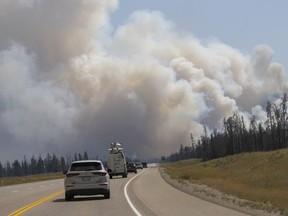
Fire burns along a mountain slope just east of the townsite of Jasper on Tuesday,July 23, 2024 . The town and surrounding area is currently being evacuated. PHOTO BY GREG SOUTHAM /Postmedia
The recent and ongoing disaster in Jasper National Park will undoubtedly generate a slew of commentary about the inevitable effects of climate change. While I readily agree that climate change is a huge factor in the spread of wildfires, in the current instance, it is not that simple.
I believe that a major part of the immediate problem in Jasper — which could have been considerably mitigated in all of the Rocky Mountain national parks — is the Parks Canada “green” policy of protecting the forest in all of the Rocky Mountain national parks as the primary objective of all of their current policies and operational activities.
- Jasper wildfire live updates: Photos from inside Jasper townsite emerge | Jasper mayor finds home razed by fire
- Opinion: 'Green' forest policy turned Jasper into a tinderbox
- Two charged after Edmonton police seize 12 stolen cars worth $780K
- Keith Gerein: Jasper in flames is Alberta's worst wildfire nightmare come to life
- 'We’re going to find you': Edmonton police arrest key suspects, seek alleged leader of arson extortion crime ring
When the Rocky Mountain national parks were first established over one hundred years ago, the historical landscapes all featured a highly varied mix of vegetation, with forest on the montane slopes, but grasslands and low bushes dominant in all of the valleys and immediate uplands.
This natural state was the result of prairie fires frequently intruding into the front ranges, suppressing the forest growth in large areas of the parks. When the parks were established, though, this natural state was soon artificially altered by a policy of “protecting” all growth by the vigorous suppression of fires. The result was the gradual replacement of the valley bottom prairies and immediately adjacent uplands with ever-denser stands of coniferous trees (sometimes referred to by firefighters as “fireworks on a stick”).
This new, humanly created landscape gradually became accepted as the “natural state,” when, in reality, it is nothing of the sort. This shortsighted policy was vigorously opposed by provincial officials who managed Alberta’s forests, out of fear that the parks were becoming tinder boxes which would not only destroy the federal parks but, once started and out of control, would spread into adjacent Alberta forests. These provincial forests, in contrast, were being actively managed by a wide variety of means, including controlled burns, logging, and allowing natural fires to run their course if lives or private property were not at risk.
Some 25 years ago, in my capacity then as deputy minister for Community Development, including responsibility for managing Alberta provincial parks, I was personally present at a meeting with senior Parks Canada and Alberta officials. At that meeting Fred McDougall, the Alberta deputy minister of Forestry, eloquently and passionately chastised the federal officials for their lack of foresight, stating unequivocally that their commitment to maximum preservation as the cornerstone of their forestry management policy was creating an explosive situation they would live to regret.
Several years ago, Waterton Lakes National Park experienced the first direct result of that failure to adapt. Now Jasper National Park is experiencing the same fate. Can Banff National Park dodge the bullet?
I seriously doubt that it will, as all three of these parks abut significant prairie regions, which for timeless millennia directly influenced the landscapes of the front ranges of the Rocky Mountains by channeling prairie fires into the valley bottoms and adjacent uplands.
That is all gone now and instead, we have the reality of the humanly introduced “natural state” of our artificially managed current landscapes in the Rocky Mountain national parks. Massive forests throughout, steadily accumulating deadfall and forest-floor litter, and no relief in sight.
I deeply regret that we have apparently learned little from historical realities.
Dr. W.J. Byrne is a former deputy minister of Alberta Community Development and of Alberta Advanced Education (retired).
Bookmark our website and support our journalism: Don’t miss the news you need to know — add EdmontonJournal.com and EdmontonSun.com to your bookmarks and sign up for our newsletters here.
You can also support our journalism by becoming a digital subscriber. Subscribers gain unlimited access to The Edmonton Journal, Edmonton Sun, National Post and 13 other Canadian news sites. Support us by subscribing today: The Edmonton Journal | The Edmonton Sun. |



