Low cost renewables still unbeatable after seven consecutive years: GenCost report
For the seventh year in a row, a CSIRO report has found renewables have the lowest cost range of any new-build electricity generation technology, with solar and wind coupled with firming technologies like batteries remaining the standouts.
December 9, 2024 Ev Foley
Image: pv magazine
Share
    
Australia’s national science agency, the CSIRO has released its draft 2024-25 GenCost report, finding for the seventh year in a row renewables have the lowest cost range of any new-build electricity generation technology.
Though the impact of inflation on each technology’s unique raw material inputs and supply chains remains mixed, the report found large scale solar capital costs fell 8% two years in a row, and batteries recorded the largest annual reduction with capital costs falling 20%.
On the flip side, gas turbine costings increased 11%, reflecting the additional cost of being hydrogen ready and modelling nuclear’s long operational life factors across all new-build electricity generation technologies was found to present no unique cost advantage over other technologies.
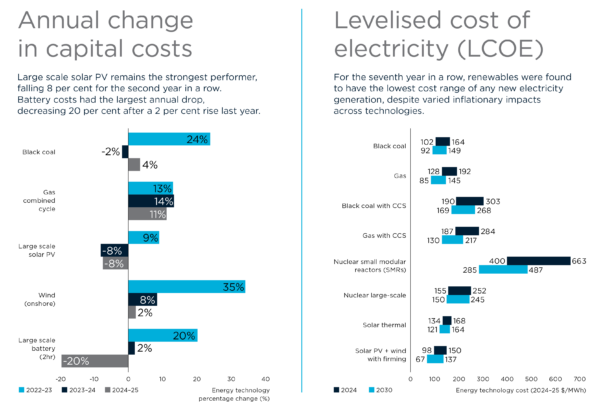
Large-scale solar costs have fallen 8% in each of the past two years, and batteries by 20%. Image: CSIRO
CSIRO’s Director of Energy Dr Dietmar Tourbier said GenCost provides objective cost benchmarks using the best available and verifiable data.
“GenCost’s annual update delivers data-based forecasts that support informed decision-making across the energy sector,” Tourbier said.
“Collaboration and transparency are central to this process, and the feedback we receive plays a vital role in ensuring our data and projections are relevant and impactful.”
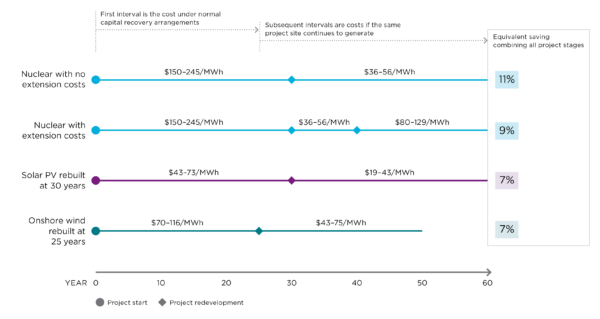
Costs for long-lived multi-stage projects and associated cost reduction. Image: CSIRO
Feedback during the nine-week public consultation period ends on 11 February 2025 with the final GenCost 2024-25 report released in the second quarter of 2025.
GenCost presents capital, levelised and firming cost estimates of building new electricity generation and storage projects and hydrogen technologies up to the year 2050, which includes fossil fuels coal and gas, solar, wind, nuclear, bioenergy, hydrogen electrolysers and storage such as pumped hydro and batteries.
pv-magazine-australia.com |



