Judge blocks Trump’s homelessness, transit conditions on King County
June 5, 2025 at 11:03 am

The Seattle Times’ Project Homeless is supported by Campion Foundation, Raikes Foundation and Seattle Foundation. The Seattle Times maintains editorial control over Project Homeless content.
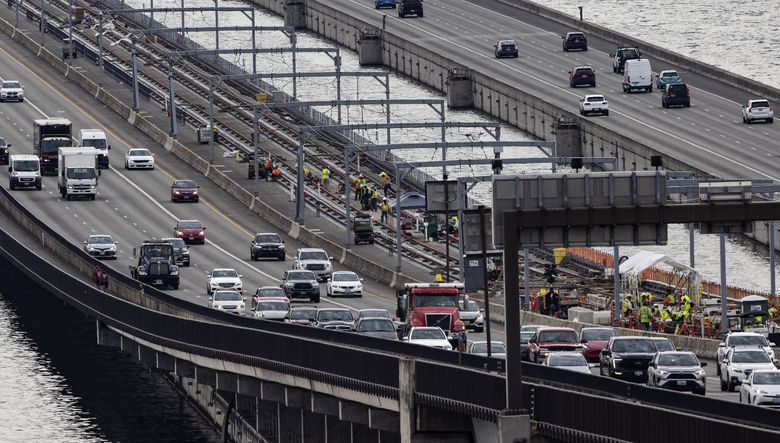
Sound Transit construction would likely be in peril if the federal government were allowed to pause or pull back grant funding over new rules. (Ken Lambert / The Seattle Times)
By
Greg Kim
Seattle Times staff reporter
The Seattle Times’ Project Homeless is supported by Campion Foundation, Raikes Foundation and Seattle Foundation. The Seattle Times maintains editorial control over Project Homeless content.
King County notched a win in its lawsuit against the Trump administration Tuesday after a federal judge temporarily blocked the federal government from imposing new conditions on homelessness and transit funding.
Earlier this year, the U.S. Department of Housing and Urban Development and the Department of Transportation added requirements to grants that had already been awarded to local governments. They prohibited any programs from promoting diversity, equity and inclusion; transgender acceptance; elective abortions; or illegal immigration.
The federal agencies threatened to rescind grants or block access to awarded funds if local governments didn’t comply with the new rules.
Last month, King County and dozens of other municipal agencies around the country filed a lawsuit against those agencies, arguing that the executive branch lacks authority to change federal grant conditions without approval from Congress, which created the programs and holds the power to determine spending. The Regional Homelessness Authority, the Port of Seattle, Pierce County and Snohomish County also joined the lawsuit as plaintiffs.
The plaintiffs said the new conditions were imposed “to coerce grant recipients that rely on federal funds into implementing President Trump’s policy agenda.”
The lawsuit has not been decided, but in issuing a preliminary injunction, the court signaled the plaintiffs were likely to win. The court also said the local governments suing the federal agencies showed that a loss of these funds would be “devastating and irreparable.”
“We are pleased that Judge Rothstein ruled strongly in favor of our coalition’s request for a preliminary injunction,” said Amy Enbysk, a spokesperson for King County Executive Shannon Braddock. “King County remains committed to protecting our residents when the federal administration sidesteps Congress and imposes unlawful conditions on funding that supports essential services across the country.”
King County — where a record 16,868 people experienced homelessness in 2024 — receives $66 million in federal homelessness grants, most of which goes toward permanent housing with supportive services for formerly homeless people. King County Metro Transit — which is typically the nation’s seventh-largest public bus agency and currently serves nearly 300,000 daily passengers — has $446 million in current federal grants, the lawsuit said.
Braddock said last month when the lawsuit was filed that she had a duty to enforce the law and protect housing support and transit operations for residents.
According to King County, if it agreed to the administration’s new conditions, any violation could make the county liable to the federal government for three times the amount of the grant — “further endangering critical services for county residents.”
The Regional Homelessness Authority said in April that a new requirement to check that all clients served by homelessness programs are U.S. citizens would have a chilling effect on people seeking services. The agency said it signed contracts with local homelessness nonprofits that did not contain the new conditions the federal government tried to impose.
King County Metro deploys millions in federal money for basic services. The Federal Transit Administration typically covers 80% or more of the price of new buses, a huge outlay that for Metro amounts to $61.3 million for new buses budgeted in 2025-26 alone. A legion of less-visible capital needs, from water taxi maintenance to bus-washing equipment, new trolley bus power poles and right of way improvements to Beacon Hill’s Route 36, all are scheduled to use federal money.
In the light rail network, nearly $4 billion in federal grants have been distributed since 2017, such as a $1.2 billion grant for the 2024 Northgate-Lynnwood line and $780 million for the 2026 Federal Way extension, along with $4.2 billion in low-interest loans.
Sound Transit assumes $15 billion in future federal grants through 2046, not just to maintain its equipment but to cover part of West Seattle, Ballard, Everett, Tacoma or other future corridors.
Greg Kim: 206-464-2532 or grkim@seattletimes.com. Greg Kim is a reporter covering homelessness for The Seattle Times.
seattletimes.com |



