| | Trump administration fires Seattle immigration judge despite huge case backlog
Oct. 20, 2025 at 6:00 am Updated Oct. 20, 2025 at 6:01 am
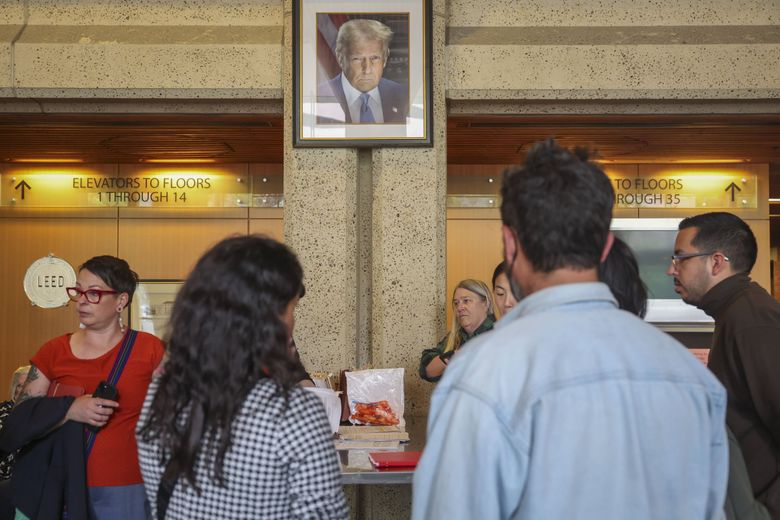
An official portrait of President Donald Trump overlooks volunteers with Northwest Immigrant Rights Project assisting people reporting to immigration court in a lobby of the Henry M. Jackson Federal Building in Seattle last summer. (Ivy Ceballo / The Seattle Times)

By
Nina Shapiro
Seattle Times staff reporter
The Trump administration has fired an immigration judge in Seattle, one of dozens ushered out this year despite a huge backlog that has some cases waiting for years to be resolved.
Seattle’s Susana Reyes, just shy of finishing her two-year probationary period as an immigration judge, received a termination notice Sept. 19 amid the latest of several waves of firings across the country, according to the International Federation of Professional & Technical Engineers, the umbrella union for a national immigration judges association.
The administration has fired more than 83 immigration judges sincePresident DonaldTrump took office, 24 of them in September, according to their union. Roughly 60 more have been forced out or left of their own accord. That leaves fewer than 600 immigration judges nationally to hear roughly 3.8 million pending cases.
Union President Matt Biggs said those quitting are fed up with pressure from the administration, as it carries out a mass deportation effort, to dismiss cases — allowing Immigration and Customs Enforcement to bypass judges and detain immigrants — or issue rulings unfavorable to immigrants.
The U.S. Department of Justice oversees immigration judges, who are not part of the independent judicial branch. An August Justice Department memo said “notwithstanding an oft-repeated myth to the contrary,” immigration judges can independently decide cases. Yet, the memo warned of “corrective action or discipline” if they do so at odds with the law or its interpretation by their boss: the U.S. attorney general.
The memo went on to say judges’ standards slipped under the Biden administration and the current one is “now forced to take numerous remedial actions.”
As Biggs sees it, the administration’s firing of judges runs counter to its aim of deporting as many people as quickly as possible. To do that, more judges are needed to work through the backlog. The so-called “One Big Beautiful Bill” passed by Congress in July calls for funding up to 800. In addition, the administration is currently training military lawyers to serve as temporary immigration judges.
So getting rid of judges already serving strikes Biggs as “bizarre.” Termination notices, often effective immediately, have given no reasons.
“It does appear on its face that they are targeting judges that were hired during the Biden administration,” Biggs said.
The Department of Justice did not immediately respond to questions.
In the eyes of the Trump administration, Seattle’s Reyes may have had a couple of strikes against her. She was hired during the Biden administration. And, while many immigration judges previously served as ICE attorneys, she had worked as an immigration lawyer in Texas.
Her rulings were not, however, especially favorable to immigrants who appeared before her. She denied 71% of asylum applications in roughly her first year, according to data compiled by the Transactional Records Access Clearinghouse. That’s about average for Seattle’s immigration court, somewhat higher than the Tacoma immigration court’s denial rate of 66% and significantly above the national average of 57.7%.
Asylum decisions by WA immigration judges
Most Washington immigration judges denied asylum at a higher rate than such judges nationwide between October 2018 and September 2024. The national denial rate was 57.7%. One Tacoma judge had the same rate, (comma) while the rates of others in Seattle and Tacoma ranged from 62.7% to 80%. Susana Reyes, fired last month, was in the middle of the pack. Charles Neil Floyd was recently named U.S. attorney for Western Washington.
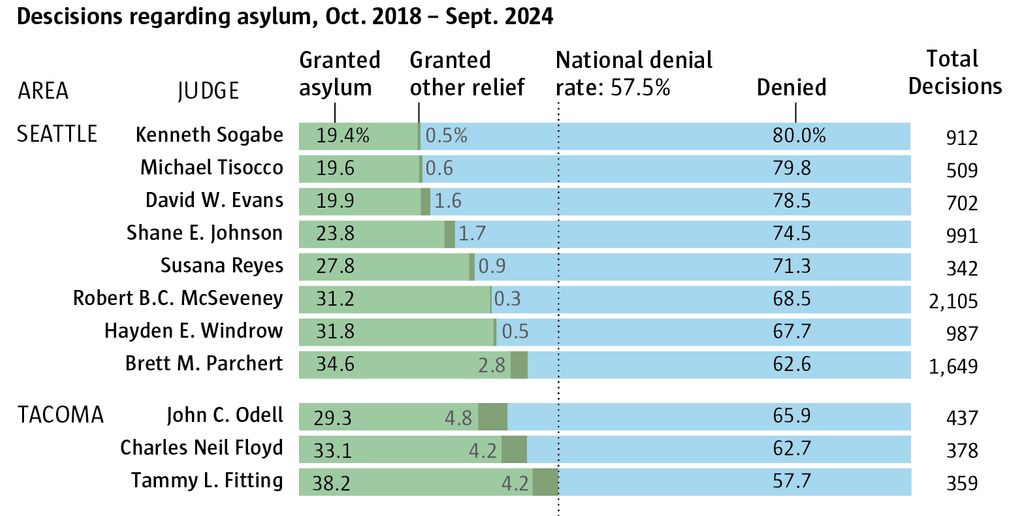
Source: Transactional Records Access Clearinghouse (Reporting by Nina Shapiro, chart by Chris Kaeser / The Seattle Times)
“She wasn’t granting a whole lot of cases,” said Seattle immigration lawyer Adam Boyd. He said appearing before her was a pleasant experience. “She treated us with respect. She seemed pretty fair.”
“She was actually listening to my clients,” added Mill Creek immigration attorney Shara Svendsen, who said some immigration judges have been known to yell at immigrants and their attorneys.
Reached by phone, Reyes declined to comment.
Now that she’s off the bench, lawyers are wondering what will happen to cases that were on the judge’s docket. “It doesn’t seem like there’s any plan,” Boyd said. “We’re left guessing.”
Seattle immigration lawyer Brian Wolf said he has not been informed what will happen to a case Reyes was in the middle of deciding. He had a hearing last month before Reyes and she reserved judgment. Wolf doesn’t know whether a new hearing will be held or another judge will issue a decision by reviewing the records.
Related Seattle’s immigration court, which has more than 50,000 pending cases, according to TRAC, has seven remaining judges.
Meanwhile, uncertainty hangs over Portland’s immigration court. Immigration lawyers have found scheduled hearings before two of the court’s three judges have recently been canceled, according to Jordan Cunnings, legal director for Innovation Law Lab, a nonprofit immigrant rights group. And a member of an immigration lawyers association who liaisons with the court informed colleagues that it will have one judge for the foreseeable future, Cunnings said.
The umbrella union representing judges said no firings have hit the Portland court, and three judges were still listed on its website as of this weekend. It’s possible the judges were reassigned elsewhere, are hearing cases in different cities remotely or have quit or retired.
The Portland court handles not only all of Oregon’s cases but also all of Idaho’s and Alaska’s.
While judges working remotely from other cities could conceivably stand in, Cunnings wondered what will happen if only one judge is left to handle a backlog of nearly 42,000 cases. She said some immigrants have been waiting as long as seven years for a hearing.
Most Read Local Stories“For a case to be set out again is just really devastating for a lot of people,” she said.
Compounding the pain, she said, the July budget bill implemented a new $100 fee for each year that an asylum application is pending. A family of four that waits seven years would have to pay $2,800.
Military lawyers could help tackle the backlog in the Northwest’s immigration courts. Some immigrant advocates don’t see that as a solution, fearing members of the armed services would be more swayed by administration pressure and less schooled in immigration law, an enormously complicated specialty.
Portland immigration lawyer Rachel Game doesn’t see it that way exactly. “I think if they have enough training and they come in with an idea of being neutral arbitrators of the facts … it’s OK,” she said.
The question for her is whether they can do so under the current administration.
Correction: An earlier version of this story misstated that the funding bill passed in July calls for up to 800 new immigration judges. It calls for funding up to 800 total.
Nina Shapiro: 206-464-3303 or nshapiro@seattletimes.com. Nina Shapiro is a reporter at The Seattle Times who covers immigration and other social issues, examining how policies affect people's lives.
seattletimes.com |
|



