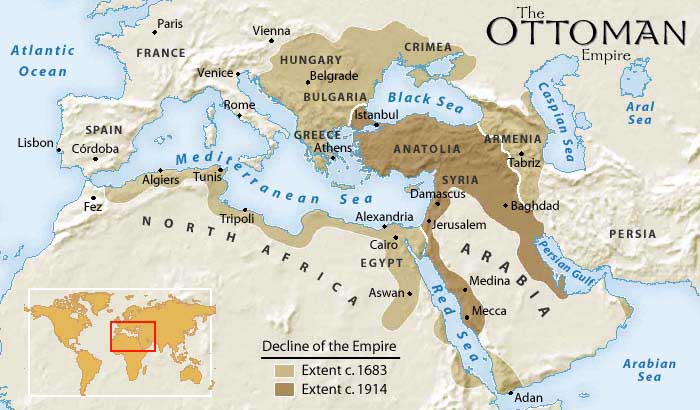
The migration of refugees to Europe is part of a long historical trend. The last invasion ended with the Battle of Vienna, which took place in Vienna on September 11, 1683, and concluded on the following day. The battle caused the first financial panic on that list of panics I stumbled upon which led to the discovery of the Economic Confidence Model
This current migration, which some are calling an invasion, appears to be on time no matter what we call it. Whether it is a real invasion or fleeing from another Islamic civil war the results, to a large extent, are the same. The attempts of the Muslim world to invade Europe go back to the Battle of Tours in October 732 AD (also known as the Battle of Poitiers) led by Charles Martel (688-741 AD), the grandfather of Charlemagne. During the Battle of Tours, Martel stopped an invasion led by the Umayyad Caliphate, the second of four major Islamic caliphates established after the death of Muhammad. This particular caliphate was centered on the Umayyad dynasty rising directly from Mecca
For those unfamiliar with the history of Islam, there were rivalries between the Arab tribes that caused civil unrest in the provinces outside Syria. The Second Muslim Civil War (680–692 AD) occurred when the leadership of the Umayyad clan shifted from the Sufyanid branch of the family to the Marwanid branch. The failed invasion of Europe in 732 AD during the Battle of Tours led to a decline in confidence of the leadership. The Berber Revolt of 740–743 AD closely followed this period. As a direct result of all this warfare, the resources of government were exhausted. The Umayyads were further weakened by the Third Muslim Civil War (744–747 AD) and were finally defeated by the Abbasid Revolution in (750 BC–132 AD). One branch of the family fled across North Africa to Al-Andalus and established the Caliphate of Córdoba, which lasted until 1031 AD in Spain.
So has Europe imported a civil war? Clearly, the Western powers do not understand history or the fact that the attempt to topple the Syrian government will lead to total chaos. This is by no means in the best interest of national security for Europe or the United States. This is a braindead war game with very serious consequences for it is not over territory; it involves religion with no borders.
Sorry – It’s Just Time.
armstrongeconomics.com
|



