U.S. crude exports in April rise to highest level in 15 years
U.S. Energy Information Administration
June 16, 2014
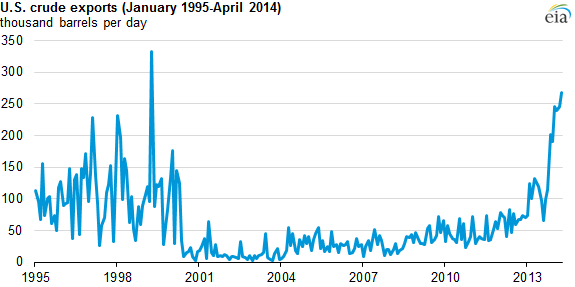
Source: U.S. Energy Information Administration, Petroleum Supply Monthly
The United States exported 268,000 barrels per day (b/d) of crude oil in April (the latest data available from the U.S. Census Bureau), the highest level of exports in 15 years. Exports have increased sharply since the start of 2013 and have exceeded 200,000 b/d in five of the past six months. The increase in crude exports is largely the result of rising U.S. crude production, which was 8.2 million b/d in March.
To export crude oil from the United States, a company must obtain a license from the Bureau of Industry and Security (BIS) of the U.S. Department of Commerce. Under export licensing requirements, the following kinds of transactions will generally be approved:
- Exports from Alaska's Cook Inlet
- Exports to Canada for consumption or use therein
- Exports in connection with the refining or exchange of strategic petroleum reserve oil
- Exports that are consistent with international energy supply agreements
- Exports of foreign-origin crude
- Exports of California heavy crude up to an average of 25,000 b/d
- Temporary exports or exchanges
Licenses for other exports of U.S.-origin crude are considered on a case-by-case basis. For such other exports, the regulations describe the characteristics of transactions that will generally be approved as in the national interest.
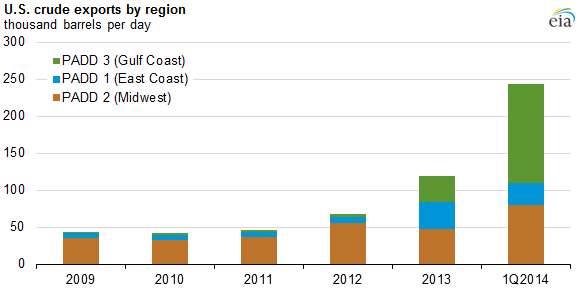
Source: U.S. Energy Information Administration, Petroleum Supply Monthly
Note: 2014 regional data are through March. PADD denotes Petroleum Administration for Defense District.
Almost all of the crude oil exported from the United States has been delivered to Canada, and most of the recent increase in crude oil exports has been from the U.S. Gulf Coast (PADD 3). Gulf Coast crude exports averaged 134,000 b/d in the first quarter of 2014, a 283% increase over 2013's record high of 35,000 b/d. In the first quarter of 2014, nearly 75% of Gulf Coast exports have left the region from the Houston-Galveston district, in Texas. The remaining barrels were loaded in Port Arthur, Texas and New Orleans, Louisiana.
Exports from the East Coast (PADD 1) averaged 30,000 b/d in the first quarter of 2014, down slightly from 2013 levels, but up from 9,000 b/d in 2012. First-quarter exports from PADD 1 were evenly distributed between the Port of New York and Portland, Maine, which is the starting point of a pipeline that delivers crude to refineries in the Montreal area. Exports of crude from the Midwest (PADD 2) have long been a source of crude for refineries in Sarnia, Ontario.
Principal contributor: Hannah Breul
eia.gov |



