Re <<China's Semiconductor Industry 'Decapitated Overnight': What 'Annihilation Looks Like'>>
China China China is losing as is Russia Russia Russia is similarly losing, each in own way, looking like. I remain agnostic and in learning mode.
Nato must either send boots to the battle arena or directly negotiate w/ Russia irrespective of what Kiev authorities say they want to do, as that bunch appears suspect, albeit I remain agnostic.
I base suspicion on below thedreizinreport.com cited by C2

zerohedge.com
Cracks Appear In US Deep State As Insiders Warn Negotiations With Russia The Only Way Out: "Everyone Loses"
Back in February of this year, Polish Defense Minister Gen. Rajmund Andrzejczak shocked his American show hosts when during a rare MSNBC Morning Joe appearance he provided a dose of cold hard reality as to what Ukraine and its Western backers are up against when it comes to facing Russia's military on the battlefield. At that time he urgently warned the West not to underestimate Moscow and the Russians' fighting ability. Nobody wanted to hear it, and few listened to him, despite being head of a powerful NATO member country's military, just in Russia's backyard.
It must be remembered that this was significantly before the start of the Ukrainian counteroffensive, which kicked off later by the beginning of June, and thus was a time of much greater optimism in Western mainstream press and among D.C. officials. There was even a prevailing narrative at the time that Russia was "losing". The clip is worth revisiting now that headlines have belatedly reversed course and US officials have expressed deep frustration amid the failing Ukraine offensive. Watch:
Now in September, after a summer of largely stalemated frontlines, and with Russia having firm hold over the majority of the four territories in eastern and southern Ukraine (Donetsk, Luhansk, Kherson and Zaporizhia), and with Ukraine having suffered staggering losses amid superior Russian firepower and manpower, where do things stand?
Currently, there are rumblings that deep state decision-makers in Western governments are seriously considering ways to jump-start potential peace negotiation talks.
Of course, this would require Ukraine to make territorial concessions and give up Zelensky's dream of 'liberating' the east and Crimea. So far Kiev shows no willingness - at least publicly - but likely brutally difficult discussions are quietly taking place in Brussels and the halls of the State Department behind the scenes.
There was a recent bombshell report in The New Yorker detailing how one of RAND Corporation's top Russia experts has declared that the proverbial writing is on the wall, and that negotiated peace is the only way out for Kiev, and if the West wants to avoid miring itself further into escalating catastrophe. His message is dire and urgent.
Samuel Charap, right, via Flickr  That recent New Yorker piece begins: That recent New Yorker piece begins:
If you want to hear a different perspective on the war in Ukraine, talk to Samuel Charap. A fine-featured Russia analyst with, at forty-three, a head of gray hair, Charap works at the rand Corporation, a think tank that has been doing research for the U.S. military, among other clients, since the nineteen-forties. In the self-abnegating architectural spirit of many Washington institutions, it rents several floors of an office tower attached to a mall in Arlington, Virginia, not far from the Pentagon. The mall has a Macy’s and a Bath and Body Works, which are not places that Charap likes to go. ...Nonetheless, for Charap, there was more that the U.S. might have tried to prevent the fighting. In recent months, as the fighting has gone on and on, he has become the most active voice in the U.S. foreign-policy community calling for some form of negotiation to end or freeze the conflict. In response, he has been called a Kremlin mouthpiece, a Russian “shill,” and a traitor. Critics say he has not changed his opinions in fifteen years despite changing circumstances. But he has continued writing and arguing. “This is a five-alarm fire,” he said. “Am I supposed to walk past the house? Because, as bad as it’s been, it could get much, much worse.”
Samuel Charap is author of a prescient book published in 2016 appropriately entitled, "Everyone Loses"...
In the wake of Russia’s annexation of Crimea and incursion into eastern Ukraine, in 2014, Charap wrote a book, with the Harvard political scientist Timothy Colton, called “Everyone Loses,” about the background to the war. In it, Charap and Colton argue that the U.S., Europe, and Russia had combined to produce a “negative sum” outcome in Ukraine. Russia was the aggressor, to be sure, but by asking that Ukraine choose either Russia or the West, the U.S. and Europe had helped stoke the flames of conflict. In the end, everyone lost.
And more from the New Yorker piece on the Rand wunderkind:
In the following years, as Russia became more and more of a neuralgic subject in American politics, Charap continued to travel to Russia, engage with Russian counterparts, and look for ways to lower the temperature of the relationship. Going to Valdai—the annual conference where Vladimir Putin pretends to be a wise tsar interested in discoursing with professors on international politics—had become somewhat controversial. But, before the war began, Charap went to the conference whenever he could, and several times even asked Putin a question. “It’s my job to understand these people, and I was given firsthand access to them,” he said. “How can you understand a country if you don’t go and talk to the people involved in the decision-making?”
This week, another important establishment US defense analyst and policy "insider" has sounded the alarm alongside Charap, warning similarly "Kyiv will likely lose this war, no matter how much support we [the US] give."
Charap's initial warnings were published all the way back in 2016:
[url=]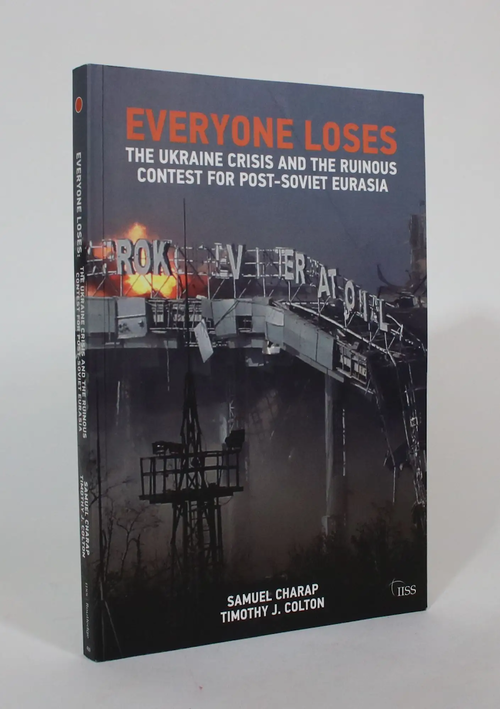 [/url] [/url]
Daniel L. Davis, a Senior Fellow for Defense Priorities and a former Lt. Col. in the US Army, wrote a summary of his main points which were featured in a longer article in 19fortyfive.com which was published Monday and entitled How Ukraine’s Heroic Stand Against Russia Could Collapse Into Failure. He is attempting to inject realism and restraint at a moment the public policy debate is still being driven by the D.C. hawks - and at the expense of Ukrainian lives.
Below is a compilation of his thoughts of where things stand in Ukraine, written on X, formerly Twitter [emphasis ZH]...
* * *
"Regardless of what anyone desires or prefers, centuries of war experience and an acknowledgement of the true balance of power between Ukraine & Russia indicates Kyiv will likely lose this war, no matter how much support we give.
Historically speaking, an analysis of centuries of warfare indicates the side with the most troops available, most artillery, and in past 100 years the side with most tanks will win. Russia possess an advantage in all those categories."
[url=] [/url] [/url]
"It is near impossible to form a new army, on the fly, under fire, while suffering egregious casualties and still advance to defeat a foe with superiority in the air, air defense, armor, and ammunition.
To continue ignoring these facts and blindly support Ukraine "for as long as it takes" is most likely to condemn the people of Ukraine to a futile death that likely won't change the outcome.
If we genuinely care about Ukraine and its people, the sanest course of action would be to elevate diplomacy to try and get the best deal we can, with the greatest benefit for Kyiv, preventing the loss of any more people or cities.
"Refusing to take such an admittedly very difficult decision will likely not prevent an eventual Russian victory; it'll just cost more for Ukraine to reach a negotiated end to the conflict."
"I grieve for the people of Ukraine, for the war widows, for the fatherless kids created on a daily basis; for the senseless destruction of entire Ukrainian cities. I would fight like the devil myself if my country were invaded - but if continued resistance led to complete defeat...then wisdom demands a different path.
For Ukraine to have a shot at a prosperous future, it must survive its current fiery trial. I pray for wisdom and the ability of leaders in Kyiv, Washington, and Brussels to make the hard choices necessary to keep Ukraine alive."
* * *
[ZH]: Again, all of the above strongly suggests US deep state policy makers and those within the think tank foreign policy establishment are beginning to change their tune as reality sets in after a summer of bad news for Ukraine and Washington. The sooner Kiev gets to the negotiating table with Moscow, the more lives can be saved. Territory will have to be sacrificed. "Reputations" among NATO officials will have to take a far backseat.
But will those deep state elements who are who've shown themselves willing to "fight to the last Ukrainian" (no doubt the same who are still raking in the defense contractor largesse connected to the war) in the end prevail? Will the Biden administration keep this utterly disastrous and futile nightmare just on NATO's 'eastern flank' going for years to come? Will American taxpayers be forced by Biden to write checks for billions more, as the cost in blood and treasure ratchets higher and higher?
Below is a compilation of statements by top officials given before and on the eve of the Ukraine counteroffensive, revealing the blind hawkish optimism on display that drove Washington's decision-making:
Defense Secretary Lloyd Austin: “I think Ukraine will have a very good chance of success.” [ 03/28/23]
National security adviser Jake Sullivan: “We believe that the Ukrainians will meet with success in this counteroffensive.” [ 06/04/23]
NATO Secretary General Jens Stoltenberg: “I’m confident that when Ukraine decides to launch new operations to liberate more land, Ukraine will be successful.” [ 4/21/23]
Former CIA Director, Gen. David Petraeus (ret.): "I personally think that this is going to be really quite successful. .. And [the Russians] are going to have to withdraw under pressure of this Ukrainian offensive, the most difficult possible tactical maneuver, and I don't think they're going to do well at that." [ 05/23/23] “I think that this counteroffensive is going to be very impressive.” [ 06/03/23]
Retired U.S. Army Gen. Ben Hodges: “I actually expect, however, that [the Ukrainians] will be quite successful.” [ 05/12/23]
Historian Edward Luttwak: “If Kyiv and the West are looking for the most plausible path to victory, this is it.” [ 05/11/23]
Atlantic Council non-resident fellow Richard Hooker: “As we are often told, no plan survives contact with the enemy. There will likely be the occasional tactical miscue or operational hiccup during the coming counteroffensive, but a careful assessment suggests the odds are heavily in favor of Ukraine.” [ 05/23/23]
Former Chief of the British General Staff, General Richard Dannatt: “[A]fter Kyiv's successful counteroffensive, Vladimir Putin ‘may be swept out of the Kremlin.’” [ 03/28/23]
Paul Massaro, senior policy adviser, the Commission on Security and Cooperation in Europe: “Full Ukrainian victory is coming. Sooner than you think.” [ 06/12/23] |



