The High Price of Denial
by Douglas Murray
March 15, 2018 at 5:00 am
gatestoneinstitute.org
- They are now admitting what is visible to the eyes of ordinary Europeans may be an admission that things have got so bad -- and are so well known -- that even Chancellor Merkel and the New York Times are no longer able to ignore them.
- If so, one thought must surely follow: imagine what might have been solved if the denials had never even begun?
Is it possible that mainstream politicians and the mainstream media are finally recognising what the European public can see with their own eyes? Two recent occurrences suggest that this might be so.
The first is a concession by German Chancellor Angela Merkel, who almost half a year after her party's embarrassment in national elections has finally managed to put together a coalition government. Last September saw not only Merkel's party and her erstwhile coalition partners suffer a historic dent in their vote-share, but also saw the entry to Parliament of the five-year old anti-immigration AfD (Alternative for Germany) party, which is now so large that it constitutes the country's official opposition. If German voters meant to send a message, it could hardly have been clearer.
Perhaps it was even listened to. On Monday February 26, Merkel gave an interviewto the German broadcaster N-TV. In it she finally admitted that there are "no-go areas" in her country: "that is, areas where nobody dares to go." She continued: "There are such areas and one has to call them by their name and do something about them." The Chancellor claimed that she favoured a "zero tolerance" attitude towards such places but did not identify where they were. Two days later, her spokesman, Steffen Seibert stressed that "the Chancellor's words speak for themselves."
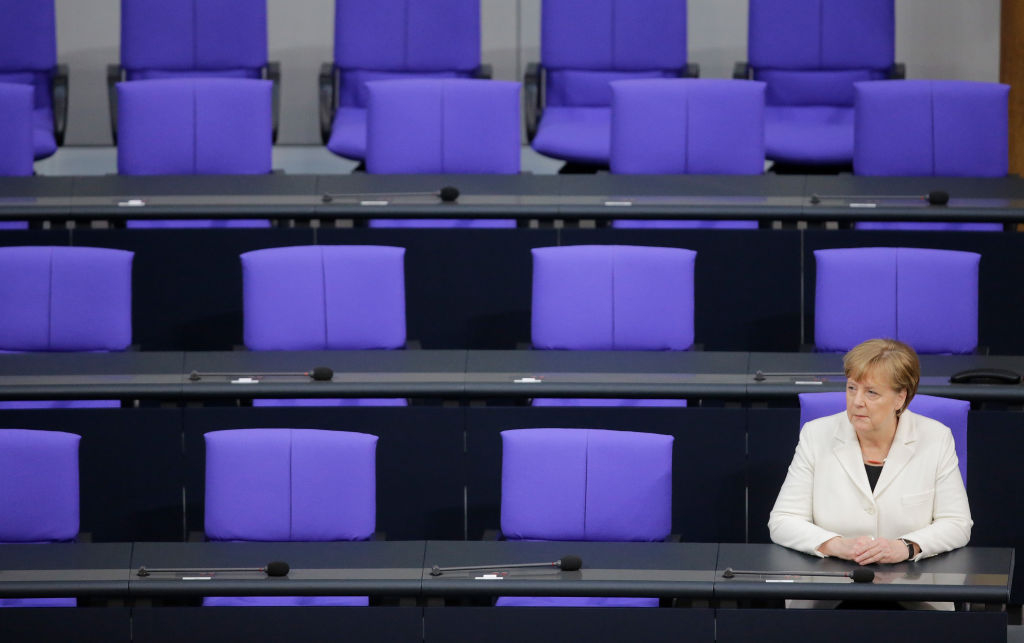 Germany's Chancellor, Angela Merkel. (Photo by Carsten Koall/Getty Images) Germany's Chancellor, Angela Merkel. (Photo by Carsten Koall/Getty Images)
|
Although the Chancellor chose to use few words, that she said these things at all is significant. For years, German officials, like their political counterparts across the continent, have furiously denied that there are any areas of their countries to which the rule of law does not extend. Denials have also issued forth from officials in, among other countries, Sweden and France. In January 2015, Paris's Mayor Anne Hidalgo threatened to sue Fox News after the station said there were no-go zones in her city. Hidalgo claimed at the time in an interview on CNN that "the honour of Paris" and the "image of Paris" had been harmed. It was a typically extraordinary claim, which ignored that if the "image of Paris" had taken any battering around that time, it might have been due to the massacre of 12 journalists, cartoonists and policemen at the offices of the satirical magazine Charlie Hebdo, and the slaughter of four people in a kosher supermarket two days later. So concessions like Merkel's -- as opposed to cover-ups like Hidalgo's -- are to be applauded, slightly, when they occur.
Just a week later, another strange milestone was reached. The front page of the New York Times on March 6 carried a story -- also graced with the page's only pictures -- which nobody could have expected the paper to run. Under the heading "Old weapons rattle Sweden," the paper recorded the recent death of a 63-year old man in the Stockholm suburb of Varby Gard. As the paper records, Daniel Cuevas Zuniga had only recently finished a night-shift as an aide for disabled adults, and was cycling home with his wife, when, spotting a spherical object on the floor he stopped and reached out. It was an M-75 hand grenade; its explosive charge and 3000 steel metal balls instantly killed Mr Zuniga and blew his wife off her bicycle.
cont... |



