Unfortunately the aversion isn't strong enough, or there are other political forces that can overcome it.
It has the highest poverty
Different standards for poverty.
Measuring relative poverty. In absolute purchasing power parity terms the bottom ten percent or twenty percent in the US compare well to the bottom 10% in Europe.
Also groups in the US do as well or better than their Europen counterparts.
For example -
"A Scandinavian economist once stated to Milton Friedman: "In Scandinavia we have no poverty." Milton Friedman replied, "That's interesting, because in America among Scandinavians, we have no poverty either." Indeed, the poverty rate for Americans with Swedish ancestry is only 6.7%, half the U.S average. Economists Geranda Notten and Chris de Neubourg have calculated the poverty rate in Sweden using the American poverty threshold, finding it to be an identical 6.7%.
In 1950, before the high-tax welfare state, Swedes lived 2.6 years longer than Americans. Today the difference is 2.7 years."
While I agree with the thrust of Brook's article, he neglects one figure.
"These cultural phenomena do not disappear when Swedes cross the Atlantic to the supposedly inferior “cowboy” country. On the contrary, they appear to bloom fully. The 4.4 million Americans with Swedish origins are considerably richer than the average American. If Americans with Swedish ancestry would form their own country their per capita GDP would be $56,900, more than $10,000 above the earnings of the average American.
The old Sweden, in contrast, has not done as well in economic terms. In 1960 taxation stood at 30 percent of GDP, roughly where the US is today. As taxes rose, economic growth decreased, with Sweden dropping from being the 4th richest country in 1970 to being the 12th richest in 2008. Swedish GDP per capita is now $36,600, far below the $45,500 of the US, and even further behind the $56,900 of Swedes in America."
Swedes are a very competent people. Under the American free-market system, they earn about 50% more than they do in Swede. Despite the fact that the Swedish system is geared towards reducing poverty and income inequality, they manage only the same poverty rate, and much lower average income.
newgeography.com
super-economy.blogspot.com
The graph is income per capita in Sweden and the U.S (for Americans with Swedish ancestry) for 10 income groups, based on official Swedish statistics and census data. I define you as American with Swedish ancestry if the main ancestry group is Swedish. Americans with Swedish ancestry have a 55.8% advantage in income compared to people in Sweden; very close to the figures I estimated using similar underlying numbers and a somewhat different methodology (is a good sign).
The results of the comparison is striking.
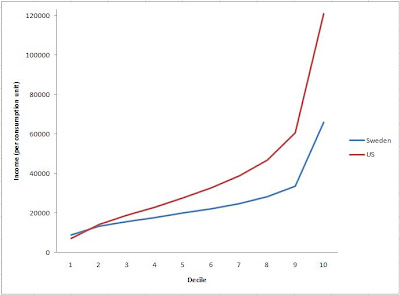
Swedes under the American small-government system beat Swedes in the Swedish welfare system for almost 90% of the income distribution. Among the first 10th percentile the Swedes in Sweden do better. By the 15th percentile or so the Swedes in the U.S have caught up, and vastly outperform Swedes in Sweden for the rest of the income distribution.
super-economy.blogspot.com
and the highest infant mortality
Measured differently in different countries.
We provide among the least generous unemployment benefits in the industrial world.
Here Porter gets it right. He accurately present the facts. But not having extremely long unemployment benefits is a good thing not a bad thing.
Not long ago one of the most educated countries in the world, the United States is slipping behind.
To the extent this is true look to the lack of efficiency and performance from our public education system, not lack of funds. Funds have about doubled in real per student terms every twenty years and we haven't much to show for it.
Also there is some doubt that it is true, at least to the extent that is often claimed.
See super-economy.blogspot.com
we can’t afford the policies needed to improve our record.
Many of the policies that Porter would seem to recommend would do little to improve the record, except the record in terms of what measures are taken, rather than the results. An example of that is counting length of unemployment benefits as part of the record, as an end rather than a means. When considered as a means it would have a negative effect on a number of things in the real record, like unemployment rates, GDP per capita, and median income.
Virtually every economist knows that just maintaining Medicare and Medicaid benefits will require raising taxes on the middle class.
No plausible tax increase will cover unreformed programs. Programs reformed to contain cost growth would not necessarily require tax increases. And since the problems here are long term, tax increases, which have a negative effect on economic growth and such the tax base, probably can't contribute much anyway. |




