Lazy Summers, Short Days, Fewer Weeks in School
By Mark J. Perry
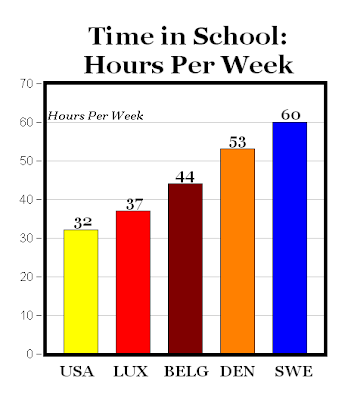
THE ECONOMIST -- American children also have one of the shortest school days, six-and-a-half hours, adding up to 32 hours a week. By contrast, the school week is 37 hours in Luxembourg, 44 in Belgium, 53 in Denmark and 60 in Sweden (see chart above). On top of that, American children do only about an hour's-worth of homework a day, a figure that stuns the Japanese and Chinese.
American children have it easier than most other children in the world, including the supposedly lazy Europeans. They have one of the shortest school years anywhere, a mere 180 days compared with an average of 195 for OECD countries and more than 200 for East Asian countries. German children spend 20 more days in school than American ones, and South Koreans over a month more. Over 12 years, a 15-day deficit means American children lose out on 180 days of school, equivalent to an entire year.
Americans also divide up their school time oddly. They cram the school day into the morning and early afternoon, and close their schools for three months in the summer. The country that tut-tuts at Europe's mega-holidays thinks nothing of giving its children such a lazy summer. But the long summer vacation acts like a mental eraser, with the average child reportedly forgetting about a month's-worth of instruction in many subjects and almost three times that in mathematics.
The understretch is also leaving American children ill-equipped to compete. They usually perform poorly in international educational tests, coming behind Asian countries that spend less on education but work their children harder. California's state universities have to send over a third of their entering class to take remedial courses in English and maths. At least a third of successful PhD students come from abroad. |



