300 Million Chickens at ‘Edge of Death’ on Hubei Lockdown
Logistic curbs to control coronavirus halt shipments
By
Alfred Cang
30 de janeiro de 2020, 05:23 WET Updated on 30 de janeiro de 2020, 10:18 WET
Hubei is asking for corn, soymeal for local producers
Logistic curbs to control coronavirus halt shipments
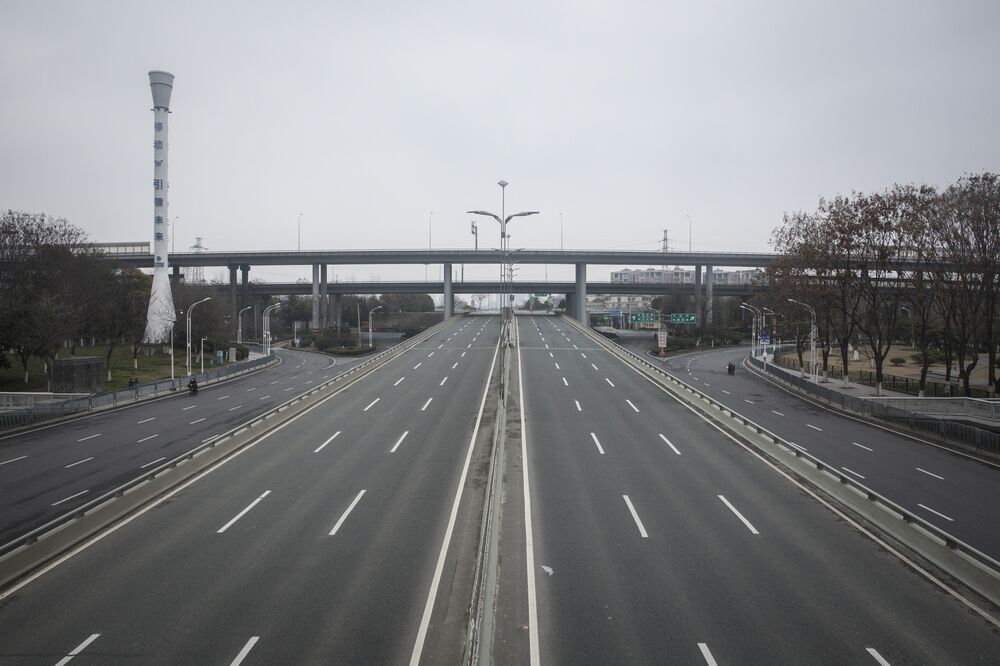
Roads remain empty in Wuhan, Jan. 27. Photographer: Getty Images
The lockdown in China’s Hubei province is pushing its flock of more than 300 million chickens to the “edge of death,” according to the region’s poultry association.
Halting transport in and out of Hubei has “basically paralyzed” shipments of animal feed supplies and the raw materials needed to make them, the local poultry association said in letters, seen by Bloomberg, asking state producers to deliver supplies urgently.
Most farms in the province will likely run out of feed by the end of the week, said a separate letter from the provincial agricultural department seen by Bloomberg. Hubei consumes about 1,800 tons of corn and 1,200 tons of soymeal a day as animal feed, and may see a 600,000-ton deficit of these products by the end of next month, the letters said.
Calls to the offices of Hubei’s agriculture department and poultry association went unanswered. The China Animal Agriculture Association called on the country’s feed makers to supply 18,000 tons of corn and 12,000 tons of soymeal to Hubei immediately, according to a website statement Thursday.
Industries from carmakers to retailers have been hit by the spread of the novel coronavirus in China as the death toll rises and authorities globally tighten travel restrictions and movement of people to contain the epidemic. Commodities markets have been especially hit hard on fears that demand from China, the world’s top producer and user, will weaken and hurt consumption of everything from crude to soybeans.
Egg futures on China’s Dalian Commodity Exchange are set to resume trading on Feb. 3 after Beijing extended the Lunar New Year break and delayed the opening of the financial markets. Hubei province is the country’s 6th-biggest poultry producer and accounts for 5% of China’s annual egg output.
China’s central bank will inject more than $21 billion of liquidity in seeking to avert a potential sell-off from the coronavirus outbreak. Meanwhile, a city 700 kilometers from the epicenter quarantined 9 million residents.
A Wuhan man died in the Philippines, the first from the virus outside China. A jump in fatalities and a surge in infections stoked fears of contagion.
Airlines in Asia, Europe and the Middle East stopped flights to the mainland. U.S. restrictions on travel from China take effect Sunday.
Bloomberg is tracking the outbreak here.
Key Developments:China’s central bank will pump 150 billion yuan ($21.7 billion) into markets on Monday to prevent a sell-off.A Wuhan man who traveled to the Philippines is the first known person to die outside China.China recorded 45 deaths and 2,590 cases for Feb. 1. Total infections rose to 14,380 in the country, with 304 deaths.More countries have blocked arrivals from China.The U.S. is studying the economic impact of the outbreak.

PLACES OUTSIDE MAINLAND CHINA WITH MOST INFECTIONSNUMBER OF CASES|
| Japan | 20 | | Thailand | 19 | | Singapore | 18 | | South Korea | 15 | | Hong Kong | 15 |
U.S. Offer Unanswered by China (1:30 p.m. NY)The U.S. offered top public health experts to help China with the coronavirus outbreak, but so far Beijing hasn’t responded, National Security Adviser Robert O’Brien said Sunday.
“This is a worldwide concern -- we want to help our Chinese colleagues if we can,” O’Brien said on CBS, noting the Centers for Disease Control and Prevention and the National Institutes of Health are world-class organizations. “We’ve made the offer and we’ll see if they accept.”
So far, Chinese health officials are providing information and the U.S. is “taking that for what it’s worth, but at the same time we’re monitoring ourselves,” he said on “Face the Nation.”
Uber Suspends Mexico Accounts (1:15 p.m. NY)Uber Technologies Inc. suspended 240 accounts in Mexico to contain the spread of coronavirus after the users rode with two drivers who came into contact with a possible infected patient, the company said on its Mexican Twitter account. To date, no confirmed cases of the virus have been reported in Mexico.
Mexico City’s Health Ministry confirmed a driver picked up a passenger from Los Angeles infected with the coronavirus, based on information from U.S authorities. The ministry said of the suspected cases tied to the passenger, none have developed symptoms in 10 days since contact.
France Gets Second Flight (12:05 p.m. NY)An evacuation flight from Wuhan landed Sunday at France’s Istres military airbase where about 100 French passengers will be quarantined in a firefighters’ compound, government officials said. The first evacuation flight to France landed on Friday.
Officials said that when the flight left Wuhan, none of the passengers had symptoms of coronavirus. They include French, Belgians, Dutch, Danes, Czechs, Slovaks and some citizens of African countries, the Associated Press reported.
France’s foreign minister Jean-Yves Le Drian urged citizens not to travel to China.
G-7 Leaders Mull Coordination (11 a.m. NY)Leaders of the Group of Seven nations are in talks to coordinate their response to the coronavirus outbreak, Germany Health Minister Jens Spahn said Sunday, according to Handelsblatt.
Spahn said he had spoken with a U.S. health official, by phone, and they had decided on the need for a telephone conference of G-7 health ministers. Spahn said: “There is no point in one country taking action alone, especially not in Europe.”
WHO Takes on Virus Rumors (10:33 am NY)The World Health Organization highlighted “myths and rumors” tied to the outbreak in its daily situation report, saying that it’s making available public health information and advice, including “myth-busters,” on Twitter and other social media channels along with its website.
Researchers and journalists have documented an expanding number of cases of misinformation about the virus, ranging from racist explanations for the disease’s origin to false claims about miracle cures.
Coastal Chinese City Quarantined (7:55 a.m. NY)Wenzhou, an eastern port of 9 million people, became the first city outside central Hubei province to impose quarantine measures due to the coronavirus outbreak. The city, some 700 kilometers from the epidemic’s origin in Wuhan, is in Zhejiang province, which has about 600 confirmed cases of the virus, the highest number outside Hubei. The two cities are known for their business ties.
Families will be allowed to send one person out of the house every two days to shop for necessities, city authorities said. Residents are advised to leave their homes only for medical treatment or related reasons.
White House Studies Virus Impact (6:23 a.m. NY)White House economic advisers are studying the potential impact of the epidemic of the coronavirus on the U.S. economy, the Washington Post reported, citing people familiar with the matter.
The White House National Economic Council and the Council of Economic Advisers are conducting a preliminary assessment of the potential short-term and long-term effects of the outbreak, the newspaper said.
One area that may feel the impact will be the international education industry. Australian Education Minister Dan Tehan estimated the global impact on the market could reach A$8 billion ($5.4 billion), the Sydney Morning Herald reported. About 200,000 Chinese students are due to study in Australia this year, the paper said, with many more attending schools and universities throughout the rest of the world.
Thai Doctors Use Antivirals (5:16 p.m. HK)Thailand doctors who used a mix of antivirals to treat a Chinese patient with the novel coronavirus who was in serious condition reported postive results, according to a health ministry briefing. The doctors used the flu treatment oseltamivir along with lopinavir and ritonavir, both HIV drugs.
In a separate case, the reported use of an experimental drug from Gilead Sciences Inc., called remdesevir, has encouraged doctors to support further testing of the medication against coronavirus.
Indonesia, Oman Suspend Flights (5:30 p.m. HK)Indonesia will temporarily ban flights to and from China from Feb. 5, Detik news portal reported, citing Foreign Minister Retno Marsudi. The government is asking Indonesians not to travel to mainland China temporarily, she was cited as saying. Oman’s aviation authority said it suspended all flights between the sultanate and China.
Infections May be Underreported (5 p.m. HK)Many people suspected of being sick with the coronavirus in Wuhan aren’t being counted as having been infected, and some suspicious deaths haven’t been checked and included in the death toll due to a shortage of tests, according to Caijing, a Chinese media company. The Saturday report was deleted from the internet Sunday. The deaths were recorded as due to viral pneumonia and not pneumonia caused by the coronavirus, Caijing wrote.
An unidentified doctor from a Wuhan hospital designated for coronavirus treatment said that they have admitted about 600 severe cases, but none of these patients were confirmed as having coronavirus due to a lack of tests.
More Studies Needed on Virus Spread (3:45 p.m. HK)More studies are needed to determine if the virus can transmit via the fecal-oral route, a Chinese CDC official said at a press conference Sunday.
The novel coronavirus was detected in the loose stool of the first U.S. case -- a finding that hasn’t featured among case reports from Wuhan. Squat latrines, common in China, lacking covers and hands that aren’t washed thoroughly with soap and water after visiting the bathroom could be a source of virus transmission, said John Nicholls, a clinical professor of pathology at the University of Hong Kong.
China Market Support (3:15 p.m. HK)China’s central bank will supply 1.2 trillion yuan ($174 billion) to money markets on Monday, according to a statement on Sunday. The China Securities Regulatory Commission said it’s on high alert for abnormal reaction on Monday, when markets reopen. The decision to reopen markets comes after weighing all factors, it said, adding it’s studied measures to hedge risks and ease panic.
More Global Infections (1:15 p.m. HK)India reported a second coronavirus case in a patient with a travel history to China. The patient is in a stable condition, it said. It said Chinese passport holders and those who reside in China who have electronic visas to India won’t be able to come over.
Vietnam said a 73-year-old Vietnamese American was tested positive for the novel coronavirus on Jan. 31, more than two weeks after transiting in Wuhan. He had a two-hour stopover at a Wuhan airport on the way to Vietnam from the U.S on Jan. 15. That brings the total there to seven.
South Korea has 15 confirmed cases now. From Feb. 4, the country will temporarily ban foreigners who have visited or stayed in Hubei within 14 days from entering, Prime Minister Chung Sye-kyun said. Seoul will also suspend its no-visa favor for Chinese tourists to Jeju Island for now, he said.
Hong Kong Hints at Tighter Travel Curbs (1 p.m. HK)A Hong Kong executive council member said that residents should avoid traveling to the mainland or risk having difficulties returning to the city, according to an RTHK report, a sign the government could ramp up border control restrictions. Lam Ching-choi said on Sunday that possible measures include shortening opening times for ports, limiting transportation and introducing laws to curb cross border traffic, the report said.
Medical Supply Allocations (11:50 p.m. HK)Chinese Premier Li Keqiang on Sunday called for all-out efforts to improve the allocation of key medical supplies such as protective suits and facial masks, especially for medical workers on the front-line. The Chinese government vowed to “severely” deal with those who hiked prices, or hoard and profiteer on such goods.
Medical equipment has been in severe shortage in Wuhan and other virus-hit areas. Production of medical supplies are currently at 60% after an early resumption of the manufacturing during the holiday, the Ministry of Industry and Information Technology said Sunday.
WHO Reports Death in the Philippines (10:35 a.m. HK)The World Health Organization said a 44-year-old male, a known resident of Wuhan, experienced fever, cough and a sore throat before being admitted to San Lazaro Hospital in Manila. He died on Feb. 1.
He was the second confirmed case of the virus in the Philippines and a close contact of the first infection in the country, also a Wuhan resident.
Just hours before the announcement of the death, Philippine President Rodrigo Duterte widened his travel ban previously imposed on visitors from Hubei province to all of China, including Hong Kong and Macau, while prohibiting Filipinos to travel to those areas. Returning citizens and permanent residents must be quarantined.
Mapping the Coronavirus Outbreak Across the World
— With assistance by Steve Geimann, Michelle Cortez, Alfred Liu, Miaojung Lin, Debby Wu, Dandan Li, Abeer Abu Omar, Sara Marley, and Helene Fouquet |



