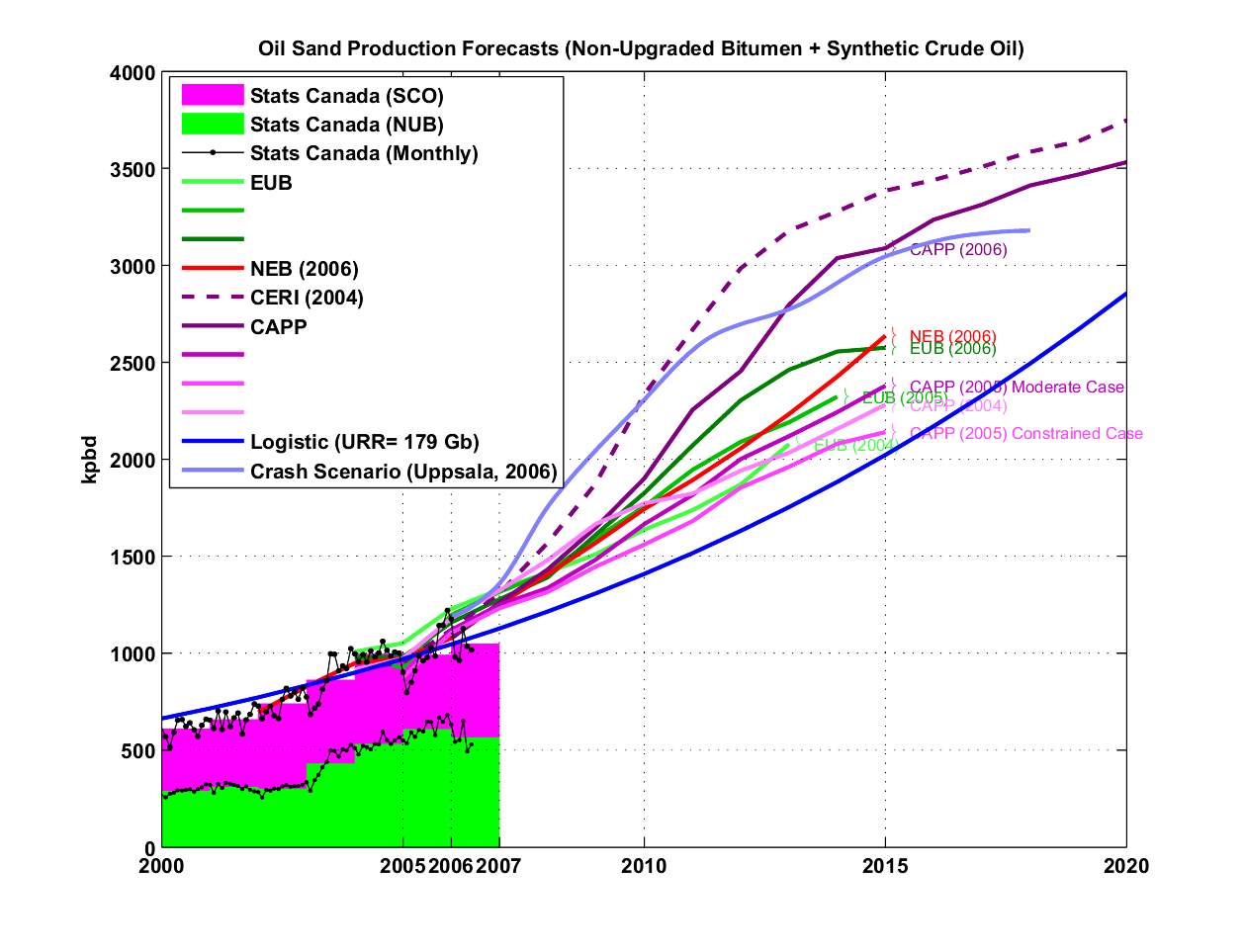
Various forecasts for Synthetic Oil Crude (SCO) and Non-Upgraded Bitumen (NUB) derived from oil sands.
Canadian Oil Sands Production Update
Posted by Khebab on Monday October 30, 2006 at 10:51 AM EST
This is the first version of a monthly post about the last production numbers from Canadian oil sands (also called Tar sands).
Oil Sands Production in a Nutshell
I won't go into too much detail about oil sands. I invite people to read the excellent stories previously posted on TOD by Dave and Heading Out:
Oh, Canada -- Natural Gas and the Future of Tar Sands Production
Mining Canadian Oil Sands into the future
The raw material of the oil sands industry is crude bitumen:
Crude bitumen means a naturally occurring viscous mixture, mainly of hydrocarbons heavier than pentane, that may contain sulphur compounds and that, in its naturally occurring viscous state, will not flow to a well.
The raw crude bitumen is recovered either by surface mining or by In-Situ technologies for deeper deposits (THAI, SAGD, etc.). The crude bitumen is not the final product and has to go through Upgrading:
Bitumen is deficient in hydrogen, compared with typical crude oils, which contain approximately 14 percent hydrogen. To make it an acceptable feedstock for conventional refineries, it must be upgraded into higher quality synthetic crude oil (SCO), through the addition of hydrogen or the rejection of carbon, or both. (National Energy Board, 2000) Upgrading bitumen utilizes natural gas as a source of heat and steam for processing, and also as a source of hydrogen for hydroprocessing.
In the following I will only consider two crude oil categories:
Non Upgraded Bitumen (NUB).
Upgraded Bitumen or Synthetic Crude Oil (SCO).
There's more… (1094 words)
canada.theoildrum.com |



