This riot drove more White votes to Trump.
What the "National Conversation" about Policing Looks Like
In Milwaukee over the weekend, yet another black man with most of his life ahead of him was gunned down by the police. This has sparked calls for peace, and for a renewed national conversation about police misconduct and community trust.
I thought it would be useful to see what the conversation looks like.
Here are a few pictures:
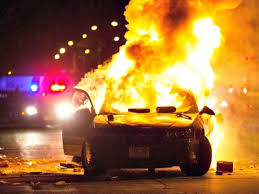
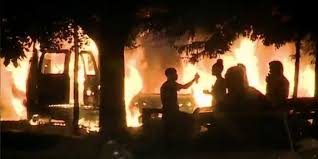


I could put up quite a few more, but you get the idea.
The "national conversation" looks a good deal like "space to destroy," in the memorable phrase of Stephanie Rawlings-Blake, Mayor of Baltimore and opener of the Democratic National Convention.
It was also Baltimore where, after the charges against six officers in the Freddie Gray case -- not a single one of which was proved (before a black judge) and all of which we recently dropped -- the murder rate spiked by 63% in 2015.
Of course, this is a mystery to liberals. There is no discernible reason. Could be the the economy was lousy (although it was no lousier than in 2014). Could be that there was a sudden influx of guns (although there's not a wisp of evidence that there was even one more gun in the city than in 2014). Could be sunspot activity.
Or it could be that when you have a shrinking police force intimidated by a raft of false felony charges put forward by a BLM-style amateur masquerading as a sober prosecutor, the police take a step back.
That, of course, is the one explanation sure to get pooh-poohed by the press and academia -- because if it weren't pooh-poohed, the country might have to take seriously the prospect that when you take aim at the police (culturally and physically), the police will become more cautious -- and violent criminals less so.
As I say, that explanation will not do.
One more thing. The narrative that spawned the BLM snarling of which Milwaukee is merely the most recent, but assuredly not the last, example, is that unarmed black males minding their own business get gunned down by the cops, sometimes "merely" out of racist assumptions, and more often out of purebred, Klan-style racism. See, e.g., the (fictional) recounting from Ferguson, Mo., about white policeman Darren Wilson.
As recounted
here, this is what actually happened in Milwaukee. The evidence thus far is that the person shot was about as innocent as Willie Sutton:
Milwaukee Police Chief Edward Flynn has provided details of the fatal shooting by a black police officer of Sylville Smith, a black Milwaukee man. The shooting sparked riots on Saturday and Sunday night.
According to Chief Flynn, who reviewed video from the body camera of the officer who shot Smith, the chain of events that led to the shooting occurred during a period of just 20 to 25 seconds. It began when Smith, who had been pulled over in a traffic stop, started running away. The officer ([who is black and] whose name is being withheld due to concerns for his safety) chased Smith on foot.
Very soon after the chase began, the officer encountered Smith in a fenced yard. Smith was armed. According to Chief Flynn, "[Smith] did turn toward the officer with the firearm in his hand." The gun "was in [Smith's] hand; he was raising up with it." The officer had told Smith to drop the gun.
After Smith raised the gun, the officer fired several shots, as anyone with a decent regard for his own life would do in these circumstances. He hit Smith in the chest and arm. There is no indication that Smith fired a shot. The video of this confrontation will likely be released before long. The decision is up to the state Department of Justice. Flynn said the quickest release he knew of was one week, in a Chicago case.
Given the high probability that the video will be released, it is difficult to believe that Flynn is mis-characterizing what it shows.
The problem is that neither the local rioters, the Black Lives Matter movement, nor the U.S. Department of Justice cares what actually happened in Milwaukee on Saturday. The locals are using the incident as an excuse to riot and attack police officers regardless of the merits.
Similarly, the Black Lives Matter movement can be expected to use the incident to incite anti-police sentiment, just as they continue to use the justified killing of Michael Brown who also attacked a police officers (Brown was unarmed). BLM protesters will continue to chant that they want "dead cops" and want them "now."
In other words, it has nothing to do with a "conversation." It has even less to do with peace. What it has to do with is the culture war against standards, lawful behavior, and legitimate authority. And let there be no mistake: For the enablers and the soldiers in this war, it's also time to start shooting. As the police assassinations in New York City, Dallas and Baton Rouge tell us, it's past time
|



