Scientists baffled after extremely high-energy particle detected falling to Earth
Experts have been left wondering how the event could have happened, as the particle appeared to emerge from the Local Void, an empty area of space bordering the Milky Way galaxy.
Friday 24 November 2023 09:52, UK
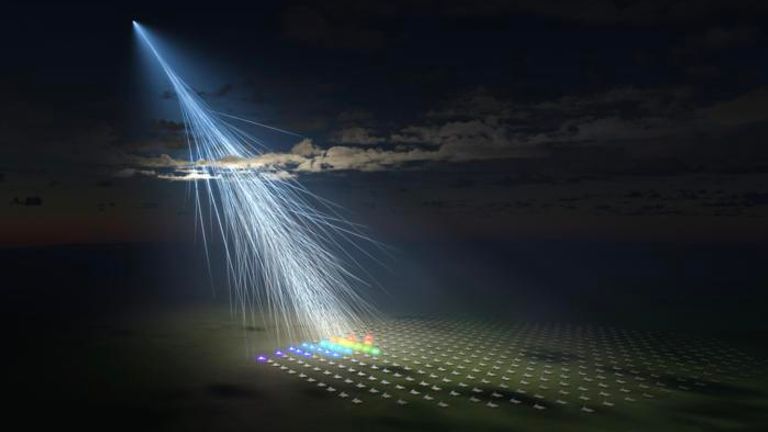
Image:Artist's impression of detected cosmic ray. Pic: Osaka Metropolitan University/L-Insight, Kyoto University/Ryuunosuke Takeshige
A rare and extremely high-energy particle has been detected falling to Earth by astronomers.
Named after the Japanese sun goddess, Amaterasu, it is one of the highest-energy cosmic rays ever detected, according to scientists.
The Amaterasu particle has an energy exceeding 240 exa-electron volts (EeV) and comes only second in recorded history to the Oh-My-God particle, another ultra-high-energy cosmic ray which was detected in 1991, possessing 320 EeV of energy.
The origins of the particle are unknown, but experts believe that only the most powerful celestial events - bigger than a star explosion - can create them.
Toshihiro Fujii, an associate professor at Osaka Metropolitan University in Japan, said he thought there "must have been a mistake" when he first discovered the particle.
"It showed an energy level unprecedented in the last three decades," he said.
Read more:
Image from James Webb telescope captures heart of Milky Way
NASA astronauts accidentally drop toolbox into space
Telescope captures first full-colour images of the universe
The mystery deepens for scientists, as the particle seemingly came out of nowhere.
John Matthews, a research professor at the University of Utah's department of physics and astronomy, explains that there was nothing in the area high energy enough to have produced the event.
It appeared to emerge from the Local Void, an empty area of space bordering the Milky Way galaxy.
"You should be able to point to where they come from in the sky," Prof Matthews said.
"But in the case of the Oh-My-God particle and this new particle, you trace its trajectory to its source and there's nothing high energy enough to have produced it.
"That's the mystery of this - what the heck is going on?"
Typically, when ultra-high-energy cosmic rays hit Earth's atmosphere, they cause a cascade of secondary particles and electromagnetic radiation in what is known as an extensive air shower.
Some charged particles in the air shower travel faster than the speed of light, producing a type of electromagnetic radiation that can be detected by specialised instruments.
One of those instruments is the Telescope Array observatory in Utah, which found the Amaterasu particle.
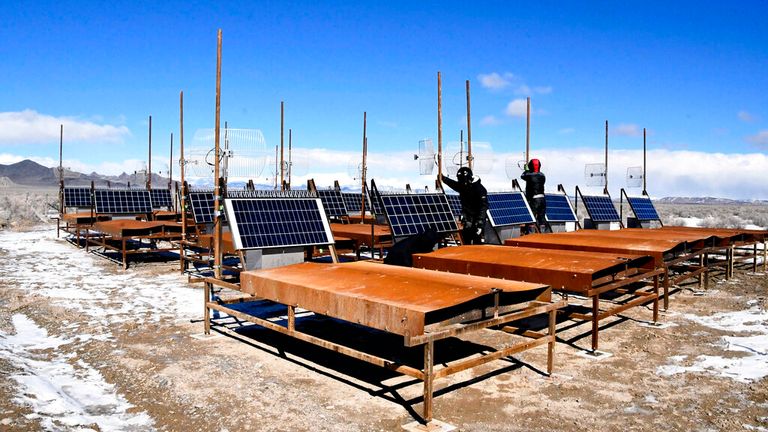
Image:Telescope Array surface detectors in Utah. Pic: AP
The hope is now that the particle will pave the way for further investigations that could help shed light on ultra-high-energy cosmic rays and where they come from.
Experts suggest it could indicate a much larger magnetic deflection than predicted, an unidentified source in the Local Void, or an incomplete understanding of high-energy particle physics.
Another professor in Utah, John Beltz, said he is "spit-balling crazy ideas" to try to explain the mystery.
"These events seem like they're coming from completely different places in the sky. It's not like there's one mysterious source," he said. "It could be defects in the structure of spacetime, colliding cosmic strings."
But he added: "There's not a conventional explanation." |



