Snowflakes are the Golden Section. As is all of nature.
Snowflakes are snow crystals form when tiny supercooled cloud droplets (about 10 µm in diameter) freeze. These droplets are able to remain liquid at temperatures lower than -18 °C (0 °F) because, to freeze, a few molecules in the liquid droplet need to get together by chance to form an arrangement close to that in an ice lattice; then the droplet freezes around this 'nucleus'.
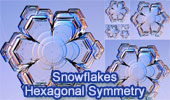
The individual ice crystals often have hexagonal symmetry. Although the ice is clear, scattering of light by the crystal facets and hollows/imperfections mean that the crystals often appear white in colour due to diffuse reflection of all spectrum of light by the small ice particles. The 6-fold symmetry arises from the hexagonal crystal structure of ordinary ice, the branch formation is produced by unstable growth, with deposition occurring preferentially near the tips of branches.
Wilson "Snowflake" Bentley (1865 - 1931), born in Jericho, Vermont, is the first known photographer of snowflakes.
A golden rectangle is a rectangle whose side lengths are in the golden ratio, one-to-phi, that is, approximately 1:1.618. A distinctive feature of this shape is that when a square section is removed, the remainder is another golden rectangle, that is, with the same proportions as the first. Square removal can be repeated infinitely, which leads to an approximation of the golden or Fibonacci spiral.
 |



