Insiders Cash In, Consumers Pay Under New Energy Bill
Major players in Washington cheered the latest version of an energy bill, which tries to buy votes with “something for almost everyone.” But beleaguered consumers will get stuck with skyrocketing bills after others feast on new government benefits.
We can expect any new “green jobs” to be offset by a larger loss of existing jobs, possibly up to 3-million, depending on details of how the bill’s cap-and-trade system is implemented to tax carbon dioxide emissions.
“Climate Plan Aims to Provide Something for Everyone,” headlined Congress Daily about the re-worked legislation from Senators John Kerry (D, MA) and Joe Lieberman (D, CT). That same phrase was echoed by a multitude of media.
But the “something” for everyday Americans is higher utility bills—another hit for struggling families in a sour economy.
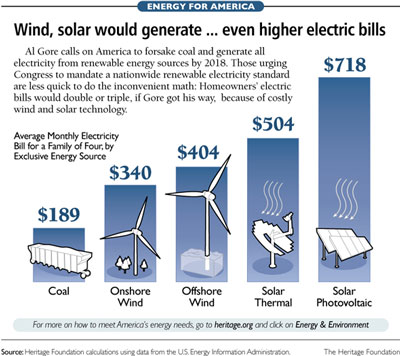
If the massive new bill stalls from its own complexity, Sen. Harry Reid says he’ll pursue a simpler-but-still-costly backup plan: Dictating that an ever-increasing portion of electric power must be generated from sources other than fossil fuels—a so-called RES “renewable energy standard” which by itself could cost a million jobs as well as higher electric bills averaging $2,400 a year for a typical family.
Just like the Kerry-Lieberman bill, the RES would force higher bills on unwilling and skeptical Americans.
According to Rasmussen Reports, only 18% of voters are willing to pay even $300 a year for cleaner energy or to fight global warming. And 56% of all voters say they aren’t willing to pay anything more at all in taxes and utility costs. (19% said they’d pay only $100 more a year.)
Consumers would pay as businesses passed along the new costs created by the bill. Many benefited groups gathered to attend and support the Kerry-Lieberman announcement, thanks to the potpourri of billions in federal subsidies, incentives and programs. The New York Times wrote, “The Kerry-Lieberman proposal . . . provid[es] something for every major energy interest — loan guarantees for nuclear plant operators, incentives for use of natural gas in transportation, exemptions from emissions caps for heavy industry, free pollution permits for utilities and modest carbon dioxide limits for oil refiners.” The Times identified the Edison Electric Institute, Nuclear Energy Institute, Duke Energy, and FPL Group as being there; stated that written statements of support were expected from oil giants British Petroleum, ConocoPhillips and Royal Dutch Shell; and reported that the bill had bought silence from the American Petroleum Institute and the U.S. Chamber of Commerce.
The Chamber’s public response was timid: “We thank Senators Kerry and Lieberman, as well as Senator Graham, for their work to constructively engage the business community on these issues. The Kerry-Lieberman bill is a work in progress. Few in Congress or the business community have had a chance to review the entire bill.”
For everyday Americans, the bill is nothing to cheer. Ben Lieberman, senior energy and environment policy analyst at The Heritage Foundation, told Talk Radio News Service that the APA amounts to nothing more than a giant energy tax. “The only way to reduce these greenhouse gas emissions from fossil fuels is to raise the cost of energy,” he said. “They have to raise costs high enough so that people are forced to use less, that’s how this works.”
But according to handouts from Kerry and Lieberman, “roughly two-thirds of the revenues generated by the new law would be passed back to consumers through energy bill discounts or direct rebates”. That sounds like a store that jacks up prices then offers a “discount” that still leaves a 33% price hike.
A major backer of the Tea Party movement, FreedomWorks, quickly condemned the measure as “the largest tax hike in history, and would hit the poor and middleclass, who spend a higher proportion of their income on essentials like electricity and fuel, the hardest.”
They added, “Cap and trade will bring sky high energy prices for consumers and a new government slush fund for Washington. A twenty-seven cent “Fuels’ Fee” on every gallon of gasoline included in the bill means not just higher prices at the pump, but higher prices on shipping and food production. Higher energy costs will put the cost of doing business through the roof and send American jobs overseas at a time of record unemployment.”
As President Obama personally predicted, his own plan will make our electricity rates “skyrocket” as higher costs are passed on to consumers.
blog.heritage.org
Subsidized Green Jobs Still Destroy Jobs Elsewhere
Last month Politico reported that the alternative energy sector had upped its lobbying efforts from $2.4 million in 1998 to $30 million in 2009. So what is the renewable power industry getting for its investment? Studies like this one by Navigant Consulting, Inc. for the Renewable Electricity Standard-Alliance for Jobs. The RES Alliance study found that “that a 25% by 2025 national RES would result in 274,000 more renewable energy jobs over no-national RES policy.”
Which is great news if you own a renewable electricity business. But what if you’re not? What if you manufacture widgets and you need inexpensive power to stay in business? The RES Alliance study tells you nothing about what happens to those jobs. It never even tries.
The reality is that Renewable Electricity Standards will cause energy prices to go up and that those higher energy prices will lead to job losses throughout the economy. Just ho many jobs will RES destroy on net? The Heritage Foundation’s Center for Data Analysis crunched the numbers and found that an RES would reduce employment by more than 1,000,000 jobs.
The idea that forcing Americans to pay artificially high energy prices thanks to renewable electricity standards is a classic example Frederic Bastiat broken window fallacy. In 1850 Bastiat wrote:
Have you ever witnessed the anger of the good shopkeeper, James Goodfellow, when his careless son happened to break a pane of glass? … Suppose it cost six francs to repair the damage, and you say that the accident brings six francs to the glazier’s trade—that it encourages that trade to the amount of six francs—I grant it; I have not a word to say against it; you reason justly. The glazier comes, performs his task, receives his six francs, rubs his hands, and, in his heart, blesses the careless child. All this is that which is seen.
But if, on the other hand, you come to the conclusion, as is too often the case, that it is a good thing to break windows, that it causes money to circulate, and that the encouragement of industry in general will be the result of it, you will oblige me to call out, “Stop there! Your theory is confined to that which is seen; it takes no account of that which is not seen.”
It is not seen that as our shopkeeper has spent six francs upon one thing, he cannot spend them upon another. It is not seen that if he had not had a window to replace, he would, perhaps, have replaced his old shoes, or added another book to his library. In short, he would have employed his six francs in some way, which this accident has prevented.
blog.heritage.org |



