SI
SI
discoversearch

We've detected that you're using an ad content blocking browser plug-in or feature. Ads provide a critical source of revenue to the continued operation of Silicon Investor.  We ask that you disable ad blocking while on Silicon Investor in the best interests of our community.  If you are not using an ad blocker but are still receiving this message, make sure your browser's tracking protection is set to the 'standard' level.
Strategies & Market Trends : Underexposed Technical Analysis
AQN 6.625+0.1%Feb 11 3:59 PM EST

 Public ReplyPrvt ReplyMark as Last ReadFilePrevious 10Next 10PreviousNext  
From: Underexposed4/11/2017 4:45:49 AM
1 Recommendation

Recommended By
robert b furman

   of 914
 
Bollinger Bandwidth (BBwidth)

Introduction

The Bollinger Bandwidth (BBwidth) is an indicator developed by John Bollinger’s Bollinger Bands. It is The percentage difference between the upper and lower Bollinger band and is calculated using the following formula:

BBwidth = ((upper Bollie – Lower Bollie) / middle band) x 100

where the middle band is the SMA on which the bands are based ( usually the 20 daySMA)

Interpretation and use of BBwidth

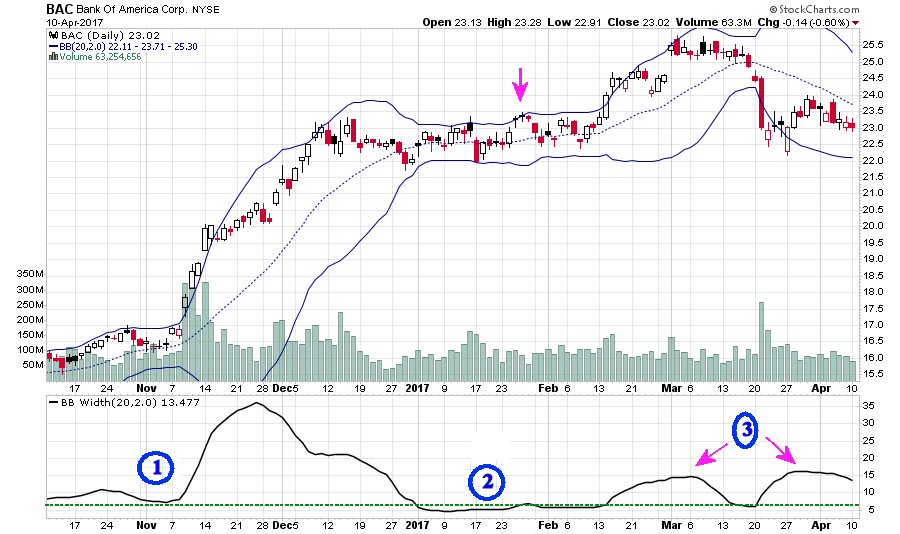
Consider the following chart:


1) The indication of a pending Bollie squeeze

On the surface it would that the BBwidth simply is an easy way to determine the state of the bollies as they approach a squeeze situation. Truly this is an important function as we have discussed before it is when the squeeze occurs, that major breakouts occur.

You can see three breakouts in this example Nov 8, Feb 14, and March 20. You cannot anticipate exactly when those breakouts will occur, as it shown here it can be months before the breakout happens (2).... but you know it is pending.

Look at the bottom green dotted line.... It varies with the stock ticker but there seems to be a level that the BBwidth must fall to before you can expect a new breakout.... for BAC that value for the BBwidth is about 6. So you can, for the most part, ignore minor changes in price until the BBwidth reaches that magic level. It is not perfect it is a guideline you otherwise don’t have.

2) Indication of a head fake breakout.

Look at the arrow at the top of the chart. The share price seems to be starting a break out of that BB tunnel. But look at the reaction of the BBwidth to that rise in price (2)... barely a ripple. In order for the breakout to be real there should be a sharp increase in the slope of the BBwidth curve.

3) BBwidth gives no help as to the direction of the breakout

The two breakouts shown by the arrows at (3) look identical from a BBwidth point of view... and it is true. You cannot judge the direction of a breakout... only that it has occurred. As we discussed in the post on Bollinger bands, we can sometimes judge the direction from the position of the share price relative to the 20day SMA ( the centre of the bands. If it is above the 20daySMA it should be bullish... below it should be a bearish movement... This worked on Nov 8 but failed on March 19... so it is not perfect.

Conclusion

As you can see the BBwidth indicator has very limited use as a solo indicator. It can warn of a pending breakout but offers no help in identifying the direction. Is it a useless indicator.... nopes... it is extremely powerful when used in concert with certain indicators as you will soon learn.

It is when you combine indicator readings with the main chart that the true power occurs... The best is yet to come...the Trigger chart...
Report TOU ViolationShare This Post
 Public ReplyPrvt ReplyMark as Last ReadFilePrevious 10Next 10PreviousNext