China Unveils New Measures to Aid Growth Amid Trade Uncertainty
State Council issues tax breaks, support for smaller firms
Policy is more ‘fine-tuning’ than major shift: Macquarie
China unveiled a package of targeted policies to boost domestic demand. Bloomberg’s Tom Mackenzie reports.
China unveiled a package of policies to boost domestic demand as trade tensions threaten to worsen the nation’s economic slowdown, sending stocks higher.
From a tax cut aimed at fostering research spending to special bonds for infrastructure investment, the measures announced late Monday following a meeting of the State Council in Beijing are intended to form a more flexible response to “external uncertainties” than had been implied by budget tightening already in place for this year.
Fiscal policy should now be “more proactive” and better coordinated with financial policy, according to the statement -- a signal that the finance ministry will step up its contribution to supporting growth alongside the central bank. The People’s Bank of China has cut reserve ratios three times this year and unveiled a range of measures for the private sector and small businesses.
With the economic impact of reciprocal tariffs on trade with the U.S. as yet unclear and no end to the trade dispute in sight, policy makers are pulling multiple levers to stabilize the economy. For now, that’s being done without resorting to large-scale stimulus or broad-based monetary easing, as officials remain committed to a multi-year campaign to curb debt growth.
“I don’t think there is a significant easing or a policy U-turn; it’s more of a fine-tuning,” said Larry Hu, head of China economics at Macquarie Securities in Hong Kong. “Policy makers are sewing patches, offsetting the deleveraging drive that was too rapid and fierce.”
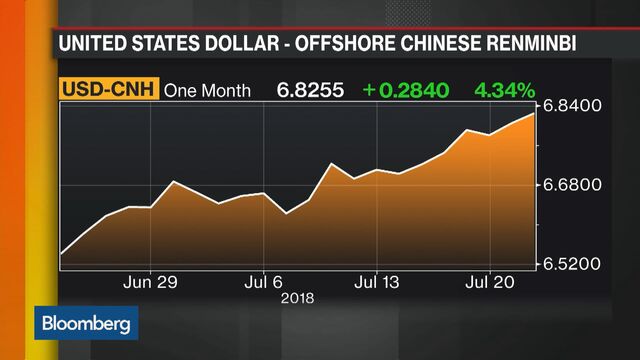
The onshore yuan fell as much as 0.65 percent to 6.8295 per dollar, the lowest level since June 2017. Stocks in Shanghai and Hong Kong advanced.
Nomura Holdings Inc. said the statement signals “the start of fiscal stimulus,” Guotai Junan Securities Co. said it “confirmed the easing bias in monetary policy,” and Deutsche Bank AG views it “as a confirmation of policy stance changing toward loosening.” Standard Chartered Bank Plc said policies will be slightly looser to support domestic demand but that there is no intention to introduce large stimulus.
The meeting reiterated language that China will strike a balance between easing and tightening and keep liquidity “reasonable and sufficient.” It also pledged to improve the transmission of monetary policy, a phrase the PBOC had dropped since a campaign to curb credit growth started in late 2016.
While there hasn’t been an official shift from the central bank’s “prudent and neutral” policy, steps announced in recent days indicate that officials are taking a supportive stance amid the trade dispute with the U.S. They include Monday’s record injection of funding for banks and the publishing of new guidelines for the asset management industry.
The economy grew 6.7 percent in the second quarter, the slowest expansion since 2016. Expansion is forecast to slow this year to 6.5 percent, in line with the official target.
The meeting also called for faster investment growth and steady financing to local investment projects. Policy makers stressed they’d refrain from using stimulus to flood the economy.
"It is now quite clear that Beijing has fully shifted its policy stance from the original deleveraging towards fiscal stimulus that will be underpinned by monetary and credit easing," said Lu Ting, chief China economist at Nomura Holdings Inc. in Hong Kong.
The policy package contained measures that included giving an additional tax cut of 65 billion yuan ($9.6 billion) to companies with R&D expenditure, expediting non-budgeted special bond sales to assist local government infrastructure financing and easing restrictions on banks’ issuance of financial bonds for small firms.
Private investment is to be boosted by introducing projects in transport, gas, and telecommunications, local governments will be pushed to make better use of untapped fiscal funds, and policies to attract foreign businesses to re-invest will be improved together with further opening up.
Policies also will seek to guide financial institutions to ensure reasonable funding to local government financing vehicles so that necessary projects aren’t held up, to facilitate construction and planning of a number of big projects that will meet development purposes and public demand and accelerate fundamental research and core technology breakthroughs.
— With assistance by Judy Chen, Yinan Zhao, Miao Han, Xiaoqing Pi, and Kevin Hamlin |



