Why Deniers are Panicking. Clean Energy on the Rise
February 4, 2016

If you wonder why there’s been a rash of climate denial show-hearings on capitol hill lately, here’s why. Big fossil Post-Paris panic.
Bloomberg:
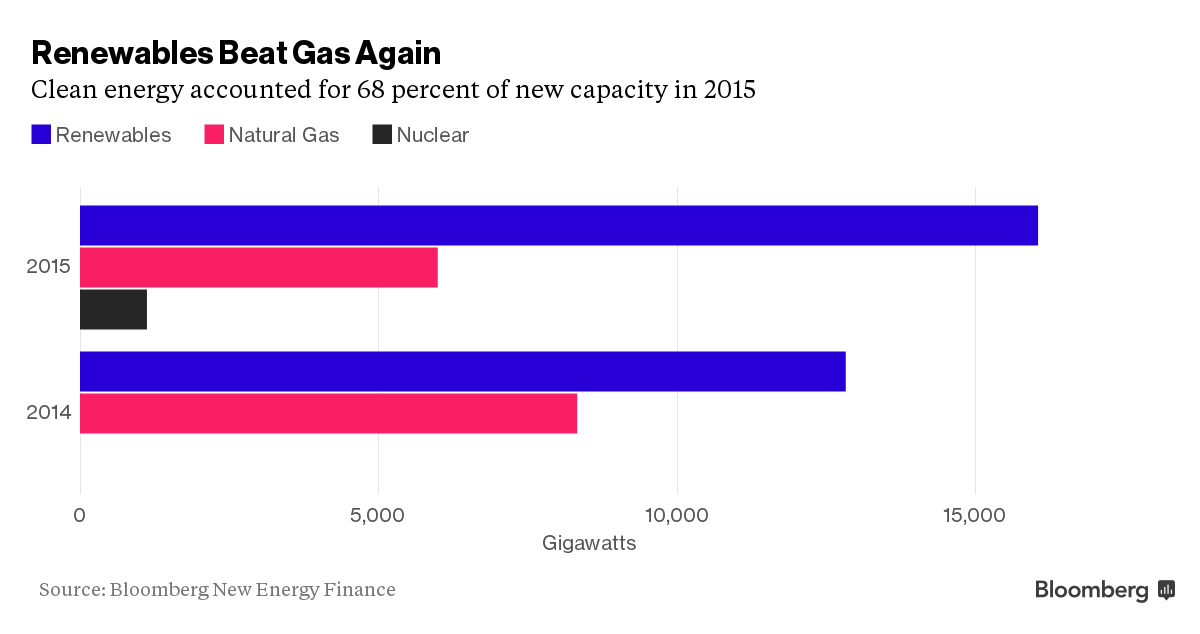
Renewable energy was the biggest source of new power added to U.S. electrical grids last year as falling prices and government incentives made wind and solar increasingly viable alternatives to fossil fuels.
Developers installed 16 gigawatts of clean energy in 2015, or 68 percent of all new capacity, Bloomberg New Energy Finance said in its Sustainable Energy in America Factbook released Thursday. That was the second straight year that clean power eclipsed fossil fuels.
The biggest growth came from wind farms, with 8.5 gigawatts of new turbines installed as developers sought to take advantage of a federal tax credit that was due to expire at the end of 2016; Congress extended it in December.
“This is a long-term trend,” said Colleen Regan, a New Energy Finance analyst who follows North American power markets. “System costs have really come down for renewables, which makes the case for installing them a lot stronger.”
U.S. clean-energy investments rose to $56 billion last year, up 7.5 percent from 2014. The majority, $30.2 billion, went to solar. Investors pumped $11.6 billion into wind energy and $11.1 billion into technology to improve grids, boost efficiency, develop storage systems and other ways to better manage power usage.
Paul Krugman:
It turns out that solar and wind accounted for two-thirds of the generation capacity added last year.
Now, that’s not enough: coal-fired generation is slowly being phased out, but the process needs to go much faster, and while replacement of coal with natural gas could in principle be a net positive — less carbon, more hydrogen — in practice the leaks associated with fracking make that highly doubtful.
But the point you should take is that really dramatic reductions in greenhouse gas emissions are well within reach, requiring only moderate incentives rather than a complete teardown of the existing system.
climatecrocks.com |