Researchers design new analog chip architecture with high precision
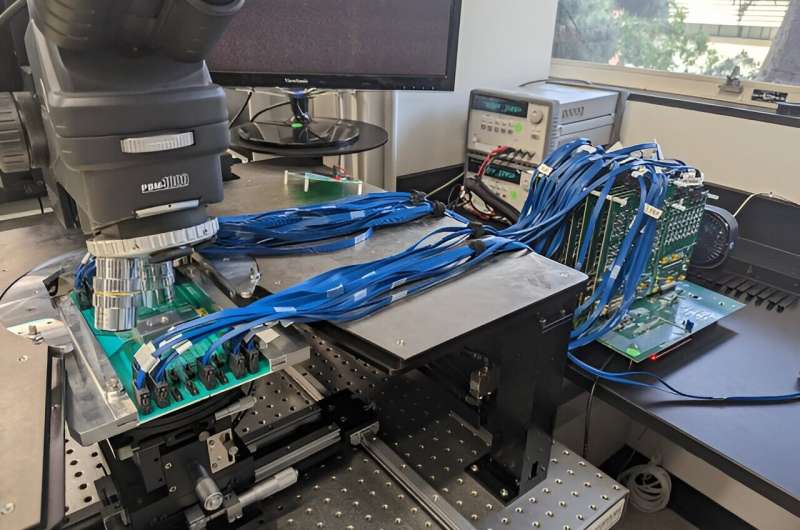
Photo of the 1T1R testing system. Credit: Science (2024). DOI: 10.1126/science.adi9405
While most computing in the world is still digital, the data around us is captured in analog via sensors–images through cameras, temperature, and sound, for example, and has to be converted into a digital form for precision. But imagine an autonomous vehicle that needs to capture what's on the road and then make decisions instantaneously: this data needs to be converted very quickly with low energy and high precision.
What if newly designed analog chips could provide the precision of digital computing with the energy-saving and high-speed advantages of analog computing? A paper titled "Programming memristor arrays with arbitrarily high precision for analog computing" has been published in the journal Science.
A memristor is a relatively small-sized component of a circuit that stores and processes data very efficiently. In a previous paper from the lab of USC Viterbi School of Engineering Electrical and Computer Engineering professor, J. Joshua Yang, researchers were able to tweak a memristor to achieve unprecedented precision.
His lab, within USC Viterbi and its School of Advanced Computing, is focused on developing devices for computing. The lab has designed a new circuit and architecture to achieve even higher precision with the same memristors, which could greatly extend the applications of such technology beyond the traditional low-precision territory, such as neural networks.
Moreover, says Yang, this innovation is applicable to other types of memory technologies as well, including magnetic memories that use the same device as the read-head of the magnetic hard disk drives, and phase change memories that use the same material as the compact disks (CDs).
Normally, says Yang, it is very challenging to quickly program an analog device precisely to a target value. Yang's lab developed circuit architecture and corresponding algorithms to do exactly that. This innovation makes analog computing using analog devices much more attractive for many applications.
Yang says it has "higher efficiency and higher speed with accuracy of the digital systems."
This type of improvement is critical, says Yang, as such innovations can be applied to train neural networks which are needed to develop artificial intelligence (AI) and machine learning (ML) but thus far can only be done in very expensively with digital systems. The innovation will also enable new applications beyond AI and ML, such as scientific computing for such as weather forecasting.
techxplore.com |



