Samsung now producing 256GB ultra-fast memory chips for smartphones
By Joel Hruska on February 26, 2016
extremetech.com
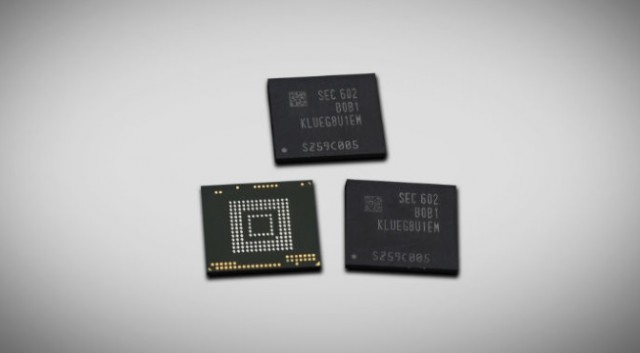
When we talk about smartphone performance, we typically discuss its CPU and graphics solution. NAND flash performance is just as important as these factors, however, and it’s an area where smartphone manufacturers often offer very different experiences. Samsung has been pushing a new storage standard for mobile devices, called Universal Flash Storage (UFS). Now, the company is increasing its maximum memory density as well, with 256GB, UFS-capable NAND chips.
Universal Flash Storage
The UFS standard is designed to replace the embedded MultiMediaCard standard. In theory, eMMC is faster than traditional SATA, with a maximum transfer rate of 400MB/s. eMMC has a number of practical limitations, however — it doesn’t support out-of-order execution, the protocol is CPU intensive, the queue depth is limited, and the protocol is only half duplex, not full duplex (it can only read or right, but can’t do both simultaneously). To be fair, SATA itself suffers from this last limitation — but UFS doesn’t.
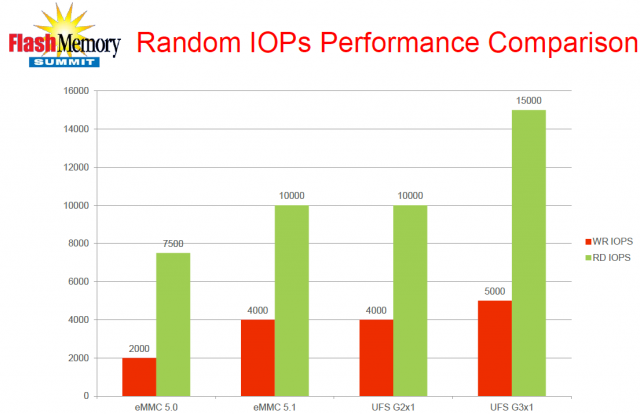
UFS supports multi-lane configurations — the initial spec targets a 580MB/s transfer per lane, and manufacturers can implement two lane solutions for a maximum of 1.2GB/s. That’s a respectable bandwidth jump over eMMC, and it should allow for substantially faster devices. Unlike eMMC, which uses eight parallel communication lanes, UFS uses high-speed serial connections.

Samsung is claiming that its new 256GB chips are capable of up to 850MB/s sequential read and 260MB/s sequential write. The read speeds are faster than a standard SSD can manage, though the write rate is slower than what we’ve seen claimed for many modern SSDs. Samsung claims that the new chip and interface is capable of pushing 4K Ultra HD movies to a TV while simultaneously searching for additional files or clips — no sweat for a desktop, but a significant leap for a mobile device.
As for when we’ll see these capabilities in shipping products, you’re guess is as good as mine. Smartphone manufacturers have shown no great interest in pushing the storage envelope — Apple continues to rely on 16GB entry-level devices, while Samsung starts at 32GB. Asus’ Zenphone 2 has offered a 256GB storage option, but there aren’t many devices out there with this much capacity. I suspect part of the problem is that most users would rather buy a low-end device, then add a microSD card if they need additional room rather than paying the additional price. Smartphone vendors tend to sell storage in $100 steps — $100 to move from 32GB to 64GB of storage, and another $100 to jump from 64GB to 128GB.
The good news is, adding faster storage to smartphones should boost their performance the same way it did for PCs. Despite being based on NAND flash, many smartphones offer anemic data transfer rates — the increases UFS brings should be noticeable and a welcome improvement.
* * * |



