Are Rifles Used a Lot in Homicides?
A great barrage of information is coming from the left , Bloomberg-owned organizations, and the media (threedundancy noted) about the necessity to immediately ban “assault weapons” (a term deliberately left undefined) or the “AR-15 used in the Orlando attack.” (Never mind that an AR-15 was not used in the Orlando attack, but one reporter made that “fact” up, which is what reporters do, and every other reporter plagiarized the first, which is what reporters do. (Remember that Walter Duranty, Steven Glass, Janet Cooke, Mike Barnicle and Jayson Blair were all top award-winning reporters, and all fabricated, plagiarized, or both).
These Firearms are Extremely Common While the rifle used in the Orlando assault — not an AR-15, not that you’d ever learn that from ban-happy reporters with the bit of The Narrative™ in their teeth and, no doubt, an honorarium from Bloomberg in their pockets — was an uncommon and expensive firearm, the semiauto AR-15, AK-47, and other firearms are extremely common. Nobody knows how common (we have an idea for a methodology for a future post) but this year, approximately 30 million NICS checks will be conducted, and our estimate is that 2 to 5 million of them will be for AR type rifles alone. Some individual manufacturers of AR type rifles have, over time, sold millions of the things. 20-25 million ARs in circulation in the US is plausible, and probably near a low bound. Their penetration into hunting, target shooting, collecting, and self-defense markets continues to grow.
To put this in perspective, ARs are more common in the United States than some things you see every day, even if (unlike, say, us) you don’t see AR’s every day:
- Toyota Priuses (about 2 million to North America so far of 5.7 million built);
- First generation (1965-73) Ford Mustangs ( about 3 million);
- Fire hydrants ( about 6 million total installed).
- Motorcycles ( 8.4 million registered in the USA in 2014)
- Boats ( about 12 million in use, including jet-skis and other personal watercraft);
To put it in further perspective, even though your probably got stuck in traffic behind one of these yesterday, every Prius shipped to America, ever, is not a number equal to the number of ARs not in circulation, but that are added to the ones in circulation annually. Do you have neighbors who own boats, or motorcycles? Your neighbors don’t show them off in their driveways, but they are twice and three times as likely to have an AR-15 type rifle.
How Often are Rifles Used in Homicide? To begin with, we have to use “rifle” because the FBI, whose grim duty it is to compile crime statistics, only breaks things down to rifle/handgun level. Read on and you may understand why.
One crime is in the news. How common is this kind of crime? It turns out there are real stats. Let’s talk first about the numerator: how many crimes. Someone has already graphed things out, using data sourced from the FBI Uniform Crime Report. Here is how often a rifle has been used in a homicide in the last twenty years:
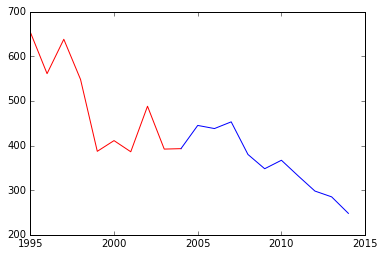
The numbers were never high, but they’ve been declining along with other homicides pretty steadily. Why are homicides declining? Pick your panacea, but it’s probably more than one of these factors:
- End of the crack wave?
- Better ER medicine? (This is one of our personal favorites. But shootings are down overall).
- Locking more criminals up and keeping them locked up longer?
- Increasing legal concealed-carry?
- Kid brothers deciding that big brother dead/doing time is a suboptimal role model?
- “No more violence” marches and vigils? (Hey, the people doing these must think they’re worth something).
We Can Rule One Thing Out One thing it definitely wasn’t was an assault-weapon ban. The Federal Government had one in force from 1994 to 2004, which the maker of the graph hash helpfully coded red (ban in force) and blue) ban expired. Some states retain assault weapons bans, and some such as Massachusetts, California, New York and New Jersey retain bans, many of them stricter than the expired Federal ban. Those four states, for example, continue to struggle with homicides higher than demographically similar neighboring states. For example, Massachusetts has five times the population of New Hampshire, but eleven times the murders. If MA had NH’s murder rate, more lives would be saved every year that were killed and wounded in Orlando. MA has among the most restrictive gun laws, NH among the most lax.
Some More Aspects of Rifle Homicides They’re really, really rare compared to handgun homicides. They’re also declining (but at a low rate, as you might expect for something that only occurs at a low incidence already).
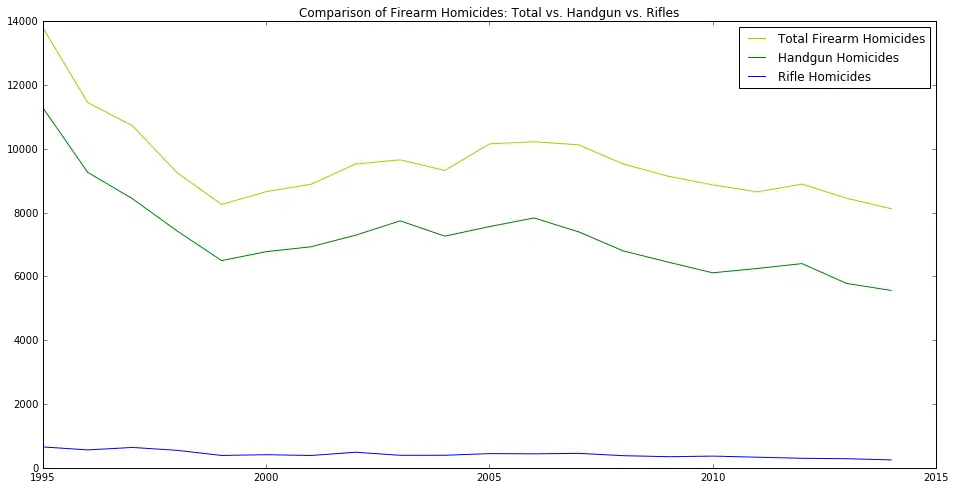
So why do many people perceive these crimes as extremely commonplace? You’ll have to ask the people in the media who make (sometimes, as with the “AR-15 in Orlando” media myth, sometimes literally “make”) the news. They claim to shape people’s perception (they will deny it when they’re accused of propaganda or misleading people, but watch what they tell firms they’re pitching ad sales to).
Since Rifle Homicides Don’t Compare Well to Handgun Homicides, What Do They Compare To?
Well, here’s a clue. The red line is “rifles”, and this includes rifles of all kinds, not just the tens or scores of millions of AR-15s:
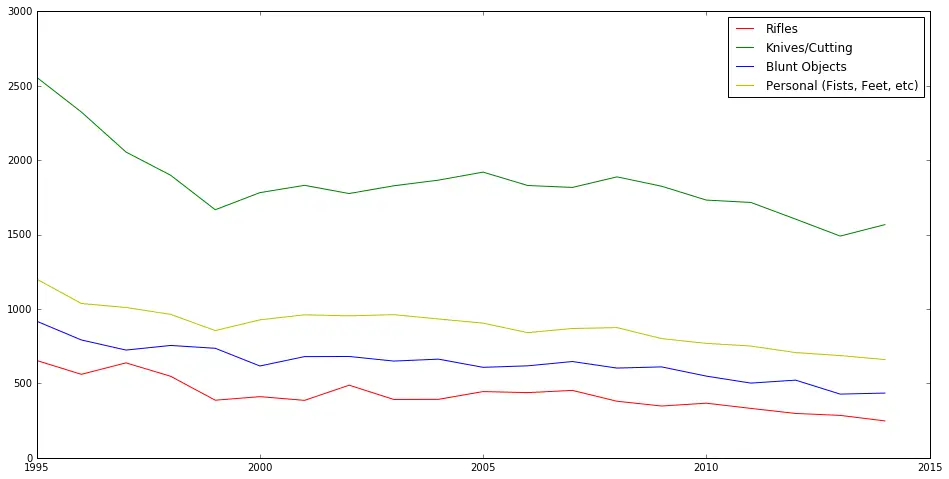
So today’s murder victim is nearly twice as likely to be bludgeoned as shot with a rifle, and three times more likely to be punched, kicked, strangled or shoved to his doom by his murderer’s bare hands or shod feet.
And this is all rifles, of course, not just dangerous AR-15s like the one a guy didn’t use to blow away a bunch of harmless, defenseless (literally) gay guys dancing a few nights ago. (Remember, he used a rifle, but not an AR-15.
A guy from a radical, extreme mosque who also followed a jailbird violent imam, and was a registered member of the party that is intimately associated with gun control. You won’t find any of those details in the New York Times, Palm Beach Post, Boston Globe or Philadelphia Daily News, but you will read about the bad guy’s AR-15.
It is practically a typological marker of politicians everywhere, that when a great misdeed is committed, they make convoluted excuses to lift the blame from the shoulders of the criminal who did it onto the necks of those multitude who did not.
Update We did this post at oh-dark-hundred and were remiss in that we did not credit the source of the graphics. They are plotted here, complete with the scripts that generate them and links to the source data:
nbviewer.jupyter.org
We regret the oversight and apologize to the creator of these graphics. All his comments at that link are worth reading, especially his note on correlation, which strongly implies that weapons choice is a subordinate factor in homicide (at least, that’s how we read it), due to the high correlation coefficients of all weapons choices with overall homicide rates. In other words, looking at weapons choice as an independent variable suggests it’s not really an independent variable.
weaponsman.com
Looking at the linked stats I see that more that twice as many people are killed without a weapon (beaten to death strangled, etc.) then with rifles of all types combined. |



