SI
SI
discoversearch

We've detected that you're using an ad content blocking browser plug-in or feature. Ads provide a critical source of revenue to the continued operation of Silicon Investor.  We ask that you disable ad blocking while on Silicon Investor in the best interests of our community.  If you are not using an ad blocker but are still receiving this message, make sure your browser's tracking protection is set to the 'standard' level.
Politics : Rat's Nest - Chronicles of Collapse

 Public ReplyPrvt ReplyMark as Last ReadFilePrevious 10Next 10PreviousNext  
To: Wharf Rat who wrote (9721)11/24/2009 12:26:26 AM
From: Wharf Rat   of 24213
 
A bit more...2012 is in about 700 days

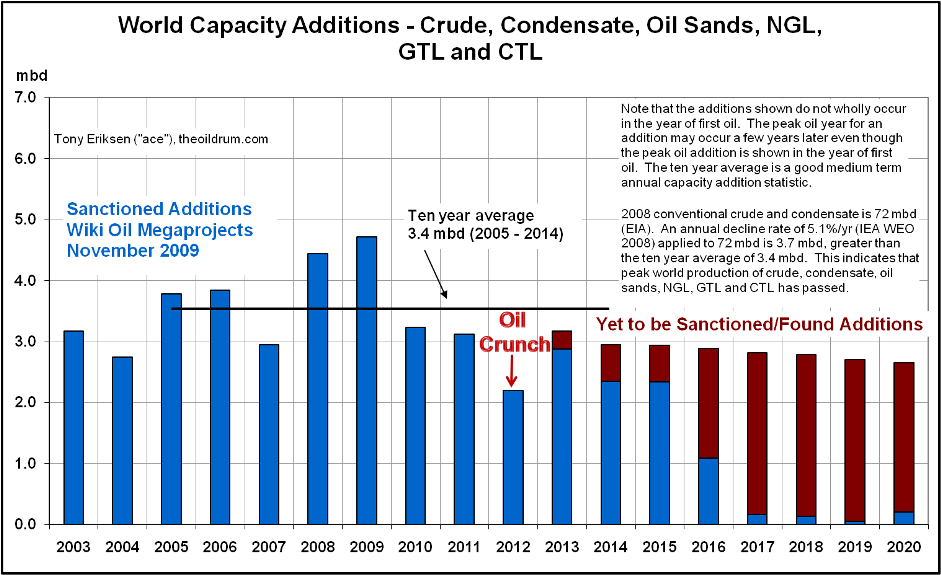
High volatility of future oil prices is also expected due partly to delays in project investment causing future annual oil capacity additions to decline sharply to 2012. This declining trend in capacity additions is shown in the chart below which is derived from this oil megaproject database. About 3.7 mbd of annual capacity additions are needed just to offset declines from existing fields. Annual capacity additions from 2010 are forecast to be less than 3.7 mbd implying that world production of crude, condensate, oil sands, NGL, GTL and CTL will continue declining. The chart below shows capacity additions from new projects and not production additions. Allowing for maintenance, unplanned outages and other incidents, future production additions may be about 15% less than capacity additions. This means that the production additions for 2010 to 2012 could be less than 3 mbd, well short of the required 3.7 mbd to offset declines from existing fields.

Many large capacity additions started in 2009 including over 1 mbd from Saudi Arabia, over 0.4 mbd from Brazil, over 0.5 mbd from Russia and almost 0.3 mbd from USA. Key producer Saudi Arabia has no more capacity additions until Manifa's 0.9 mbd scheduled to start in 2013, at the earliest. Capacity additions from Brazil, Russia and USA decline from 2009 to 2010. World capacity additions drop further in 2011 and decrease again in 2012. Consequently, an oil supply crunch is likely to occur in 2012 as shown below. The capacity additions do not include bio-fuel additions but these additions are unlikely to ease the 2012 oil crunch.


Fig 6 - World Capacity Additions to 2020 -
Report TOU ViolationShare This Post
 Public ReplyPrvt ReplyMark as Last ReadFilePrevious 10Next 10PreviousNext