Western Digital Stuns Storage Industry with MAMR Breakthrough for Next-Gen HDDs
by Ganesh T S on October 12, 2017
anandtech.com
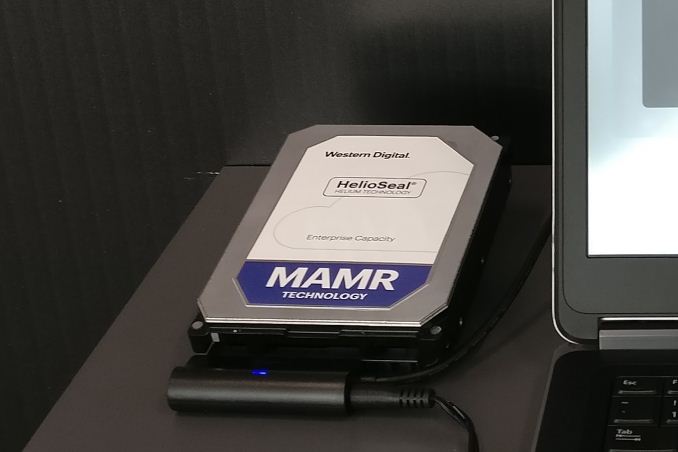
Yesterday, Western Digital announced a breakthrough in microwave-assisted magnetic recording (MAMR) that completely took the storage industry by surprise. The takeaway was that Western Digital would be using MAMR instead of HAMR for driving up hard drive capacities over the next decade. Before going into the specifics, it is beneficial to have some background on the motivation behind MAMR.
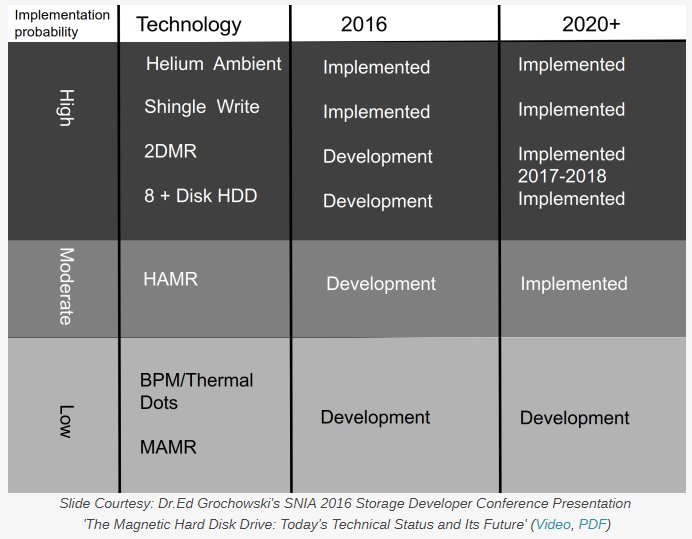
?Hard drives may be on the way out for client computing systems, but, they will continue to be the storage media of choice for datacenters. The Storage Networking Industry Association has the best resources for identifying trends in the hard drive industry. As recently as last year, heat-assisted magnetic recording (HAMR) was expected to be the technology update responsible for increasing hard drive capacities.
Mechanical Hard Drives are Here to Stay
One of the common misconceptions amongst readers focused on consumer technology relates to flash / SSDs rendering HDDs obsolete. While using SSDs over HDDs is definitely true in the client computing ecosystem, it is different for bulk storage. Bulk storage in the data center, as well as the consumer market, will continue to rely on mechanical hard drives for the foreseeable future.
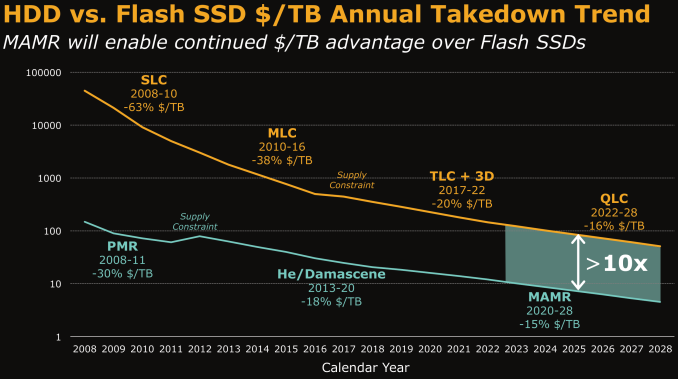
The main reason lies in the 'Cost per GB' metric.
Home consumers are currently looking at drives to hold 10 TB+ of data, while datacenters are looking to optimize their 'Total Cost of Ownership' (TCO) by cramming as many petabytes as possible in a single rack. This is particularly prevalant for cold storage and archival purposes, but can also expand to content delivery networks. Western Digital had a couple of slides in their launch presentation yesterday that point towards hard drives continuing to enjoy this advantage, thanks to MAMR being cost-effective.
Despite new HDD technology, advancements in solid state memory technology are running at a faster pace. As a result SSD technology and NAND Flash have ensured that performance enterprise HDDs will make up only a very minor part of the total storage capacity each year in the enterprise segment.
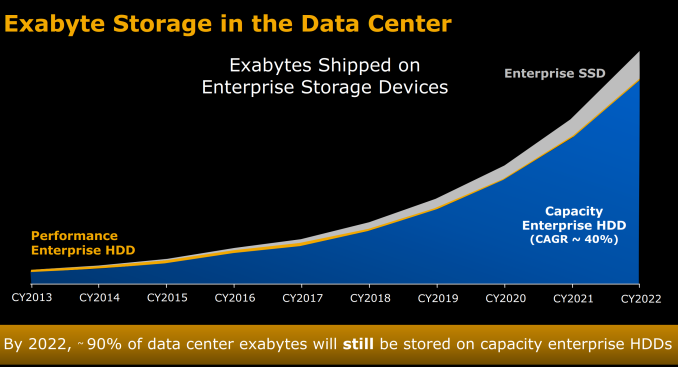
The projections presented by any vendor's internal research team always need to be taken with a grain of salt, but given that SanDisk is now a part of Western Digital the above market share numbers for different storage types seem entirely plausible.
In the next section, we take a look at advancements in hard drive technology over the last couple of decades. This will provide further technical context to the MAMR announcement from Western Digital.
PART 1: SCALING HARD DRIVE CAPACITIES AND A ROUTE TO MAMR
* * * |



