SI
SI
discoversearch

We've detected that you're using an ad content blocking browser plug-in or feature. Ads provide a critical source of revenue to the continued operation of Silicon Investor.  We ask that you disable ad blocking while on Silicon Investor in the best interests of our community.  If you are not using an ad blocker but are still receiving this message, make sure your browser's tracking protection is set to the 'standard' level.
Strategies & Market Trends : Mish's Global Economic Trend Analysis

 Public ReplyPrvt ReplyMark as Last ReadFilePrevious 10Next 10PreviousNext  
To: Elroy Jetson who wrote (52618)6/25/2006 3:06:02 AM
From: shades   of 116555
 
en.wikipedia.org


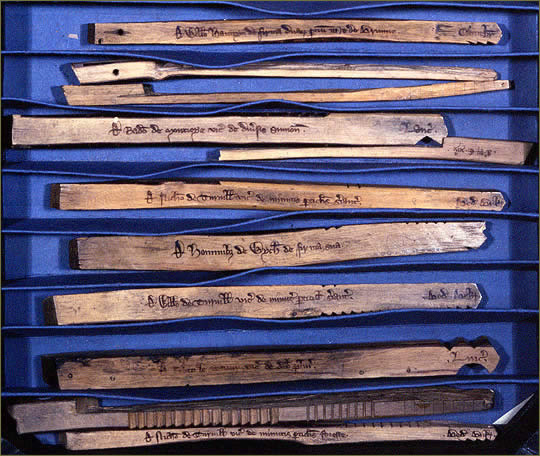
The split tally is a technique which became common in medieval Europe which was constantly short of money (coins) and predominantly illiterate in order to record bilateral exchange and debts. A stick (squared Hazelwood sticks were most common) was marked with a system of notches and then split lengthwise. This way both of the two halves record the same notches and each party to the transaction received one half of the marked stick as proof. Later this technique was refined in various ways and became virtually tamper proof. One of the refinements was to make the two halves of the stick of different lengths. The longer part was called stock and was given to the party which had advanced money or (other items) to the receiver. Hence the word stockholder.

The shorter portion of the stick was called foil and was given to the party which had received the funds/goods. Using this technique each of the parties had an identifiable and tamper-proof record of the transaction. The split tally was accepted as legal proof in medieval courts and the Napoleonic Code (1804) still makes reference to the tally stick in Article 1333. Along the Danube and in Switzerland the tally was still used in the 20th Century in rural economies.

The most prominent and best recorded use of the split tally was in medieval England as a tool of the Exchequer for the collection of taxes by local sheriffs (tax farmers “farming the shire”). The split tally of the Exchequer was in continuous use until 1826 (see also: Burning of Parliament) and the system of tally marks of the Exchequer is described in The Dialogue Concerning the Exchequer (see Literature below) as follows:

"The manner of cutting is as follows. At the top of the tally a cut is made, the thickness of the palm of the hand, to represent a thousand pounds; then a hundred pounds by a cut the breadth of a thumb; twenty pounds, the breadth of the little finger; a single pound, the width of a swollen barleycorn; a shilling rather narrower than a penny is marked by a single cut without removing any wood".

Royal tallies (debt of the Crown) also played an infamous role in the formation of the Bank of England at the end of the 17th century when these royal tallies – trading at a hefty discount of up to 60 percent – were engrafted into the Bank’s capital stock .
Report TOU ViolationShare This Post
 Public ReplyPrvt ReplyMark as Last ReadFilePrevious 10Next 10PreviousNext