dailyreckoning.com

gold-eagle.com
"In The Wealth of Nations, 1776, he argued that the market, under certain conditions, would naturally regulate itself and would produce more than the heavily restricted markets that were the norm at the time. He assigned to government the role of taking on tasks which could not be entrusted to the profit motive, such as preventing individuals from using force or fraud to disrupt competition, trade, or production. His theory of taxation was that governments should levy taxes only in ways which did not harm the economy, and that "The subjects of every state ought to contribute towards the support of the government, as nearly as possible, in proportion to their respective abilities; that is, in proportion to the revenue which they respectively enjoy under the protection of the state." He agreed with Hume that capital, not gold, is the wealth of a nations."
"Immanuel Kant was strongly influenced by Hume's empiricism and rationalism. His most important contributions to liberal thinking are in the realm of ethics, particularly his assertion of the categorical imperative. Kant argued that received systems of reason and morals were subordinate to natural law, and that, therefore, attempts to stifle this basic law would meet with failure. His idealism would become increasingly influential, since it asserted that there were fundamental truths upon which systems of knowledge could be based. This meshed with the ideas of the English Enlightenment about natural rights."
REASONS for POG+ =>
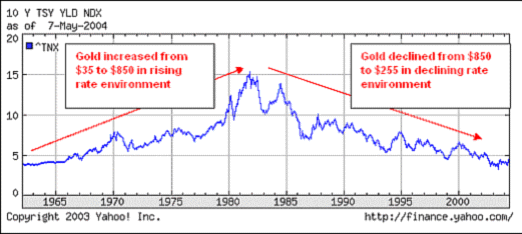
It would seem that an increase in sales heralds an increase in sales, therefore and increase in inflation, and therefore an increase in POG. The inevitable interest rate hikes would seem to presage this or come soon after. We saw the highest prices of gold in the 1980's after a round of inflation and increased consumer demand of the 70's, much higher salaries, increased oil prices, fallout from war after 1968-72, unrest in the mid east, and fall from the gold standard. As inflation dived in the late 1980's and interest rates too, the gold price fell.
Here are some tomes on demand, interest and POG.
GOLD AS MONEY
The problem with gold is that it is not viewed as a scarce resource, but a form of money, so its supply/demand is not seen a prime driver of its price. (The idea driven by its price setters that money is not scarce? I guess its scarcity depends on whether you are a political force and friend of the banker or a mere businessman. )
A Mythology has developed since the 1930's driven by, of all people/forces, the central bankers, who duplicitously deny gold's evident usage in order to try to extricate the metal from its monetary connection and by doing so free up their cash machines from being followed by a a tell-tale index. That mythology is that gold has little use and is of low value. This philosophy, if accepted widely, would ordinarly help to make their cash of high value no matter how much they printed.
************************************************
DEMAND
"With the General Theory, as it became known, Keynes sought to develop an theory that could explain the determination of aggregate output - and as a consequence, employment. He posited that the determining factor to be aggregate demand. Among the revolutionary concepts initiated by Keynes was the concept of a demand-determined equilibrium wherein unemployment is possible, the ineffectiveness of price flexibility to cure unemployment, a unique theory of money based on 'liquidity preference', the introduction of radical uncertainty and expectations, the marginal efficiency of investment schedule breaking Say's Law (and thus reversing the savings-investment causation), the possibility of using government fiscal and monetary policy to help eliminate recessions and control economic booms. Indeed, with this book, he almost single-handedly constructed the fundamental relationships and ideas behind what became known as 'macroeconomics'."
**********************************************************
INTEREST
"And second, if interest rates always orient to one magnitude, and reliably so, and not to the profitability of a project, but to the balance of payments of a country, then you always know whether they will go up or down. If there is a balance of payments deficit, they will rise, and if there is a surplus, they will drop. I.e., the financial markets of the nineteenth century were embedded in a globally ordered system. And it is always a certain aha!-experience for me--I do not know whether representatives of the present Free Democratic Party, the liberals, are among us--that today's liberals have no notion that, in the nineteenth century, everything was quite liberal on the markets for goods and commodities, but there was one market that was never liberal: That was the money market. This market was always ordered by the state and high authority by means of central banks, by means of coinage laws, and a political price of gold."
****************************
GOLD
"This system did nevertheless--many would say, astonishingly--collapse in the great stock market crash of 1929, Black Friday. Today, we can recognize rather precisely why. Because at that time people broke the rules. At that time, the United States, misevaluated the situation and ignored the rules of the gold standard, and although it was a surplus country, it did not reduce interest rates, but raised them. This interest-rate escalation then spread quickly to the countries of the gold standard at that time. Furthermore, since the United States was in a difficult domestic situation, as were England and Germany, also, but for different reasons, the U.S. could not live with this imported rise of interest rates, and that led to their exit from the gold club and the end of the gold standard, and that led to a real economic crisis, which, from 1930-35, then led not only to hundreds of currency devaluations--because everyone passed the devaluation on down the line. Rather, in real terms, it led to the tripling of the values on the commodities, services, and investment markets in the world economy of that time."
**************************************


 |



