Mobile Cultures ...
The San Jose based author of the blog entry below is a "technology guy working as a principal at Rubicon Consulting, [that helps] companies solve marketing, product planning, and competitive problems." He's a former Chief Competitive Officer and VP of Product Planning at Palm, VP of Strategic Marketing at PalmSource, and director of Mac Platform Marketing at Apple.
>> European vs. American Mobile Phone Use
Michael Mace
Mobile Opportunity
September 05, 2006
tinyurl.com
In last week's post about Palm's phone plans, I made a passing comment about the right way to display your mobile phone at dinner in Europe [see excerpt that follows this]. It turned out to be the most popular part of the post, and produced a couple of requests that I say more comparing European and American attitudes toward mobile phones. I don't pretend to the world's expert on the subject, but I'll summarize what I've seen. Here goes:
In the US, a cellphone is a tool. In Europe, a mobile phone is a lifestyle.
I guess I ought to give a few details. Let me start with a disclaimer: It's very dangerous to talk about "Europeans" as if they're some sort of unified cultural group. Europe is a continent of many nationalities, and each one has a different culture and history. National regulations on phones also differ dramatically within Europe, which has an important impact on mobile use.
I saw a good example of this in the responses to my last post. I said all Europeans put their mobile phones on the table during a meal. I got replies from some countries agreeing with me, and others saying I was completely wrong. It turns out the table thing differs from country to country.
It's only slightly less hazardous to talk about a "typical" American mobile phone user. The culture in the US is more uniform than it is in Europe, but there are profound differences between various market segments. The average 16-year-old in the US views a mobile phone very differently than the average 40-year-old. (Come to think of it, I suspect average 40-year-old mobile users in Berlin and Chicago probably have more in common with each other than either of them have with the 16-year-old.)
Now that I've hedged thoroughly, here are those details:
Vocabulary
The differences start with the words we use to talk about the industry. In Europe, a mobile phone is usually called (in English-speaking countries) a "mobile." As in, "I'll ring your mobile." In the US, mobile phones are most often called "cellphones," and that's sometimes shortened: "I'll call your cell."
The term differs in other European countries, of course (for example, Hermann on Brighthand says the term in Germany is "handy.") I do know that if you say "cellphone" pretty much anywhere in Europe, people will look at you like you're a dork. Found that out the hard way.
Occasionally young people in the US use the term "mobile," but it's not very widespread. I try to use the term "mobile phone" in this website because it's understood on both continents.
There are also differences in the terms used to describe the companies that sell mobile phone services. In the US they are generally called "carriers." But the second easiest way to piss off a European mobile exec is to call his or her company a carrier. They are "operators." As the distinction was explained to me, an operator actively runs a network, while a carrier merely delivers something passively.
(In case you're wondering, the first easiest way to piss off a European mobile exec is to ask how his MMS revenues are doing.)
The operator vs. carrier thing is very confusing in the US, because to most Americans an "operator" is a person who runs a switchboard. The archetypal operator is Ernestine, a character created by actress Lily Tomlin. She snorted annoyingly, was rude, and reveled in her ability to manipulate customers:

"Here at the Phone Company we handle eighty-four billion calls a year. Serving everyone from presidents and kings to scum of the earth. (snort) We realize that every so often you can't get an operator, for no apparent reason your phone goes out of order [snatches plug out of switchboard], or perhaps you get charged for a call you didn't make. We don't care. Watch this [bangs on a switch panel like a cheap piano] just lost Peoria. (snort) You see, this phone system consists of a multibillion-dollar matrix of space-age technology that is so sophisticated, even we can't handle it. But that's your problem, isn't it? Next time you complain about your phone service, why don't you try using two Dixie cups with a string. We don't care. We don't have to. (snort) We're the Phone Company!" - Ernestine -
Some people might say that's a good metaphor for a mobile phone company, but it's hard for an American to understand why any company would want to apply the term to itself.
The Mobile Phone Culture
To me, one of the most pronounced differences between mobile use in the US and Europe is that Europe has a more developed mobile phone culture. There are huge variations in attitude from person to person, but on average, people in Europe expect the mobile to play a more prominent, recognized role in the structure of society, and many people look to the mobile as a central source of new innovations. The belief is almost that the mobile phone has a manifest destiny to subsume everything else. This love affair with the mobile phone is far more common in Europe than it is in America.
You can find a good example of this attitude in an essay about the future, on the website of the Club of Amsterdam, a think tank based in the Netherlands:
"Every machine will be a mobile phone, talking to their owner but mainly to other machines.... In 2020 the world is one big video screen, one big video camera, one big mobile phone.... The mobile will act as a "trust machine". It will be our most important lifestyle instrument. It will probably be decomposed with its core elements scattered all over and inside our body."
People in the US can be just as enthusiastic about mobilizing technology, but they often think in terms of shrinking and mobilizing the PC and Internet, rather than growing the cellphone. In the US, the cellphone is often viewed as a necessary tool rather than something to love. For example, an MIT survey in 2004 found that Americans rated the cellphone number one in the list of inventions they hate but can't live without, edging out the dreaded alarm clock.
If you're still having trouble picturing the difference in attitudes, look at it this way – many people in Europe feel about their mobiles the way that Californians feel about their cars.
Okay? Got it now?
The European love of the mobile phone has several facets to it ...
Fashion. To many people in Europe, their mobile phone seems to be a fashion statement. It says something about you, much like your clothing. Americans also care about the look of their phones (just take a look at my daughter's Razr, covered in stick-on jewels and shiny dangling beady things). But in general I don't think Americans identify with the phone as deeply.
It seems much more common for someone in Europe to change phones than it is for someone in the US. All phones in Europe are GSM, and people generally understand that you can pop out your SIM card and pop it into a new phone anytime you want. The mobile is just a skin that you wrap around your phone contract. Major retail chains, like Carphone Warehouse, sell large numbers of mobile phones independent of any operator.
Although you can do the same sort of phone swap in the US if you have a GSM phone, it seems like relatively few people do it, and very few phones are sold outside of the carriers' stores. I'm not sure why. I think awareness of the capability is lower (I'll bet a majority of American GSM users couldn't even find their SIM card). And of course many mobile phone users in the US are on CDMA, forcing them to go through the carrier if they want to switch phones. But also, I think there's just less desire to constantly update your phone in the US, because people don't pay as much attention to it.
Design. This is related to the fashion topic, but it deserves a separate discussion because it's so surprising, at least to me. In most consumer goods, there's an approximate consensus on design between the US and Europe. You can find exceptions, but in general clothing, pop music, cars, and furniture considered to be cool in one continent are admired in the other. In fact, a lot of Americans think of "European design" as automatically stylish. But mobile phone styling and features often polarize people in the US and Europe. In Europe, people generally hate external antennas on a phone. In the US, most people don't notice the antenna, and if they do notice it they may well like it because they assume it'll give better coverage.
Many people in Europe love candybar phones. Most Americans think they look cheap and dislike them. Instead, many Americans love flip phones. I think they feel the flip cover prevents accidental calls, and keeps the screen from getting scratched. Maybe they also feel a bit like Captain Kirk when they flip open the phone.
Many Europeans hate flip phones. I don't know why (although I'll speculate that the flip cover makes it inconvenient to send and receive a lot of SMS messages).
SMS vs. IM. Speaking of SMS, it's vastly more popular in Europe than it is in the US. Some of this difference is generational – young people in the US are much more likely to use SMS, whereas it's extremely rare among older Americans. Some of the difference is also training – most Americans don't have a clue how to enter text on a keypad. But even among young Americans, who do the most texting, I think PC-based instant messaging is still the king, now often tied to webcams.
History helps to explain the difference. The US started with a more PC-centric culture, and then IM was pushed aggressively by AOL in the United States, years before many mobile phones here were SMS-capable. There was no great champion for instant messaging in Europe, and besides PCs with Internet connections were less common there in the early days of IM. So SMS had a lot less competition.
Because of differences in mobile phone billing plans, I'm told that sending an SMS was often much cheaper than making a voice call in Europe. US mobile plans, with their large blocks of monthly minutes, supposedly create less of an incentive to use SMS. (In fact, many American mobile plans don't by default include any pre-paid text messages; you pay separately for each one. There's an amusing television commercial by one of the US mobile carriers showing a father relentlessly pursuing his teenage daughter around town – not to keep her out of trouble with her boyfriend, but to keep her from sending text messages on her phone.)
I did a quick spot check of Orange (UK) and Cingular (US) mobile plan charges, to look at the current price differential between voice and text. The main difference was actually that everything in the UK cost more than it does in the US, perhaps due to the horrific dollar-pound exchange rate. The difference between the US and UK in treatment of text messages was not as dramatic as I expected, but it was there. Today the US and UK both charge more for voice than text, but the plans I looked at in the UK almost all either bundled text messages in the base plan, or had options to get a lot of text messages for free if you spent a certain amount on your voice calls. In the US, text messages were always an option that you had to purchase separately, and there was no opportunity to get free text messages. Basically, you have to plan on spending extra if you want to do texting in the US.
(The details: Using a prepaid plan, Cingular in the US will sell you 900 minutes a month for $60, but you'll have to pay $5 extra per month to get 200 text messages. That same $60 spent with Orange in the UK will get you just 325 voice minutes, but 150 text messages are included in the base price. The UK plan creates a strong incentive to substitute text for a voice call when you can.
(If you look at pay as you go plans, Orange charges 38-76 cents a minute for voice calls [depending on whether the call is to a mobile or a land line], and 19 cents for each text message. So a text message is half to a quarter the price of a voice call. However, Orange also gives you 1,000 free text messages if you spend more than $19 a month. Most people would end up getting the free texting, so their effective price for text messaging drops to almost zero. Cingular charges you about 25 cents a minute for voice calls, and five cents per text message. Texting is one fifth the price of a voice call, actually a better ratio than Orange. However, there's no option to get free text messages, so you know you're paying for them no matter what.)
Differences In Market Structure
Operator power. In general, the US carriers have more power over their customers than the European operators do, for several reasons. The first is that pay as you go plans are much more popular in Europe than they are in the US. In some countries (Italy, for example), almost everyone was on pay as you go the last time I checked. In other places in Europe, users are split between pay as you go and contracts. But I don't know of any place in Europe where as many people are on contracts as they are in the US (please speak up if I've got that wrong – it's hard to find numbers on the percent of users on each type of payment program).
The second difference is mobile phone number portability (which lets you keep your number if you switch mobile operators). Many countries in Europe had it years before it came into the United States. For example, the UK got portability in 1998, Spain and Sweden in 2000, and Italy in 2001. Americans didn't get it until the end of 2003.
Another important difference is that in parts of Europe phone subsidies are illegal. I know about this one because at Palm I used to track the sales prices of mobile phones, and they varied wildly from country to country. I finally figured out that the subsidies were skewing the numbers. The subsidy laws are changing, and they may be allowed in most countries by now.
I think the relatively weaker customer control of European operators has driven faster innovation in Europe, because the operators have to do more to attract customers. They also can't lock a phone vendor out of the market completely, the way the US carriers have been strangling SonyEricsson.
Mobile Versus Fixed. Fixed-line phone companies in Europe are often monopolies, legendary for high costs and poor service. I have been told by many friends in Europe that it was faster and cheaper to get a mobile phone there than to wait for a land line, which drove very rapid movement toward mobiles. In the US, land line phone service is generally reliable, quick to install, and cheap, so there's much less incentive to get away from it. Some younger people in the US are starting to get rid of their land lines, but the movement is much slower than in Europe.
Reliability Of Coverage. In much of Europe, mobile phone coverage is more or less ubiquitous. There are always exceptions, of course, but generally you can make a voice call anytime you want to.
This really came home to me recently when I had the good fortune of taking a driving vacation in the fjords of western Norway. That's some of the most mountainous landscape in Europe, but I never noticed a spot where I was out of coverage (check out this coverage map). Contrast that to a driving vacation in the western US, where once you get out of the cities it is almost impossible to get a signal anywhere. For example, when I was in Grand Canyon National Park in Arizona a couple of years ago, I couldn't get a mobile phone signal anywhere in the park.
The usual American excuse for its poor coverage is that US population densities are low. That doesn't hold up to close examination – Norway has about 15 people per square kilometer, the same density as Arizona, which is not exactly crowded. The US overall has about 33, more than double Norway's density. I think Europe is just more dedicated to universal mobile coverage.
Brands. The prominence of mobile phone brands varies tremendously from continent to continent, and even from country to country in Europe. In general, Nokia is much better known and respected in Europe. Motorola is much better known and respected in the US (although it doesn't have the rock star status that Nokia has in Europe). And there are national champions like Siemens, which is heavily respected in Germany but nowhere else I know of. Samsung's brand awareness has been steadily rising in both the US and Europe, and LG is trying to tail along after it.
The differences over Nokia are the most surprising to my friends in Europe. Throughout Europe, and actually most of the world, Nokia is one of the top elite brands, like Nike in sports or Microsoft in computers. It produces an immediate aura of respectability. In the US, Nokia is lost in the crowd of semi-anonymous Euro-brands -- names like Saab or Peugeot that you've heard of but have never experienced personally.
I think Nokia recently compounded this problem with its "It's your life in there" television commercials in the US. The commercial that stuck in my mind was about "Jill," who praises the phone's ability to delete an ex-boyfriend from her phone's address book:
"It is so great because when you go to the phone and you delete and your phone asks 'Are you sure?' You look at your phone and you're like, 'oh yeah, I'm sure.'"
She then gives one of the most annoying, braying laughs I've heard on TV since...well. Ernestine.
I understand what Nokia was trying to do – it was making a sophisticated effort to tap into the mobile phone culture in the US. The problem for me was that, first, the mobile phone culture Nokia's trying to tap into is pretty weak in the US; and second, that Jill has just a whiff of trailer trash about her.
(Nokia has pulled the website for the campaign, which perhaps tells you how well it was received, but you can still find the commercial on the site of the agency that created it. Just follow this link and move your mouse around on the slider at the bottom of the page until you find Jill. You can also check out the other losers Nokia featured in the series.)
Americans tend to respond best to aspirational ads that make them feel good about themselves for buying a product. So buying a Mac will give you kinship with Einstein and Gandhi, which is outrageous but Steve Jobs can pull that off. Nokia's unintended message was that a Nokia phone will turn you into "a sniveling Sex in the City wannabe," as Gizmodo put it.
I think this is typical of Nokia's inability to connect with the American public.
What about the rest of the world?
There are even bigger variations in the mobile market in other parts of the world, but I didn't have the time (or the knowledge) to discuss all of them here. Mobile phone services and features in Japan and Korea make both Americans and Europeans look like techno-hicks. In Japan, the operators have so much power that phones are sold virtually unbranded, and Japanese phone manufacturers struggle to operate anywhere else in the world because the required reflexes are so different. It will be interesting to see what happens in Japan when number portability is implemented there, in late October. Surveys have said that large numbers of Japanese mobile phone users, especially those on Vodafone, would switch operators if the could.
The market worldwide is so complex that I think it's impossible for any one person to understand it all. <<
>> What iIf Palm Made a Smartphone and Nobody Cared?
Michael Mace
Mobile Opportunity
August 28, 2006
<snip beginninng>
... Many Americans make the mistake of believing that Europe is full of Europeans. It's not. It's full of French people, Germans, Italians, British, and so on – each from very distinct cultures with very different beliefs and traditions. Other than the World Cup, I'm aware of only two truly pan-European cultural institutions. One is the Eurovision song contest, and I'm not going to even try to explain that. The other is the practice of displaying your mobile phone on the table during a meal.
Go to lunch or dinner in any country in Europe, and when everyone sits down they'll take out their mobile phones and put them on the table. There's even a proper place to put the phone, about like this:
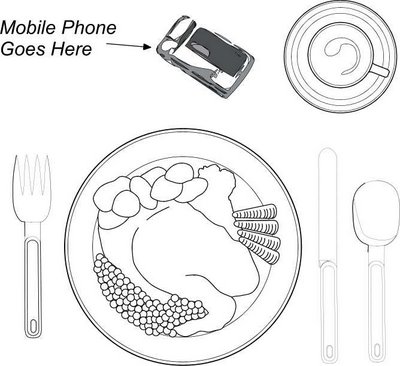
Note that you don't lay down the phone straight – it needs to look like you just casually dropped it on the table.
Then everyone at the table surreptitiously checks out everyone else's phone. There's a subtle hierarchy of status associated with which phone you carry. I haven't decoded all of it yet, but definitely you get some extra status for having what's perceived to be a stylish phone. Brand also plays a role, although I think that varies from country to country. For example, carrying a Siemens phone is OK in Germany, but will peg you as a cheapskate anywhere else in the western half of the continent. Nokia has good status, depending on the model you carry, and I think SonyEricsson gets you tagged as a little more creative than average. If you have a Motorola it says you're an American.
And then there's the Treo. I've been told by several European friends that slapping down a Treo on the table gets you labeled as a geek. And not a nice geek in the American sense (visionary and probably rich), but geek in the bad sense (socially misfit and physically underdeveloped). The keyboard, which American users tend to regard as a badge of business power and importance, comes across as pathetically computer-obsessed to a lot of folks in Europe. At least that's what I've been told by people over there.
It's possible that image is evolving as RIM and Nokia bring more keyboard-based phones to market. But if not, Palm will have a lot more trouble on its hands than just what OS it's running. .... <snip rest> <<
There are some interesting articles. posts, and links on Mobile Opportunity ...
mobileopportunity.blogspot.com
- Eric - |



