The Hoariest Night On Diablo
It was the fifteenth of August, 1962. Not yet three months out of high school, I had already been at 7500 feet above sea level for six weeks.
Alone.
I was the lookout-fireman on Diablo Mountain, and I had spent those six weeks searching in vain for a tell-tale gray wisp that would shout “Fire on the mountain!”
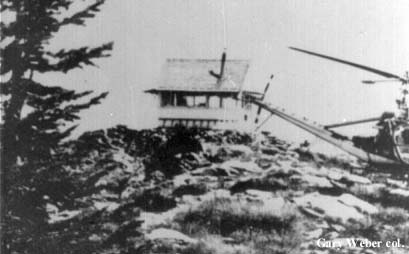
There was no smoke because there was no fire.
I was frustrated, secretly praying for lightning or a careless campfire that would make me a hero and justify my existence on the lonely granite monolith called Diablo. Day after day I searched my seen-area, memorizing every ridge, every stream, every lake, every mountain, and every named point through the walls center of my glassy cabin.
I tested myself on the Osborne Fire Finder, pretending that a boulder over on the faraway Bitterroot Divide was a smoke.

Peering through the sights at the boulder, I consulted the azimuth reading on the scale around the circular map. That gave me the exact direction in degrees from my location, indicated on the map by a tiny pin at the very center of the fire finder, to the pretend fire at the boulder.
That was the easy part.
The hard part was estimating the distance from Diablo Mountain to the boulder. My map had been lightly shaded to indicate the seen area, the terrain visible in my line of sight. The far side of ridges and peaks was outside of my seen area. I could not see slopes that were closer than slopes I could see, and in some directions the seen area was striped like a zebra. It was different in every direction, because of the lay of the land.
The storied Bitterroot Divide was the limit of my seen area to the east, and though the State of Montana was just on the other side, I could see none of it.
My weeks of practice had honed my skill, so when Big Daddy came up after three weeks with his horse and pack mule to conduct my first inspection, I got good marks for terrain knowledge. Big Daddy said my logbook was messy, and left me with the mail and extra grub he had brought. I waved at his mule as he turned the bend in the trail on his way to Elk summit and a steak dinner.
Still there was no smoke because there was no fire.
Alone again.
Twilight in the mountains is a leisurely affair, totally unlike the quick darkness that falls to mariners and lovers walking on western beaches. For the fire lookout, night comes slowly on little cat feet*.
Long before the sun went down on my abode at the top of Diablo Mountain, sunlight poured through the western window wall, revealing every smudge, every fingerprint, every streak on every pane of glass that I had just spent days scrubbing with Kimwipes and Windex getting ready for Big Daddy’s inspection.

Blinded by the sun in the west, I spent the evening watching alpenglow flood the mountains to the east.

Mesmerized by the lovely reddish glow on the granitic peaks that formed the Bitteroot Divide, I checked my watch. Seven pm. I posted the following entry in my logbook: “1900 hours, 10-7 for the night. Alpenglow on the Bitterroots.” I loved the radio codes; 10-7 meant I was at the end of my work day and turning off my two way radio.
I stepped outside for a last look-around when the hair on the back of my neck started to stand up. This would be a strange night, of that I was sure. The feeling I had was like the sensation one gets while walking down a dark alley alone at night, or crossing a graveyard in the moonlight. Like someone was watching. I could almost feel hot breath on my neck. Hot stinking breath.
At 1930 or so, the sun started to slip behind Graves Peak, and I knew by 2030 it would be dark. I could not shake the feeling of dread that was coming with nightfall, but I scanned the horizon once more and turned back east to the Bitterroot Divide.
FIRE!
Had my prayers been answered? Had that lightning strike over in Montana a week ago broken loose? Could I be seeing my first fire? And it was a big one. A crown fire, most likely, running fast. I could see my reputation now in the annals of lookout history: “The devastating Bitterroot Divide Fire of 1962 was discovered and reported by Diablo Mountain Lookout.”
I turned on my radio. “Diablo, 10-8,” I said. That code meant I was back on the air.
The longer I looked, the more alarmed I became. The blazing ridgeline grew brighter and brighter. Is that a fire? It must be! What else could it be?! I took azimuth readings on my Osborne Firefinder, but the blaze was way off the edge of my map, over in Montana. Perhaps someone has already reported it.
Now is my only chance. I picked up the mike. “Powell, Diablo.” I was about to utter the four code that would alert everyone listening in that I was about to report a wildfire.
One last look: The skyline was fully ablaze now, almost like a nuclear fireball. I took a deep breath and …
“Powell, Diablo, 10-7.”
I had saved myself by the narrowest of margins from reporting the full moon rising over the Bitterroots on the night of August 15th, 1962 at 2001 hours.

Exhausted, I flopped on my bunk. My heart thumped and all the adrenalin that had flooded my system had nowhere to go.
I lay on my bunk as the moon rose every more brightly through my eastern window wall. Fighting fear, my mind refused sleep. Eyes wide open. Staring at the ceiling, staring at my fire finder, staring at the moon well on its heavenly arc over Diablo. Staring at the ghostly shapes of moon shadows thrown by wind-tortured subalpine fir trees just under the rim of my mountain sanctuary.
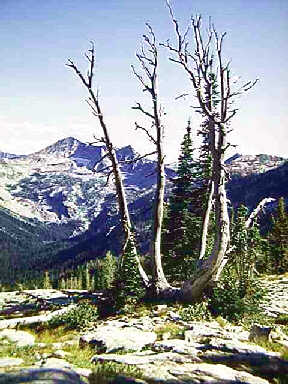
Just outside my western window wall, inches away, the precipitous cliff that distinguished Diablo Mountain from lesser hills fell away more than five hundred feet.
I heard a rock roll on the cliff. Another.
The hair on the back of my neck stood up still. The hot breath of escape from humiliation had turned to the cold breath of dread. A cold stinking breath, like that escaping the lips of a corpse.
A few more rocks rolled over the cliff, and I could hear rustling sounds, spooky sounds that terrorized my already panic-stricken mind. Scratching sounds, like that of someone buried alive trying to escape the coffin.
Suddenly there was a terrific clatter right outside my window. CLUNK! Clunk! Clunk, clunk, clinkclinkclinkclink.
Then silence.
I pulled my sleeping bag up over my head and prayed that the monster would leave me be. In due time, sleep came.
The morning sun flooded through my eastern window wall, and I rose to go outside to the customary boulder where I could whiz off last night’s coffee. I opened the door, idly noticing that my washtub was missing. After whizzing, I peered over the cliff on my western side. There the washtub lay smashed on a boulder a hundred feet below.
I started a fire in my little wood stove and filled the coffee pot with cold water from my five gallon can.
I turned on the radio. “Diablo, 10-8.” I was back on the air, my integrity intact, my nerves restored by sleep.
“Diablo, this is Powell.”
“Powell, Diablo. Go ahead.”
“Big Daddy wants to know if you saw that hoary marmot last night. He says it comes out and wanders around the lookout when the moon is full like it was last night.”

The End.
Hoary
–adjective, hoar?i?er, hoar?i?est.
1. gray or white with age: an old dog with a hoary muzzle.
2. ancient or venerable: hoary myths.
3. tedious from familiarity; stale: Please don't tell that hoary joke at dinner again tonight.
Moon Phases: shetline.com
Moonrise:
.S. Naval Observatory
Astronomical Applications Department

Sun and Moon Data for One Day

The following information is provided for Missoula, Missoula County, Montana (longitude W114.0, latitude N46.9):

        Wednesday
        15 August 1962        Mountain Standard Time

                         SUN
        Begin civil twilight       5:00 a.m.
        Sunrise                    5:33 a.m.
        Sun transit               12:40 p.m.
        Sunset                     7:47 p.m.
        End civil twilight         8:20 p.m.

                         MOON
        Moonrise                   7:20 p.m. on preceding day
        Moon transit              12:12 a.m.
        Moonset                    5:10 a.m.
        Moonrise                   8:01 p.m.
        Moonset                    6:27 a.m. on following day


Full Moon on 15 August 1962 at 1:09 p.m. Mountain Standard Time.

*  Apologies to Carl Sandburg

Carl Sandburg

Fog

                    The fog comes
                    on little cat feet.

                    It sits looking
                    over harbor and city
                    on silent haunches
                    and then moves on.
|



