I think the magnitude is for the most part comprehensible. To help the student grasp magnitudes here, think in terms of people and personal copper.
6.5 billion people on the planet.
Geometric growth rate.
(two parents try to produce 4 children every 20 years X 66% fertility rate = growth rate of 1.39%) So in 40 years we will have a population of 1.013978^40 or 11,325,428,000 people.
Now each person will consume a new millenium amount of copper equal to 50 lbs per person, per year which amounts to 257 million tons of copper per year consumed worldwide in 2051. Right now that figure is 18 million tons consumed per year.
257 million tons of copper, if composed of Cpy would be 771,000,000 tons of chalcopyrite. That would occupy 4 billion 942 million cubic feet of space. That is a cube 1690 feet on a side.
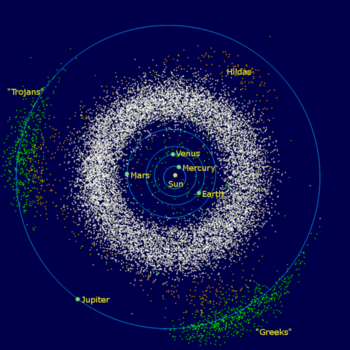
So we would have to latch on and tow an asteroid of chalcopyrite back from the near earth asteroid belt (Kuiper Belt) every year. Probably a copper asteroid every ten years would be more realistic. It takes a few years to get there and a few years to accelerate a billion tons to a good speed to make the 200 million mile journey back in good time. We need to get to about 10,000 fps with the body, which would require a force of F=MA -- 0.01585 fps/s = 764,000,0000 lbs for 2 years to get the body to 10,000 feet per second and get it here in another 1.8 years. hmmmm.. need to manufacture our own rocket fuel when we got there..
Interplanetary Superhighway Cassini, All Roads Lead to Mars Romer.

But the formula is probably not right, as all you have to do is nudge it out of orbit and it will fall to earth.. it does not seem to need speed at all... it seems to needs slowing down.. which is a whole other thing.. Actually you fire the rockets in reverse, it speeds up and falls, but that is another story.
Asteroids are zipping along at 18 km per second, so how much do we shave off to induce falling? It may turn out it is not much as the body would most likely take an interplanetary transfer orbit of very low energy as figured out by Poincare en.wikipedia.org
A third category of asteroids, forming about 10% of the total population, is the M-type. These have a spectrum that resembles metallic iron-nickel, with a white or slightly red appearance and no absorbtion features in the spectrum. M-type asteroids are believed to be formed from the metallic cores of differentiated progenitor bodies that were disrupted through collision. However, there are also some silicate compounds that can produce a similar appearance. Thus, the large M-type asteroid 22 Kalliope does not appear to be primarily composed of metal.[30] Within the main belt, the number distribution of M-type asteroids peaks at a semi-major axis of about 2.7 A.U
Don't kid yourself. A ni-cu asteroid that has 10% ni-cu-fe in it is well worth the trouble of accelarating bits of it back to earth in an ITO rail gun type thingie. Over time the fabulous stores of metal would pay handsomely. We just have to figure out how to aim it accurately so the asteroid bits only fall to earth on eskimo villages and the like where no one will hear it...
chron.com
All metals being up is a clue 'something is up'*. How many times has this happened before? It points to consumption.
* API.. all puns intended. |



