Theater breaks new ground in Beijing
usatoday.com
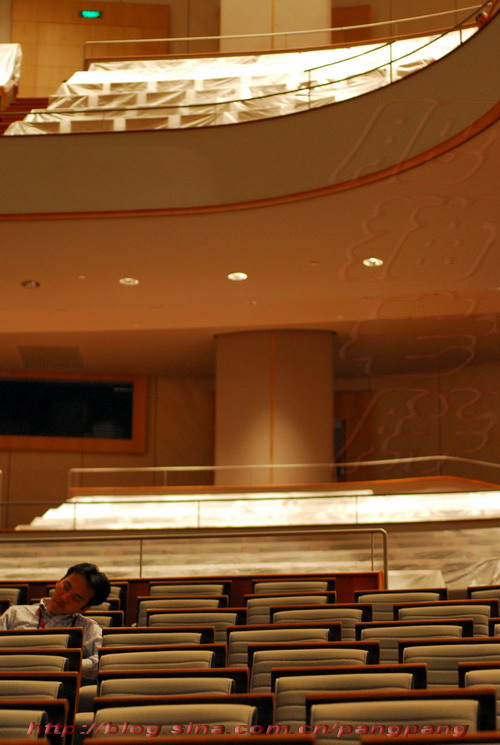
The controversial National Grand Theatre, a shiny half sphere that sits awkwardly next to the Soviet-style Great Hall of the People in downtown Beijing, is due to open at the end of the year.
Enlarge image Enlarge By Jason Lee, Reuters
The controversial National Grand Theatre, a shiny half sphere that sits awkwardly next to the Soviet-style Great Hall of the People in downtown Beijing, is due to open at the end of the year.
By Calum MacLeod, USA TODAY
BEIJING — The Eggshell, the Tomb, or the Big Bubble. Those are just a few of the derogatory nicknames that Beijing residents have used for the National Grand Theater, a massive, silvery dome in the heart of China's capital.
Despite an unusually loud outpouring of public skepticism, Chinese officials insist the building, which held its first, invitation-only shows last week, will amaze foreign visitors during the 2008 Olympic Games.
The futuristic, titanium-plated, $350 million complex just off Tiananmen Square is yet another demonstration of China's growing economic might and desire to outdo the Western world in every respect, including culture.
Deng Yijiang, the theater's director, visited Broadway and watched 42nd Street during research to produce a theater he claims will be "bigger and more advanced than any of the theaters I saw in the USA."
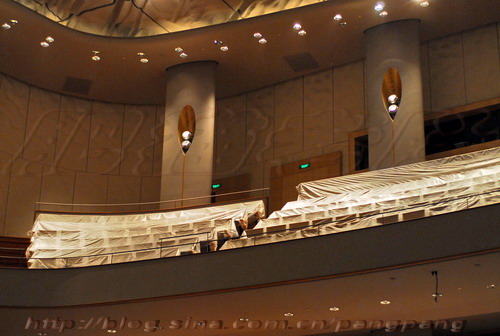
The theater — which will host opera, ballet, musicals, dance, dramas and traditional Chinese performances — is "a concrete display of China's growing national comprehensive strength," Deng said.
FIND MORE STORIES IN: China | BEIJING | Chinese | Broadway | Theater | Tomb | Paul Andreu
However, several top Chinese architects have signed petitions opposing the design, and many in online forums have described it as an eyesore. The building stands in stark contrast to the Stalinist pomp of nearby government buildings in central Beijing and the imperial grandeur of the centuries-old Forbidden City.
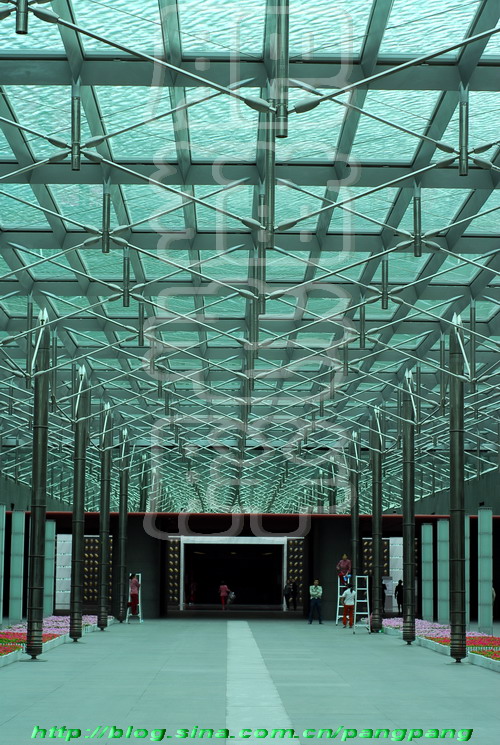
The structure's designers point out that the Sydney Opera House and the Louvre Pyramid in Paris overcame initial criticism. They say detractors have already started to change their minds as they explore the interior, which is accessed via a glass-ceilinged corridor that passes underneath a massive lake.
"People have called it an 'egg' or a 'tomb,' but I believe that 'pearl on the water' is becoming the popular name," said Zhou Qinglin, the lead Chinese designer.
"There has been controversy about the design ever since it was approved (in 2000), right up to the present, and it will continue," Zhou admitted. "But the people of Beijing are accepting the design now. When I went online, I used to see many people opposing the theater, but now I see more people are supporting it."
American philharmonic orchestras will be among the first international acts to showcase the theater in its opening season, from December through March, Deng said.
The theater is now testing its state-of-the-art equipment on homegrown fare such as the bayonet- and hand-grenade-toting ballerinas of The Red Detachment of Women, a communist piece championed by Madame Mao during the Cultural Revolution.
Cameron Mackintosh, the impresario whose theatrical spectacles have helped transform Broadway and London's West End, says his new China company will change this country, too. He plans to bring the suitably revolutionary Les Miserables, in Mandarin Chinese, to the new theater next fall.
The dream of a Chinese national theater dates to the 1950s, when then-premier Zhou Enlai first proposed the scheme. China's economic success in recent decades revived the idea, and opening up to the West meant the project could have a foreign designer — French architect Paul Andreu.
Andreu has spoken of the "enormous stress" surrounding the project, including the huge cleaning bills to keep shiny the titanium-and-glass surface in a city bedeviled by sandstorms and dust storms. But he defends his modernist approach. "Your people do not look back," Andreu told the state-run People's Daily last week. "They have a history, they know about their history and are proud of it, but they live and look ahead."

 |



