From another thread:
World Oil Forecasts Including Saudi Arabia, Kuwait and the UAE - Update Feb 2008
Posted by ace on February 17, 2008 - 10:00am
Topic: Supply/Production
Tags: aramco, burgan, demand, ghawar, kuwait, oil, oil production forecast, opec, original, peak oil, production, saudi arabia, supply, united arab emirates, zakum (list all tags)
Executive Summary
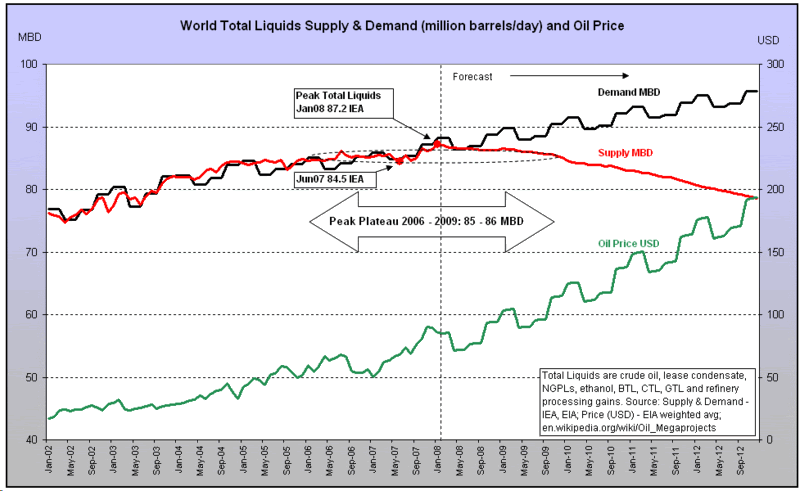
World total liquids production (Fig 1) remains on a peak plateau since 2006 and is forecast to fall off this peak plateau in 2009. Increasing numbers of oil experts are forecasting impending peak production plateaus. According to the International Energy Agency (IEA), the current peak production of 87.2 mbd occurred on January 2008. As long as demand continues increasing then prices will continue increasing.
Forecast world crude oil and lease condensate (C&C) production retains its 2005 peak (Fig 2). The forecast to 2100 shows declining C&C production, using a bottom up forecast to 2012 (Fig 3). The forecast to 2012 shows a slight decline to 2009, followed by a 3%/yr decline rate to 2012.
World oil discovery rates peaked in 1965 (Fig 4) and production has exceeded discovery for every year since the mid 1980s. Discoverable reserves in giant fields also peaked during the mid 1960s (Fig 5). The time lag between world peak discovery in 1965 and world peak production in 2005 of 40 years is similar to the time lag of 42 years for the USA Lower 48 (Fig 6).
World C&C year on year production changes to October 2007 and November 2007 (Figs 7 and 8) show significant declines for Mexico, North Sea and Saudi Arabia and significant increases for Russia, Azerbaijan and Angola. As Russia is likely to be on a production plateau and Saudi Arabia, Kuwait and the UAE have probably passed peak production, the world C&C production will continue to decline slowly.
Saudi Arabia retains its 2005 C&C peak (Fig 10), which is the same as the peak year for world C&C (Fig 2). Saudi Arabia C&C production has dropped to 9.0 mbd which is 0.6 mbd less than its peak in 2005. It is now almost a certainty that Saudi Arabia passed peak C&C production of 9.6 mbd in 2005 (Figs 9 and 10).
Kuwait retains its 2006 minor C&C peak (Fig 12). Kuwait C&C production has now dropped to 2.5 mbd which is less than its peak in 2006. There is a strong likelihood that Kuwait has passed its minor 2006 peak (Figs 11 and 12). Kuwait’s major peak was 3.3 mbd in 1972.
UAE retains its 2006 C&C peak (Fig 14). UAE C&C production has now dropped to 2.6 mbd, adjusted for maintenance, which is just less than its peak in 2006. There is a reasonable likelihood that UAE passed its 2006 peak (Figs 13 and 14).
World natural gas plant liquids is forecast to increase due mainly to new OPEC projects (Fig 15). World ethanol and XTL production is forecast to almost double by 2012 (Fig 16). World processing gains are forecast to decline slowly to 2012 (Fig 17).
Major Changes from the Previous Update Oct 2007
The major changes from the previous update are the inclusion of additional forecast production from the projects listed at Wikipedia Oil Megaprojects and the increase in OPEC production quota by 0.5 mbd starting 1 Nov 2007. There are also a few paragraphs added in section 1 below describing the increased consensus about peak oil by more oil industry experts.
1. World Total Liquids Supply & Demand
Although crude oil & lease condensate (C&C) production is forecast to continue declining, the total liquids supply remains on a plateau until 2009 (Fig 1), due to offsetting production increases from natural gas plant liquids (NGPLs), ethanol and XTL (BTL - biomass to liquids, CTL - coal to liquids and GTL - gas to liquids). The main causes for the end of the total liquids plateau in 2009 (Fig 1) are that the C&C production decline rate accelerates to 3%/yr in 2009 (Fig 3) and the production growth from natural gas plant liquids stalls (Fig 15).
Fig 1 - Total Liquids Supply & Demand to 2012 (bottom up forecast) - click to enlarge
Is future total liquids production likely to exceed the current peak of 87.2 mbd on January 2008? It might be possible but it appears unlikely. North Sea production continues to decline. Mexico's production is also in decline. Former USSR production might increase by a small amount. Canada's production should increase slowly but the oil sands are experiencing production constraints and despite claimed reserves of up to 315 Gb (billion barrels), the oil sands will probably produce, at best, a maximum of only 2.5 mbd (million barrels/day). Biofuels production should also continue increasing. Non OPEC total liquids production might increase slowly, assuming that no unexpected disruptions occur.
Increasing Numbers of Oil Experts are Forecasting Impending Peak Production Plateaus
Matt Simmons’ presentation to the Minnesota House of State Representatives, February 4, 2008, shows the current production plateau on slide 29, with a forecast of 69 mbd crude oil and lease condensate by 2012. On January 31, 2008, Kang Wu and Fereidun Fesharaki, of the East-West Center, released a book titled "Asia's Energy Future: Regional Dynamics and Global Impliciations" which stated that global oil production might increase to 100 or perhaps even 105 mbd somewhere between 2015 and 2020. Jeff Rubin and Peter Buchanan, CIBC World Markets, wrote a report, dated January 10, 2008, which forecasts a peak production plateau of just over 88 mbd from 2011 to 2012. On January 22, 2008, Jeroen van der Veer, CEO of Shell, in an email to all Shell employees, acknowledged the reality of peak plateau when he said that “after 2015 supplies of easy-to-access oil and gas will no longer keep up with demand”. In a similar acknowledgement in November 2007, the CEO of Total, Christophe de Margerie, and the CEO of ConocoPhillips, James Mulva, both stated that supply would not exceed 100 mbd. Colin Campbell, in his November 2007 newsletter also stated the possibility of a peak plateau now, altering his original forecast of a depletion based “Peak in 2010 at 87.3 Mb/d that becomes 90 Mb/d with refinery gain. A depletion-based Peak may not of course be reached if high prices hold down demand, delivering more of a plateau than a peak”.
On October 30, 2007, Shokri Ganem, Libya's National Oil Corp Chairman, said that supply may not exceed 100 mbd and later, in January 2008, he said that OPEC can do little and that most OPEC countries are producing at capacity. Sadad Al-Husseini, former Saudi Aramco exploration and production head, presented this production forecast at the Oil & Money October 2007 conference which showed a production plateau of crude oil, condensate and natural gas liquids extending from 2009 to 2012 at 83 mbd, followed by a decline. Dr. Werner Zittel and Jorg Schindler, Energy Watch Group, wrote a report, dated October, 2007, which forecasts a historic peak of 81 mbd in 2006 of crude oil, condensate and natural gas liquids. On October 8, 2007, Jim Buckee, retired CEO of Talisman Energy, said that the world is at peak production or close to it. Finally, Chris Skrebowski, editor UK Petroleum Review, said in October 2007, that world total liquids production will reach a peak plateau of 92 mbd during 2010 to 2011 but he adds: “so what my analysis is saying is that we’ve got another 5 to 7 million barrels a day to come if everything works properly”.
Another expert who made great contributions to the awareness of peak oil is Dr. Ali Morteza Samsam-Bakhtiari, a retired director of the National Iranian Oil Co., who regrettably passed away in October 2007. Dr Samsam-Bakhtiari, using his WOCAP model, predicted a 2006 to 2007 peak plateau of 81 to 82 mbd of crude oil, lease condensate and natural gas plant liquids. He also said that “it became clear that the modelling phase of ‘Peak Oil’ had come to an abrupt close and that henceforward ‘Peak Modelling’ should be shelved once and for all”.
As world total liquids production is forecast to decrease to 2012 (Fig 1), two important consequences are likely to occur. First, as demand is forecast to increase, prices are forecast to rise, using short and long run price elasticities, which will force demand downwards to equal supply. Second, the decreased available supply may invoke the IEA Response System for Oil Supply Emergencies. Unexpected supply reductions could trigger oil rationing among the 26 countries which are signatories to this IEA Response System, but unfortunately China, Russia, India and Brazil, which are not signatories, are highly unlikely to agree to the IEA’s rationing method because its rationing basis is by country rather than by person. The resulting tensions, from oil supply shortages, among the signatory and non-signatory countries could lead not only to continued competitive oil bidding, but also to continued conflicts and violence in order to secure vital oil supplies.
2. World Crude Oil & Lease Condensate Production
The largest component of world total liquids production is world C&C production. The first part, 2008 to 2012, of the forecast to 2100 (Fig 2), is created using a bottom up forecast based on over 350 continuously updated regions/projects from 2008 to 2012 (Fig 3). After 2012, two scenarios are shown.
The first scenario, shown by the red line, is based partly on BP reserves data, but large downward revisions are made to OPEC reserves and small upward revisions are made to the reserves of many countries to derive a more accurate estimate of proven and probable reserves. Yet to find C&C reserves are added to this estimate of proven and probable reserves to give world total ultimate recoverable reserves (URR) of 1.85 Tb (trillion barrels) including remaining URR of 0.78 Tb as at end 2007.
The second scenario, shown by the green line, uses Colin Campbell’s URR estimate from his February 2008 newsletter. His URR estimate is equal to 2.23 Tb, excluding natural gas plant liquids. His estimate is higher than the first scenario estimate of 1.85 Tb due to an additional 0.23 Tb URR from the UAE, Iran, Iraq, Kuwait and Saudi Arabia, and higher URR estimates from heavy oil and polar oil. The green line forecast shows what might be possible if the middle east gulf countries really do have the reserves close to what they have claimed, if promised production increases from heavy oil occur and if additional significant polar oil is discovered.

Fig 2 - World Crude Oil & Lease Condensate Production, including OPEC Core, to 2100 - click to enlarge - (the reserves and production of the Neutral Zone are shared equally between Saudi Arabia and Kuwait)
The production from OPEC Core countries of Saudi Arabia, Kuwait and UAE is shown by the blue line and retains its 2005 peak (Fig 2). These three countries are labelled as OPEC Core because these countries have over 50% of proven reserves of OPEC-12 total proven reserves, (according to BP statistics) and produce almost 50% of the OPEC-12 total C&C production. Gately also labelled these countries as core potentially due to similar reasoning. There is a strong correlation between the production from the OPEC Core and the world.
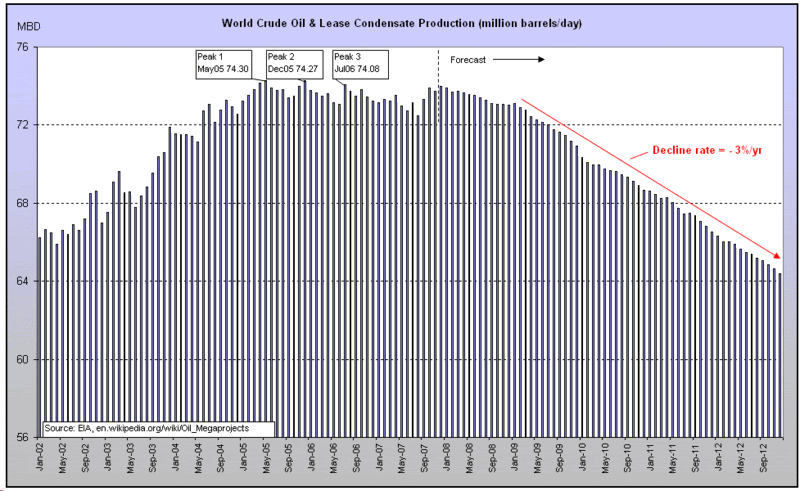
Fig 3 - World Crude Oil & Lease Condensate Production to 2012 (bottom up forecast)
read more...............
theoildrum.com |



