The only nuts I enjoy raw and unsalted are walnuts. Put a handful in my oatmeal every morning.
Fat and fiber composition of nuts
HEART SCAN BLOG
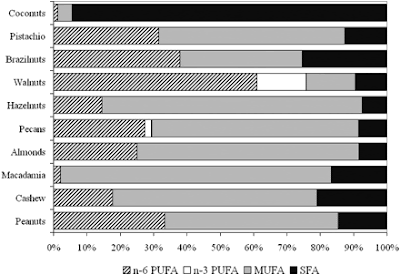
From Mukuddem-Petersen J, Oosthuizen1 W, Jerling JC. J Nutr 2005.
If you haven't yet done so, adding raw nuts to your health program yields a broad panel of health benefits.
Contrary to conventional advice, nuts can be eaten in unlimited quantities. Provided they are raw--unroasted, unsalted (since salting only accompanies roasted nuts), not roasted in unhealthy oils like hydrogenated cottonseed or soybean (very common)--they do not make you fat, regardless of the quantity consumed. Beer nuts, honey-roasted nuts, mixed nuts roasted in unhealthy oils with salt added are either fattening or exert other unhealthy effects (e.g., hypertension, rise in Lp(a), and cancer from the hydrogenated fats).
Some notable observations from the chart:
--Hazelnuts and macadamians are the richest in monounsaturates
--Walnuts are the richest in the omega-6 linoleic acid, while also richest in the "omega-3" linolenic acid.
--From a fat composition standpoint, raw cashews and dry roasted peanuts aren't so bad.
--Pistachios figure pretty favorably in this analysis, rich in monounsaturates.
--Coconuts are unusually rich in saturated fat, though about half is lauric acid--an issue for future conversation.
Here's a listing of the fiber composition of nuts per 1 oz serving (about a handful):
Almonds (24 nuts) 3.5 g
Brazilnuts, dried (6-8 nuts) 2.1 g
Cashew nuts, dry roasted, with salt added (18 nuts) 0.9 g
Hazelnuts or filberts 2.7 g
Macadamia nuts, dry roasted, with salt added (10-12 nuts) 2.3 g
Mixed nuts, dry roasted, with peanuts, with salt added 2.6 g
Peanuts, all types, dry-roasted, without salt 2.3 g
Pecans (20 halves) 2.7 g
Pine nuts, dried 1.0 g
Pistachio nuts, dry roasted, with salt added (47 nuts) 2.9 g
Walnuts, English (14 halves) 1.9 g
Data courtesy USDA Nutrient Database
Note that almonds are the winners with 3.5 grams fiber per ounce, pistachios a close second. Pine nuts and cashews place last on the fiber content chart.
Not addressed by the charts is protein content of nuts, as well as the low sugar content, all additional beneficial aspects of nuts. Nuts are also a moderate source of magnesium (though seeds like pumpkin and sunflower shine in the magnesium content area).
Rather than micromanage the specific fat and fiber content of your diet, why not get a little of the good of everything on the list and just mix and match the nuts? (Mixed and matched on your own, of course, not a hydrogenated cottonseed oil nut mixture).
heartscanblog.blogspot.com |



