What's funny is that this year is actually a record setter if you look at longer term trends, and yet, you and the media are saying it's a cold year. Very good example of how the human mind anchors on short term experiences by which to judge the present. Understandable, but not very relevant from a statistical or scientific perspective. Kudos for recognizing that anecdotal evidence isn't very relevant. However, your hint of sarcasm and the fact that you made such a silly post suggests that you still don't believe that the globe is warming, which is a testament to your illogical mind. The evidence is irrefutable that the globe is warming. We can debate the causes, but to continue to deny the earth is warming is just plain ignorant.
World heading towards cooler 2008
By Richard Black
Environment correspondent, BBC News website
news.bbc.co.uk
The early part of 2008 saw continued low temperatures in some regions
This year appears set to be the coolest globally this century.
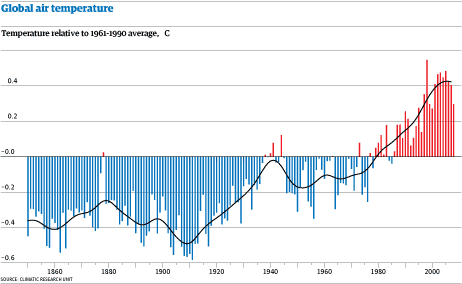
Data from the UK Met Office shows that temperatures in the first half of the year have been more than 0.1 Celsius cooler than any year since 2000.
The principal reason is La Nina, part of the natural cycle that also includes El Nino, which cools the globe.
Even so, 2008 is set to be about the 10th warmest year since 1850, and Met Office scientists say temperatures will rise again as La Nina conditions ease.
TEMPERATURES - KEY FACTS
Temperatures given as variations from 1961-1990 average
Warmest on record - 1998 - +0.515C
Coldest on record - 1862 -
-0.616C
From 2001 to 2007, varied between +0.400 and +0.479C
2008 January to June - +0.281C
Data from Hadley Centre
"The big thing that's been happening this year is La Nina, which has lowered global temperatures somewhat," said John Kennedy, climate monitoring and research scientist at the Met Office's Hadley Centre.
"La Nina has faded in the last couple of months and now we have neutral conditions in the Pacific," he told BBC News.
Scientists at the World Meteorological Organization have also suggested that 2008 will turn out to be cooler than the last few years.
Breaking the ice
La Nina cools waters in the eastern Pacific Ocean, but its effects are felt around the globe.
It is one of a number of natural climatic cycles that can re-inforce or counteract the warming trend stemming from increased levels of greenhouse gases in the atmosphere.
LA NINA EXPLAINED
La Nina 2008 Forecast (Source: UK Met Office Hadley Centre)
La Nina translates from the Spanish as "The Child Girl"
Refers to the extensive cooling of the central and eastern Pacific
Increased sea temperatures in the western Pacific mean the atmosphere has more energy, and frequency of heavy rain and thunderstorms is increased
Typically lasts for up to 12 months and generally less damaging event than the stronger El Nino
More on La Nina and El Nino
Earlier this year, one group of researchers suggested that another natural cycle, the Atlantic Multidecadal Oscillation, was likely to hold temperatures steady for about the next decade, before reversing direction and allowing a renewed warming.
"The principal thing is to look at the long-term trend," said Dr Kennedy.
"2008 will still be significantly above the long-term average. There's been a strong upward trend in the last few decades, and that's the thing to focus on."
One of the starkest effects of rising temperatures has been the rapid loss of summer Arctic sea ice, which has accelerated since the year 2000.
Earlier in the year, there were indications that 2008 could see even more ice lost than in the record-breaking melt of 2007.
Currently, the ice appears to be holding together better than a year ago, although scientists are wary as much of it is relatively fragile ice that formed in a single winter.
Canadian authorities have just declared that the Northwest Passage is "navigable", though acknowledging that some parts of it still contain floating ice. |



