The energy efficiency of energy procurement systems
Posted by Euan Mearns on February 2, 2009 - 9:51am in The Oil Drum: Europe
Some ERoEI data sources wind, tar sands, ethanol and references therein.
"We are set on a disastrous course. Governments must accept that the way we use energy must change and that a painful period of adjustment lies ahead. The energy efficiency of energy use and procurement should lie at the heart of decision-making and a good starting point is to ensure that reliable efficiency data is available to guide this process."
Energy efficiency now supposedly lies at the heart of EU and US energy policies. Whilst we are most aware of the merit of energy efficiency of energy consumption, e.g. fuel-efficient cars and well-insulated buildings, the concept of energy efficiency of energy procurement is one that has been largely overlooked. One reason for this has been the vast energy surplus provided by historic supergiant oil and gas fields of the Middle East, Russia and the Americas and vast surface coal deposits of Africa, Asia and Australia. As production from these historic fossil fuel deposits starts to decline, the OECD economies are being forced to procure energy from other sources such as wind, tidal, solar, bio-fuel and nuclear. Without most of us being aware of the fact, it has suddenly become important to understand the energy efficiency of new energy procurement systems, if industrial society as we know it is to survive the next great energy transition away from fossil fuels.
The Energy Return on Energy Invested (ERoEI) provides one measure of the efficiency of energy procurement and is quite simply defined as:
Energy procured / Energy used to procure energy
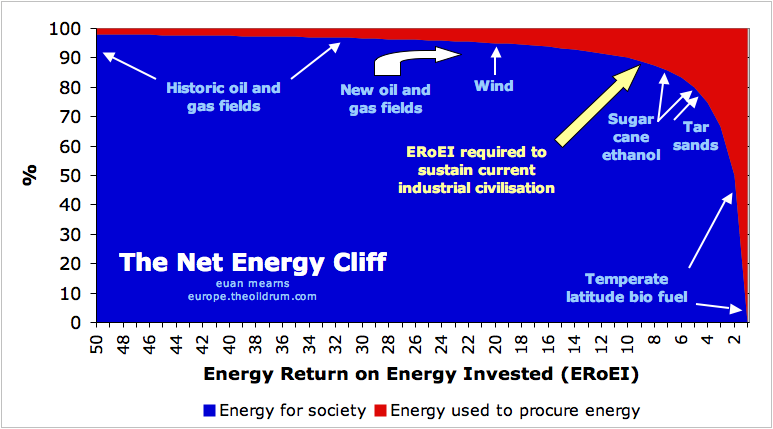
The chart shows how the proportion of net energy available for society to use varies with ERoEI. There is in fact much uncertainty in the data displayed and many large gaps in knowledge. The shape of the curve shows that for ERoEI > 10, the bulk of energy procured is available to society – to power industry, transportation, schools and hospitals. With falling ERoEI < 10 there is an exponential increase in the amount of energy required to procure energy with a corresponding decline in net energy available for society.
The chart is not zero scaled and shows that for ERoEI = 1, no net energy is produced. The yellow arrow, pointing to ERoEI = 9 is intended to provoke some debate since we do not know with any certainty what the minimum ERoEI for modern industrial civilisation is.
One thing that we do know for sure is that we have used a significant proportion of the easy to access fossil fuels and that new resources scheduled for exploitation will require much larger amounts of energy to procure. The average energy pool available to the global economy is therefore relentlessly marching towards lower aggregate ERoEI. As society uses more energy to procure energy, an inevitable consequence is that less energy is available for everything else, in a stable energy production environment. Certain areas of current energy use must fail and the way the free market is trying to resolve this problem is to select energy intensive industries for extinction, for example air travel and motor vehicle manufacture, however, current Government policies are trying to prevent this natural selection process, propping up the motor industry on both sides of the Atlantic, expanding airports, whilst subsidising inefficient means of procuring energy such as temperate latitude bio-fuels.
We are set on a disastrous course. Governments must accept that the way we use energy must change and that a painful period of adjustment lies ahead. The energy efficiency of energy use and procurement should lie at the heart of decision-making and a good starting point is to ensure that reliable efficiency data is available to guide this process.
europe.theoildrum.com |



