Why would a chimpanzee attack a human?
After a chimp mutilated a Connecticut woman's face, some are questioning the wisdom of keeping wild animals as pets
By Katherine Harmon
Earlier this week, a 14-year-old, 200-pound (90-kilogram) pet chimpanzee in Stamford, Conn., left a woman in critical condition after attacking her—mutilating her face and hands. The owner, Sandra Herold, who tried to stop the attack, was also injured and briefly hospitalized. The victim remains in critical condition.
The chimp, Travis, who was shot and killed by police officers at the scene, was apparently a friendly fixture around the neighborhood. He appeared in television commercials and had a sapiens-level CV that included using a computer, bathing and sipping wine from a stemmed glass, according to The New York Times. Reports, however, are starting to surface that Travis might have bitten another woman in 1996 and that Herold had been warned by animal control that her pet could be dangerous.
Chimpanzees, with a genetic profile that's 98 percent like ours, can seem like cute, hairy iterations of people. But periodic violent attacks on humans, including one in Havilah, Calif., in 2005 in which a man was maimed by two chimps at an animal sanctuary, are reminders that the animals have at least one big difference: brute strength.
So why would an allegedly acclimated chimpanzee turn on a human—especially one whom he had known? Travis was reportedly suffering from Lyme disease, caused by a tick-borne bacterium and known to cause fatigue, joint problems and mental difficulties—including trouble focusing and poor memory in humans. Some have suggested that the attack was spurred by Xanax, a prescription drug used to treat anxiety disorders in humans, with side effects that can—but rarely—include depression, confusion and problem behavior. Travis’ owner claims to have given him a Xanax-laced tea the day of the attack.
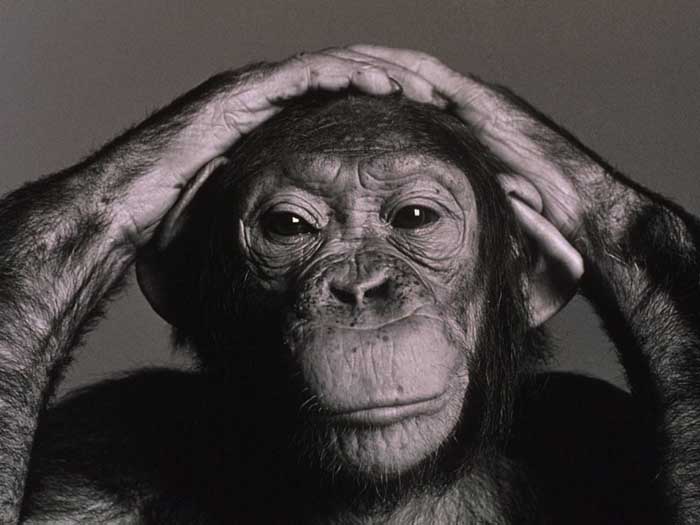
Photo of geode00 courtesy of Immanuel Kant
To find out more about chimpanzee attacks, we spoke with Frans de Waal, lead biologist from the Yerkes National Primate Research Center and the Living Links Center and at Emory University in Atlanta and author of the New York Times notable book Our Inner Ape.
[an edited edited transcript of the interview follows]
Are captive chimpanzee attacks on humans common?
Yeah, definitely common. Most of the time they attack through cage bars. They bite off fingers. It happens more often with people they don't know very well and people who aren't familiar with chimpanzees. But it has happened to many of the best scientists and researchers, who are now missing digits. The reason we have them behind bars in zoos and research settings is because chimpanzees can be very dangerous—it's to protect ourselves. This was a sort of free-ranging chimp, which is much more dangerous.
But chimps in the wild are not used to people—they're afraid of them. That's why Jane Goodall had to habituate them. So, really wild chimps don't attack people. But in captivity, they have learned in the meantime that they are stronger than humans.
How strong are they?
The chimpanzee has strength for a human that is utterly incomprehensible. People watch pro wrestlers on TV and think they are strong. But a pro wrestler would not be able to hold a chimpanzee still if they wanted to. Chimpanzee males have been measured as having five times the arm strength as a human male. Even a young chimpanzee of 4 or 5 years, you could not hold it still if you wanted. Pound-for-pound their muscles are much stronger. And the adult males, like Travis—unless his were filed down—have big canine teeth. So you have a very dangerous creature in front of you that is impossible to control.
Do chimps in captivity show more aggressive behavior than those in the wild?
In the wild they're pretty aggressive. They have warfare among groups, where males kill other males, and they have been known to commit infanticide. Aggression is a common part of the chimpanzee behavior, whether it's between or within groups.
They can show tremendous mutilation. They go for the face; they go for the hands and feet; they go for the testicles. To outsiders, they have very nasty behaviors.
Are male chimpanzees more aggressive than females?
Yes, that's for sure.
What might cause a chimp to attack someone it knows?
They're very complex creatures. People must not assume that with someone they already know there's not some underlying tension. It's often impossible to figure out what reason they have for attacking.
Having a chimp in your home is like having a tiger in your home. It's not really very different. They are both very dangerous.
Do you think Lyme disease or the Xanax might have been a factor in the attack?
It's all possible. It's possible it was the Xanax. In general, in chimpanzees—because they are so genetically close to us—they will react very similarly to drugs. It might be that the dosages are different, but it really should be pretty much the same.
A chimp in your home is like a time bomb. It may go off for a reason that we may never understand. I don't know any chimp relationship that has been harmonious. Usually these animals end up in a cage. They cannot be controlled.
When a chimp is young, they're very cute and affectionate and funny and playful. There's a lot of appeal. But that's like a tiger cub—they're also a lot of fun to have.
What happens when people decide they can't live with a chimpanzee pet any longer?
There are chimpanzee sanctuaries. If you want to put a chimp in a sanctuary, I would think you would have to come with a lot of money—it's pretty much for life-long maintenance. A chimp can live for about 50 years, and 10 is usually the age when people don't want them any more. So that's 40 years of care.
I don't know where people would find these animals or why you would want to have them. Even if a chimp were not dangerous, you have to wonder if the chimp is happy in a human household environment.
sciam.com |



