According to the International Monetary Fund, the United States began the century producing 32 percent of the world's gross domestic product. We ended the decade producing 24 percent. No nation in modern history, save for the late Soviet Union, has seen so precipitous a decline in relative power in a single decade.
Odd wording, "began the century...ended the decade", assuming he means the 21st century than it is the same as "began the decade...ended the decade", but if he means that then the data is simply false.
There was no absolute decline
Real US GDP (2000 Constant Dollars)
2000 Q1 $9,695.6
2009 Q3 $12,973.0
data360.org
As for relative decline, well maybe a slight one but hardly a competitor for worst in modern history. Many other nations did worse, as did the EU (counting the members who where members in 2000, adding new members isn't actual economic growth). Basically the US has been pretty constant as a percentage of world gross production over the decade, or over the last several decades. Before that we had a relative decline (in the context of growth in absolute terms) after WWII.
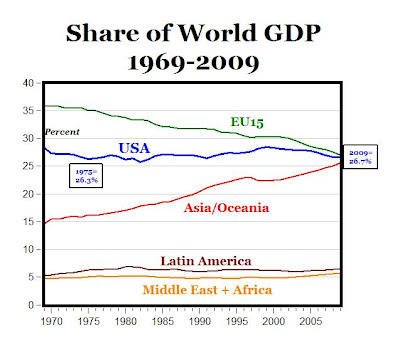
mjperry.blogspot.com
Source
ers.usda.gov
---
Between one-fourth and one-third of all U.S. manufacturing jobs have disappeared in 10 years
The world as a whole is losing manufacturing jobs. China is as well. That's a function of increased productivity, which is an economic plus not a minus. Less workers have produced more (the US reached its all time peak in manufacturing output just before the current recession, and after its over, almost certainly will continue to reach new peaks)
While the median income of American families was stagnant
I assume he's using household income stats. Households are smaller, so minimal increases in household income do not indicate minimal gain in income for people.
while the huge U.S. military presence in Afghanistan and Iraq serves as its recruiting poster.
To an extent, but not nearly as great as pulling out and having those we were fighting make massive gains would, nor as great as not responding forcefully to 9/11 and going after Al Qaeda and their allies in Afghanistan would have.
Basically Buchanan is excessively pessimistic, based partially off verifiably false information, and partially off distorted impressions caused by his selection of data points (manufacturing jobs, household income).
The only important, highly relevant, accurate, and negative points he makes are about the fiscal balance. And he spends little time on those points ("Drafting another entitlement program as we are informed that the Social Security and Medicare trust funds have unfunded liabilities in the trillions.") |



