The Guardian is changing their major direction on climate change: 9 articles describing the climate hoax – on the same day – shows a change in direction!
180grader.dk
One of the articles here:
No apology from IPCC chief Rajendra Pachauri for glacier fallacy
Head of UN climate change body 'not at fault' for false claim Himalayan glaciers would melt by 2035
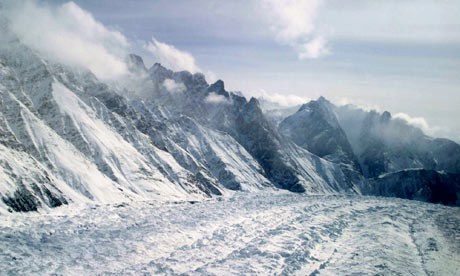
Pachauri said it would be hypocritical to apologise for the false claim that Himalayan glaciers (above) could melt away by 2035. Photograph: Channi Anand/AP
The embattled chief of the UN's climate change body has hit out at his critics and refused to resign or apologise for a ¬damaging mistake in a landmark 2007 report on global warming.
In an exclusive interview with the Guardian, Dr Rajendra Pachauri, chair of the Intergovernmental Panel on Climate Change, said it would be hypocritical to apologise for the false claim that ¬Himalayan glaciers could melt away by 2035, because he was not personally responsible for that part of the report.
"You can't expect me to be personally responsible for every word in a 3,000 page report," he said.
The IPCC issued a statement that expressed regret for the mistake, but Pachauri said a personal apology would be a "populist" step.
"I don't do too many populist things, that's why I'm so unpopular with a certain section of society," he said.
In a robust defence of his position and of the science of climate change, Pachauri said:
• The mistake had seriously damaged the IPCC's credibility and boosted the efforts of climate sceptics.
• It was an isolated mistake, down to human error and "totally out of character" for the panel.
• It does not undermine the "basic truth" that human activity is causing temperatures to rise.
• That he would not resign and was ¬subject to lies about his personal income and lifestyle.
Pachauri spoke as the second day of the Guardian's investigation into the emails stolen from the University of East Anglia reveals how climate scientists acted to keep research papers they did not like out of academic journals.
One UEA scientist, Dr Keith Briffa, wrote to a colleague to ask him for help rejecting a paper from a journal which he edited. "Confidentially I now need a hard, and if required, extensive case for rejecting."
The request apparently broke the convention that the review process should be independent and anonymous. Briffa was not able to comment because of an ongoing independent review into the stolen emails. |



